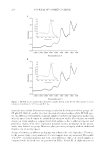
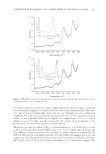
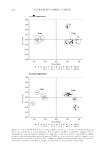
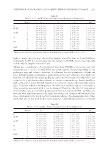
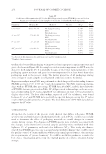
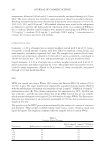
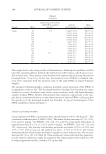
JOURNAL OF COSMETIC SCIENCE 290 sample was detected with FWA351 at 19.4 mg·kg-1. These results suggested that further study is necessary to evaluate the risk of FWAs in cosmetics and liquid detergents. CONCLUSIONS Based on the technology of ion-pairing chromatography, a simple and sensitive analytical method, using the HPLC-DAD-FLD, was developed and validated for the simultaneous determination of fi ve distyryl-type FWAs in cosmetics and liquid detergent. The limits of detection were from 0.01 to 0.1 mg·kg-1, and the limits of quantifi cation were from 0.04 to 0.4 mg·kg-1. The recovery values were between 80.7% and 103.3%. The results in this study revealed that FWA85 and FWA351 were present in various commercial products. The developed method could provide scientifi c technical support for further sources of FWA pollution and the risk assessment. ACKNOWLEDGMENTS This work was sponsored by the Shanghai Science and Technology Committee No. 17DZ2203500. REFERENCES (1) X. D. Guo, Y. P. Xian, H. Y. Luo, Y. L. Wu, D. H. Luo, Y. G. Chen, and D. Xu, Quantitative determi- nations of seven fl uorescent whitening agents in polystyrene and polyvinyl chloride plastics by ultra high performance liquid chromatography-tandem mass spectrometry, Anal. Methods, 5, 6086–6093 (2013). (2) Y. Hu, X. Zhang, J. Wang, H. Hua, and R. Xiong, Detection of several common fl uorescent whitening agent in cotton textiles, Cotton Textile Technol., 44, 39–43 (2016). (3) J. Y. Lee, H. J. Youn, and H. L. Lee, Fundamental study for quantitative analysis of the fl uorescent whitening agent (FWA) content of paper and process water, Bioresources, 7, 315–326 (2012). (4) W. C. Shu and W. H. Ding, Determination of fl uorescent whitening agents in infant clothes and paper materials by ion-pair chromatography and fl uorescence detection, J. Chin. Chem. Soc., 56, 797–803 (2009). (5) National Development and Reform Commission, QB/T 2953–2008, Fluorescent Whitening Agents for Detergent (China Light Industry Press, Beijing, 2008). (6) Z. S. Dong, Application and safety of fl uorescent brighteners, China Cleaning Ind., 4, 31–39 (2011). (7) Z. J. Wu, Y. S. Xu, M. C. Li, X. D. Guo, Y. P. Xian, and H. Dong, Determination of three fl uorescent whitening agents (FWAs) and their migration research in food contact plastic packaging containers and food simulants by UPLC-MS/MS method, RSC Adv., 6, 17941–17946 (2016). (8) C. J. Zhang, X. L. Luo, T. F. Wei, Y. F. Hu, G. K. Li, and Z. M. Zhang, Acylhydrazone bond dynamic covalent polymer gel monolithic column online coupling to high-performance liquid chromatography for analysis of sulfonamides and fl uorescent whitening agents in food, J. Chromatogr. A, 1519, 28–37 (2017). (9) J. Ai, L. N. Huang, T. T. Yan, L. Su, Y. J. Chen, and B. Yang, Safety analysis of fl uorescent whitening agent for human skin, Chin. J. Aesthetic. Med., 25, 104–107 (2016). (10) Y. L. Wu, Y. P. Xian, X. D. Guo, L. W. Chen, X. J. Zhao, B. Wang, and L. Wang, Development and validation of a screening and quantifi cation method for simultaneous determination of seven fl uorescent whitening agents in commercial fl our using UPLC-MS/MS. Food Chem., 243, 162–167 (2017). (11) R. H. Guo and Y. H. Zhou, Rapid test of migration property of FWA containing in tissue paper, China Pulp. Paper., 26, 33–35 (2007). (12) G. Anders, Limits of accuracy obtainable in the direct determination by fl uorimetry of fl uorescent whit- ening agents on thin layer chromatograms, Environ. Qual. Saf., 4, 104–110 (1975).

FLUORESCENT WHITENING AGENTS IN COSMETICS AND LIQUID DETERGENT 291 (13) S. G. Wang, Q. B. Yang, J. S. Du, J. Bai, and Y. Li, Variety of photoluminescence intensity of fl uorescent whitening agents introduced into poly acrylonitrile nanofi bers, J. Appl. Polym. Sci., 103, 2382–2386 (2007). (14) J. S. Kim, D. H. Kim, and K. Kim, Determination of fl uorescent whitening agents in paper materials by ion-pair reversed-phase high-performance liquid chromatography, Bull. Korean Chem. Soc., 33, 3971– 3976 (2012). (15) Y. Wang, X. Y. Yao, and Y. H. Han, Determination of fl uorescent whitening agents in tipping paper and plug wrapper with HPLC, Tob. Sci. Technol., 49, 40–44 (2007). (16) Y. Jiao, L. Ding, S. Zhu, S. Fu, Q. Gong, H. Li, and L. Wang, Determination of fl uorescent whitening agents in plastic food contact materials by high performance liquid chromatography with fl uorescence detector, Chin. J. Chromatogr., 31, 83–87 (2013). (17) F. Wei, S. Wu, X. Yu, X. Yin, and M. Ge, Determination of fl uorescent whitening agents in disposable sanitary products by high performance liquid chromatography, Chin. J. Chromatogr., 33, 158–163 (2015). (18) H. C. Chen and W. H. Ding, Hot-water and solid-phase extraction of fl uorescent whitening agents in paper materials and infant clothes followed by unequivocal determination with ion-pair chromatogra- phy-tandem mass spectrometry, J. Chromatogr. A, 1108, 202–207 (2006). (19) H. C. Chen, S. P. Wang, and W. H. Ding, Determination of fl uorescent whitening agents in environ- mental waters by solid-phase extraction and ion pair liquid chromatography-tandem mass spectrometry, J. Chromatogr. A, 1102, 135–142 (2006). (20) W. C. Shu and W. H. Ding, Determination of fl uorescent whitening agents in laundry detergents and surface waters by solid-phase extraction and ion-pair high performance liquid chromatography, J. Chromatogr. A, 1088, 218–223 (2005). (21) M. Holčapek, K. Volná, P. Jandera, L. Kolářová, K. Lemr, M. Exner, and A. Církva, Effects of ion-pairing reagents on the electrospray signal suppression of sulphonated dyes and intermediates, J. Mass Spectrom., 39, 43–50 (2004).
Purchased for the exclusive use of nofirst nolast (unknown)
From: SCC Media Library & Resource Center (library.scconline.org)