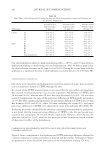
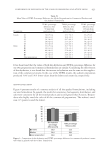
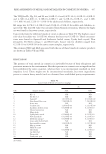
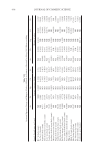
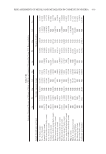
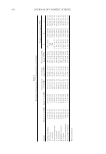
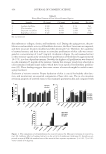
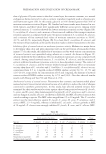
JOURNAL OF COSMETIC SCIENCE 442 THQ of nickel and cadmium in skin-lightening creams in Malaysia was 1, whereas THQ for Pb in the same study was 1. HQ in the study of cosmetic brands in Nigeria by Nduka et al. (8) were all 1 for mercury and arsenic. This is an indication of a relatively low noncarcinogenic risk from heavy metals in the cosmetics analyzed. THQ is the ratio of the potential exposure to the substance and the level at which no adverse effects are expected. HQ less than or equal to one indicates that adverse non-cancer effects are not likely to occur, and thus can be considered to have negligible hazard. HQs greater than one are not statistical probabilities of harm occurring. Instead, they are a simple state- ment of whether (and by how much) an exposure concentration exceeds the reference concentration (RfC) (42). HI is the sum of HQs for substances that affect the same target organ or organ system. Because different pollutants (air toxics) can cause similar adverse health effects, combining HQs associated with different substances is often appropriate. The HI is only an approximation of the aggregate effect on the target organ (e.g., the lungs) because some of the substances might cause irritation by different (i.e., nonaddi- tive) mechanisms. An HI equal to or greater than 1.0, however, does not necessarily sug- gest a likelihood of adverse effects. Because of the inherent conservatism of the RfC methodology, the acceptability of exceedances must be evaluated on a case-by-case basis, considering such factors as the confi dence level of the assessment, the size of the uncer- tainty factors used, the slope of the dose-response curve, the magnitude of the exceedance, and the number or types of people exposed at various levels greater than the RfC (42,43). The carcinogenic risk for children and adults was all lower than the acceptable and prior- ity risk of 1-E-04 and 1-E-06. The result of cancer risk for arsenic in the study of cosmetic brands in Nigeria by Nduka et al. (8) was 1.781E-13 and 1.95E-12. The risk associated with the potential to develop cancer after exposure to chemicals is often expressed as a probability or a fraction in a range from zero to one (0.0–1.0). Usually the numbers are very small and shown in fractions of 1 million or fractions of 100,000. 1.0E-1 means one in 10, 1.0E-2 means one in 100, 1.0E-3 means one in 1,000, 1.0E-4 means one in 10,000, 1.0E-5 means one in 100,000, 1.0E-6 means one in a million, and 1.0E-9 means one in a billion, respectively (44). Cosmetics have often been considered by many dermatologists to be more harmful than good (15). These contain more than 10,000 ingredients which are linked to many dis- eases, such as cancer, birth defects, and developmental and reproductive harm. Dermal exposure is expected to be the most signifi cant route because most of the cosmetic prod- ucts are directly applied to the skin. Oral exposure can occur from wearing of cosmetics products containing heavy metal impurities around the mouth and also from hand-to- mouth contact (5). Many factors can affect the numerical value that is used to represent the degree of dermal absorption, such as exposure time, product formulation, dose, and the fate of the chemical in the skin. Information on the exposure to metal toxins through dermal contact is very scanty, and few data exist on the personal care products (45). The SED of arsenic from the use of these cosmetic products ranged from 5E-08 to 0.075 ug/kgbw/d for both 50% and 100% bioaccessibility scenario. This value was less than the provisional tolerable daily intake (PTDI) of arsenic set as 0.002 mg/kg by JECFA (46). The SED of lead ranged from 1E-05 to 13.164 μg/kgbw/d for both 50% and 100% bioac- cessibility. The PTDI for lead was withdrawn by the FAO/WHO joint committee be- cause it could no longer be considered health protective, but nevertheless, a PTDI value of 3.6 ug/kgbw/d was used as an indicator to compare with the results of the estimated

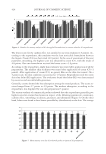
RISK ASSESSMENT OF METALS AND METALLOIDS IN COSMETIC IN NIGERIA 443 daily intake (47). The SED for some of the brands of cosmetics product sampled (body creams) were greater than the PTDI value, whereas SED of brands of cosmetic products grouped as facials, hand creams, and lip balm were less than the PTDI value. The SED of cadmium from the use of these cosmetics ranged from 2E-07 to 1.5553 μg/kgbw/d for both 50% and 100% bioaccessibility scenario. The PTDI of cadmium is set at 1 μg/kgbw/d however, the European food and safety authority (EFSA) set the pro- visional tolerable weekly intake of cadmium as 2.5 μg/kgbw/wk (48). The SED value of cadmium from the use of these brands of cosmetic products was less than 0.1% of the EFSA provisional intake, except for some brands of cosmetic products grouped as body cream, such as Aquasulf body cream and Cloral restoration cream, which had SED value greater than 1 μg/kgbw/d. The estimated value of Hg and Ni from the use of these brands of cosmetic products for both 50% and 100% bioaccessibility scenario ranged from 2E-05 to 0.0065 μg/kgbw/d and 2E-05 to 12.782 μg/kg/bw/d, respectively. The tolerable daily intake of Hg and Ni are 0.20 μg/kg/bw/d (49) and 720 μg/kgbw/d (46), respectively. The estimated SED for Hg and Ni in this study were less than their respective tolerable daily intake. The estimated MoS value for metals in these brands of cosmetics (body creams and hand creams) were lower than the proposed value of 100 set by the WHO, indicating that a signifi cant risk might be associated with the long-term use of these cosmetic products, whereas brands of cosmetic products such as lip balms, hair creams, and some facial creams had a value greater than the proposed MoS value by the WHO, which indicates a nonsignifi cant risk associated with the concentration of metals in these products. CONCLUSION This study has revealed that the heavy metal contaminants in cosmetic creams analyzed may not pose signifi cant health risk as individual concentrations are less than standard limits set by Health Canada, Food and Drug Administration, and the Cosmetics Section Committee of the Bureau of Indian Standards. Cancer risk from this study was within safe limits. Taken together, cosmetic use in Nigeria may not constitute a signifi cant source of body burden of these metals. ACKNOWLEDGMENTS This work was partly funded by Africa Education Initiative (www.nef3.org). REFERENCES (1) E. Ori sakwe and J. O. Otaruku, Metal concentrations of cosmetic commonly used in Nigeria, Sci. World J., 2013, 959637 (2013). (2) C. M. A. Iwegbue, F. I. Bassey, G. Obi, G. O. Tesi, and B. S. Martincigh, Concentration and exposure risk of some metals in facial cosmetics in Nigeria, Toxicol. Rep., 3, 468–472 (2015). (3) B. Boc ca, A. Pino, A. Alimonti, and G. Forte, Toxic metals contained in cosmetics: a status report, Regul. Toxicol. Pharmacol., 68, 447–467 (2014). (4) I. Al- Saleh and S. Al- Enazi, Trace metal in lip sticks, Toxicol. Environ. Chem., 96(6), 1149–1165 (2011).
Purchased for the exclusive use of nofirst nolast (unknown)
From: SCC Media Library & Resource Center (library.scconline.org)