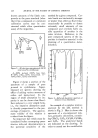
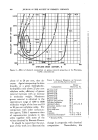
290 JOURNAL OF THE SOCIETY OF COSMETIC CHEMISTS The result of these viscosity tests is shown in the graph. . In studying the curves shown on this graph (running from right to left and starting at a temperature of 100øC.) it will be noted that the respective viscosities' of the carra- geenin solution and the sodium carrageenate solution are almost identical at temperatures above 30 to 35øC. It will be further observed that once this temperature has been reached by the cooling of a solution originally heated at 100øC., the sodium carrageenate solution remains fluid and shows a continued increase in viscosity at progressively lower temperatures. On the other hand, the carra- geenin solution will turn into a gel when a temperature of 30 to 35øC. has been reached, the rigidity of the gel increasing rapidly to the extent that the temperature is lowered further. It is pertinent to state at this point that sodium carrageenate is completely soluble in distilled water at 10øC., as established by khe homogeneity of the solution and by comparative readings of the viscosity factor taken first at 10øC. and then retaken upon heating the solution to $0øC. and cooling back to 10øC. CONCLUSION While uses of carrageenin have become fairly widespread and well established in recent years, com- paratively little has been done with respect to manufacture and utiliza- tion of the carrageenates. A study of the characteristics of these carra- geenates as exemplified by the tests carried out with sodium carrageenate as herein described prompts the conclusion that these products, with their highly interesting properties, should rapidly find highly useful applications in many fields of indus- try. Thus, it seems obvious that the elimination of a certain number of difficulties inherent in the use of a product such as carrageenin, with a variable balance of cations induced by the varying chemical constit- uents of the original plant, which cannot be completely overcome by any known method of manufacture, should automatically make one or the other of these carrageenates and principally the sodium carrageenate, eligible for many uses in which carrageenin does not at present provide either uniform or adequate results. Manufacturing methods with re- spect to production of properly con trolled and uniform carrageenates are today at a point where their production on an industrial scale does not present any particular problem or difficulty. It is likewise altogether possible that further studies of carrageenic acid may reveal interesting proper- ties and may open up new fields of application. Although agar, algin, and carra- geenin have been produced for a number of years, the extraction of algin and carrageenin is still a comparatively young industry. By

TRACER CHEMISTRY 291 the same token, while the amount of scientific knowledge which is at our disposal concerning the phyco- colloids appears fairly considerable, the complexity of the subject is such that many features and many avenues remain to be explored and it may be confidently expected that fields of application for products so far developed and for products still to be developed will be con- stantly widened. Indeed, the in- terest created by these products and the advantages inherent in their use are such that the research laboratories of many manufacturers which are either actual or potential users of these products are today furnishing substantial aid in these scientific investigations. TRACER CHEMISTRY* By ALEX MESHBANE Tracerlab, Inc., New York, N.Y. 'i•HE PRESENT status of tracer chemistry is undoubtedly due to the tremendous efforts made during the last war to produce fissionable material in adequate quantity so that the war might be brought to a rapid end through the use of atom bombs. The first uranium "pile" was an attempt to produce a con- trollable nuclear reaction, where neutrons would be evolved in a chain reacting process. Today we see "piles" springing up all over the country and plans being formulated in foreign countries as well to take advantage of the ever growing de- mand for unstable isotopes and develop means for harnessing the tremendous energy available from controlled nuclear reactions. The discovery of radioactivity by Becquerel in 1895 was rapidly * Presented at the May 15, 1952, Meeting, New York City. taken advantage of by the medical profession who used the ionizing property of radium to effect the course of certain common diseases. The penetrating abilities of the rays from radium were soon em- ployed to study the internal incon- sistencies of various metals by a technique that we commonly refer to as radiography. These two broad applications were in use within a relatively short time after the discovery of radium. The employment of unstable, radio- active elements as tracers did not come into its own until around 1920 mainly because adequate, precise, radiation instruments had not yet been devised to measure these elusive and mysterious rays. In 1920 Hevesey and Zechmeister (1) using Thorium B, which is an iso- tope of lead, showed that there was no exchange between lead ions and
Purchased for the exclusive use of nofirst nolast (unknown)
From: SCC Media Library & Resource Center (library.scconline.org)