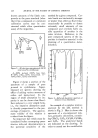
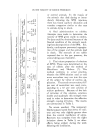
INFRA-RED SPECTROSCOPY AND ITS APPLICATION 271 from the melt or by solvent evapo- ration. In some cases, however, a glass does not result, and scattering of the beam by the small crystallites makes the method undesirable. Of- ten, therefore, the sample may be ground with mineral oil into a slurry, which is then spread on a salt plate. Here, although scattering is less, the absorption due to the oil must be subtracted in order to obtain the true absorption spectrum of the sample. In general, solutions, rather than slurties, are more con- venient to handle. Suitable sol- vents in the infra-red are CC14, CS•., cyclohexane, etc. Needless to say, water is entirely unsuitable for this purpose. However, no one solvent is known which is trans- parent over the entire in&a-red range. Thus one must apply a compensation correction for the absorption of the solvent in all cases. This is easily accomplished with both the Baird and the Perkin- Elmer double-beam spectrophotom- eters. Very little published work is available on the application of infra- red techniques to the field of cos- metic chemistry. Undoubtedly many of the problems of the indus- try have already been solved with this tool. However, it may not be inappropriate at this time to out- line the possible applications which come to mind when considering some of the typical materials en- countered in the cosmetics field. On the following Figures are listed examples of systems which appear to be quite amenable to treatment Essential Oils Terpenes: Camphene, limonene, pinene Alcohols: Menthol, eugenol, borneol Esters: Methyl salicylate, etkyl cinnamate Aldehydes: Vanillin, cinnamaldehyde Ketones: Muskone, menrhone, ionone Free Acids: Cinnamic, citronellic Phenols., .lactones, nitrogen- and sulfur- contrarang compounds Figure 7. Waxes and Oils Carnauba wax Mineral oil Beeswax Castor oil Stearic acid Peanut oil Stearic esters Tung oil Stearyl alcohol Tristearin Cetyl alcohol Tripalmitin Spermaced Lanolin Figure 8. Assorted Materials Emulsifiers: Triethanolamine, borax, glyceryl monostearate, diglycol stearate Gums: Tragacanth, gum karaya Humectants: Glycerin, sorbitol Dyes: Assorted Inorganics: Talc, boric acid, etc. Figure 9. using the infra-red method. It is the opinion of the author that mix- tures of any of the materials on a given slide may be qualitatively (and possibly quantitatively) ana- lyzed provided reference (standard) samples are available. In conclusion, then, it appears that infra-red spectroscopy could be used to good advantage in the field of cosmetic chemistry, for both analysis and control purposes. It is hoped that the material which has been presented here will perhaps serve to stimulate further develop- ments in this area.

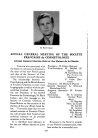
IS YOUR PRODUCT EFFECTIVE?* By S. D. GF. RsHo, PH.D.t Research Manager, Pepsodent Division, Lever Brothers Chicago, Ill. Company, As MOST OF YOU know, the research staff of Lever Brothers Pepsodent Division laboratories is moving to New Jersey in the very near future. As a result, both your Chairman, George Kolar, and your Program Chairman, Dr. William Colburn have been quite insistent on the delivery of a parting address. In thinking about a subject that could possibly be of interest to this audience and, at the same time serve an useful purpose, the subject "Is your Product Effec- tive?" was selected. With recent experience in the dentifrice field as a background, it was not difficult to develop this subject. It' is my sincere hope that this talk will leave you with some- thing to think about and will result, eventually, in a contribution to the consumer, medical profession, the companies with which you are associated, and to each of you. As little as two and one-half years ago, most critical scientists concerned with the effectiveness of dentifrice products would have * Presented at the June 10th meeting of the Chicago Chapter, Chicago, I11. t Now Assistant Research Director, Lever Brothers Company, Edgewater, N.J. agreed that conclusive, scientifically controlled evidence was not avail- able to prove that dentifrices serve an useful function, other than the pleasant effect in the mouth, follow- ing their use. In February, 1950, a publication, concerned with the effects of immediate toothbrushing with a neutral dentifrice on the reduction of the incidence of dental caries, appeared in the •7ournal of the Atmerican Dental Atssociation. In this paper, the author discusses the results of a clinical test de- signed to determine the efficacy of brushing the teeth immediately after the ingestion of foods, in the reduction of dental caries. The results of the study indicated that dental caries can be materially reduced by this procedure. The paper points out that the prevention of dental caries may therefore be much simpler than has been gen- erally thought. It is apparent that the anticaries advantages conferred by dentifrices were available prior to the publica- tion of the paper. The evidence, other than opinions based on non- scientifically controlled, or indirect observations, was not available. The 272
Purchased for the exclusive use of nofirst nolast (unknown)
From: SCC Media Library & Resource Center (library.scconline.org)