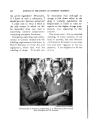
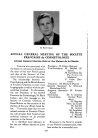
ACCEPTANCE OF HONORARY MEMBERSHIP' By J^Mv.S L. TOMSON Head of Cosmetic and Color Section, Food and Drug Division, Department of National Health and I4/elfare, Ottawa, Ont. Mr. President and Members of the SOCIETY: IT •S extraordinarily kind of the Board of Directors to recom- mend, and of you to agree, that I be offered an Honorary Membership of the SocmT¾ or COSMETIC CHEM- iSTS. For, in spite of the flatter- ing words to which you have just listened, I have really done nothing deserving of so signal an honor. Your reward, gentlemen, is over- generous for the little I have been able to do for cosmetics. By the thoughtfulness, in the first place, of my old friend Dan Dahle, and later others, I have been privileged to attend many of the meetings of the SOmETY during the last few years. I have listened to your proceedings with interest and much profit, and have made many good friends, but I never dreamt that I should one day address you as an Honorary Member. In the words of the Armed Services, you have achieved "complete surprise." I must confess to something of a feeling of inadequacy in trying to say "thank you" properly, for in selecting me, you are also reflect- ing honor on my Department and on your good neighbor, Canada. In such a case the plainest of words is often best so I shall say simply and most sincerely that I thank you very much...that I have the greatest pleasure in accepting, and that I agree to abide by the ethics laid down in the Rules of the SOCIETY. It was suggested that I might say something to you of the present position of cosmetics in Canada in relation to the Food and Drugs Act, and its regulations. My first reac- tion was that this might not be a very suitable theme for a gathering of chemists, but I realized that many of you, if not actually engaged in management, will certainly beclosely associated with it. A few words on the subject are not amiss there- fore, especially as specific cosmetic regulations are likely to be pro- claim'ed in the near future.* Ena- bling legislation regarding the regula- tion of cosmetics was included, among other changes, in an amend- * Proclaimed July 7, 1952. 318

ACCEPTANCE OF HONORARY MEMBERSHIP 319 ment to the Food and Drugs Act passed in May, 1939. War and postwar preoccupations of the Government, however, delayed the "proclamation" of the cosmetic sections until 3 years or so ago. At that time cosmetics were brought into the fold, so to speak, and were subject to the general provisions of the Act, as distinct from what- ever specific requirements might be laid down later by regulation. The proposed regulations are now in final draft form and I have a copy with me which I propose to run over very quickly, omitting legal phraseology. (The speaker dealt briefly but completely on the pro- posed regulations.--EDiTO R.) You will see that these require- ments differ hardly at all from your own, so we need not spend further time on them. Where our ideas differ is of more importance to you, but I shall come to that in a mo- ment. I should like to mention first the rather curious device by which cosmetics were brought under the Act. They were defined legally and technically as "drugs," although it must have been obvious that many of the drug provisions could not possibly apply to cosmetics. It showed I think, something of a lack of appreciation of the position and function of cosmetics which no longer obtains, although of course the definition remains until the Food and Drugs Act itself can be amended.* Owing to the good sense of our * The amendment has already been read in Parlia ment and is now in Committee. regional staffs, and our closer con- tact with them in recent years, we have not had a great deal of trouble but there have been some amusing incidents--amusing to me, I mean. Our regulations quite reasonably forbid the sending out of unsolicited samples of drugs to the public. In one of our larger cities where we have a regional laboratory a cos- metic manufacturer mailed samples of one of his products (a hand lotion as a matter of fact) to a list of people no doubt taken from a directory or similar publication. As it happened by ill-luck, his list included some of our regional laboratory staff. Some- body at the "lab" that morning must have been feeling out of sorts, for his thoughts ran this way: "free sample of hand lotion--a cos- meticmbut a cosmetic is a drug-- the distribution of free samples of drugs is contrary to regulations-- this must be stopped!" Well, we straightened that one out in Ottawa. A more recent case concerned a hair preparation alleged to grow hair. We have no desire to take the romance out of cosmetics, and we are fairly lenient with cosmetic claims, but we do not allow the un- qualified statement that a prepara- tion will cause lost hair to grow again. Our inspector instead of taking the correct attitude that the preparation was a cosmetic making a false claim, accepted the claim, and proceeding logically enough from that, ruled that since the growing of hair was a modification of organic function, the prepara- tion was a drug, and most declare
Purchased for the exclusive use of nofirst nolast (unknown)
From: SCC Media Library & Resource Center (library.scconline.org)