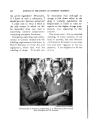
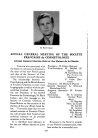
BIOGRAPHY OF JAMES LESLIE THOMSON* By L. I. PUGSLEY Chief, Laboratory Services, Food and Drug Division, Department of Na- tional Health and 14/elf are, Ottawa, Ont. JAMES LESLIE THOMSON was born in Edinburgh, Scotland, and followed the usual education course in that beautiful city, where educa- tion is one of the main industries. He attended one of the more an- cient schools where the flagstones and turret stairs have been worn hollow by geneiations of school boys through more than 300 years. His interests in those days were chemistry (in which admittedly the properties of gunpowder, etc., played a part, fortunately without serious mishap), photography, and day-long tramps in the neighbour- ing Pentland Hills so beloved by Robert Louis Stevenson. His in- terest in chemistry usually paid off in the form of a prize in that sub- ject. German was another prize- winning subject, and in his final school year he was "dux" (head of school) in that language, taking home what he considered a very hard-won medal. Rather strenuous years at the University of Edinburgh followed, for Scottish university standards * Read by Maison G. aleNavarre, in the author's absence. are high, and leave little leisure for amusement. An interest in essen- tial oils and perfume compounds developed about this time and of course continues. The later years of academic study were interrupted by World War I. During the second half of that war c.hemists became very scarce, and all final year stu- dents found themselves engaged in some war activity or other. Mr. Thomson was first concerned in the manufacture of explosives and then in the catalytic production of nitric acid, a comparatively new process at that time. After graduation in 1919, Mr. Thomson joined a well-known firm of alkaloid manufacturers (T & H Smith Company, Ltd.) as research chemist, first on morphine and its derivatives and then on physostig- mine. The firm was then em- barking on the first British produc- tion of physostigmine and its salts, and it fell to Mr. Thomson to devise suitable manufacturing procedures. After $ years of industry, Mr. Thomson returned to academic life as a lecturer in the Royal College of Surgeons in Edinburgh, combining 315

316 JOURNAL OF THE SOCIETY OF COSMETIC CHEMISTS' this with consulting work in col- laboration with a colleague, with whom he was co-author of a num- ber of papers dealing with the in- dustrial uses of x-rays. Distant fields looking green as usual, Mr. Thomson decided to come to Canada, and having chosen the shortest route, he came via Panama, arriving in Vancouver in the late Summer of 1930. Nine years of varied consulting p[actice followed. He states. that it was during this period that he really got both feet into cosmetics. As a side light it might be mentioned that he had both a brewery and a distillery among his clients thus insuring adequate supplies of cer- tain products (for analysis, of course). [It is really too bad that Mr. Thom- son and Dr. G. Robert Clark had not met when the latter was a bouncer in a Montana Bistro and Mr. Thomson had a liquor distill- ery as a client. J In May, 1939, the Food and Drug Divisions of the Department of National Health and Welfare, deciding to follow the example of the United States in the regulation of cosmetics, amended the Food and Drugs Act to bring cosmetics under its regula- tions. This led to the creation of a new position in the Food and Drug Divisions, which was duly adver- tised, and a gentleman by the name of Thomson placed first on the list of eligibles, and was duly appointed. Arriving in Ottawa in October, 1939, Thomson (Tommy) at once was handed the job of drafting cos- metic regulations. The war, how- ever, brought uncertainties, and ultimately cosmetic legislation was shelved for the duration. In June, 1940, he was "borrowed" by the United Kingdom Technical Mis- sion, handed a passport, and in a few days found himself on the side walks of New York for the first time. During the months that followed, as inspector of shell and bomb filling, he saw a good deal of the U.S., mostly from the air, from Boston in the East to as far west as Joplin, Mo. Then followed a period as assistant to the Director of Gun Ammunition and in October, 1941, he was sent to Washington as liaison with the U.S. War De- partment on gun ammunition. A period with the British Army Staff- British Supply joint Mission fol- lowed, where he participated in work concerned with flash sup- pression in aircraft machine guns. On the closing down of the British Missions he returned to the Food and Drug Divisions in Ottawa in March, 1944, only to be borrowed again by the Department of Muni- tions and Supply, where he was Chief of Pyrotechnics Division until finally returning to the Food and Drug Laboratories in 1945. Since then, this section has added alco- holic beverages and food colors to its activities. He played a major role in redrafting and piloting the regulations for these products through industry and government. He also represents his Depart- ment on the Soap and Detergents Specifications Committee of the Canadian Government Specifica-
Purchased for the exclusive use of nofirst nolast (unknown)
From: SCC Media Library & Resource Center (library.scconline.org)