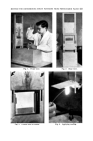
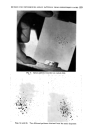
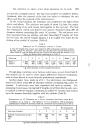
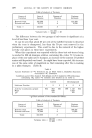
220 JOURNAL OF THE SOCIETY OF COSMETIC CHEMISTS METHOD FOR DETERMINING SPRAY PATTERNS FROM PRESSURIZED PACKS K. DIXON, B.$c.* A paper delivered before the Society at the Symposium on Pressurized Packs, on 14th October 1958. An apparatus for the determination of spray patterns, together with a method for its use, is described in detail. INTRODUCTION SINCE THE original development of pressurized fly sprays, this method of packaging has been enlarged to cover a wide range of products. The type of spray required varies with the product from pharmaceuticals for use in inhalation therapy where particle sizes of the order of 5 microns are required, through insecticide sprays with optimum particle size of 15/20 microns, to residual deposits where a coarse spray or even a jet may be the desired performance. The type of spray may be controlled in a number of ways, such as the ratio of propeilant to product, valve design and viscosity of the product. Some subjective record of the type of performance obtained from a given example may be had by simply observing the spray. It is none the less desirable that a permanent record may be obtained during formulation work. This apparatus gives a record of the pattern of the spray and also an indication of the particle size. To obtain more than an indication of particle size is a tedious and expensive process, and this matter will not be discussed further here. The basis of the method is as follows: A very soft coating of magnesium oxide may be given to a glass plate by burning magnesium beneath it. The plate is then opaque and the coating is sufficiently soft to be disrupted by small droplets of liquid. Thus when the plate has been sprayed and is viewed against a strong light a pattern of holes is seen, which correspond to the position and size of individual droplets. In order to stop an excessive quantity of spray reaching the plate and spoiling the pattern it is necessary to employ a shutter device. For this purpose a wooden "guillotine", with an adjustable stop which fails under gravity, has been devised. Although the coating is extremely soft, if it is carefully handled, the * Cooper, McDougall & Robertson Ltd. (U.K. Division), Berkhamsted, Herts.

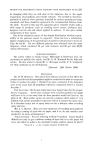
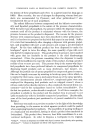
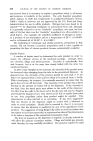
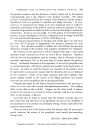
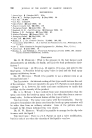
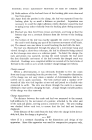
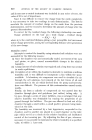
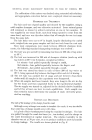
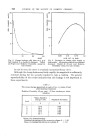
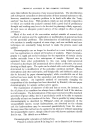
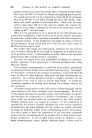
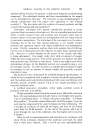
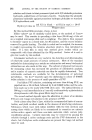
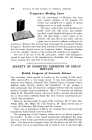
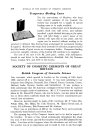
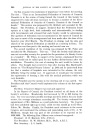
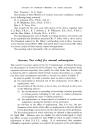
METHOD FOR DETERMINING SPRAY PATTERNS FROM PRESSURIZED PACKS 221 •i / !{i:-' . .... '•J" ß ... E'• '" • --: " ...'-: .... ::. .: , : !½ '•":':'•½ . ..½ , ..* ß : .. . --- ..: :,.... •:.: ,. ' .t.: •:. .. .. ..... • .... - • ..... ..:.: . . . _... ..... ... ........... ..'... . ... :: . . . ' "Fig.' 1. Front view. ... .... •.. } ::. . .. . : --, -*.,*': :•. ! "."i :.:: .-• •" ." • " -- . x: .... ' : ('.i .•.. .•,, ....,..• Fig. 3. Coated slide in holder. Fig. 2. I•ear view. ::, . . ,•.•.-. :..:.. ,:. :-, ..... ... .. ..4, Fig. 4. Applying coating.
Purchased for the exclusive use of nofirst nolast (unknown)
From: SCC Media Library & Resource Center (library.scconline.org)