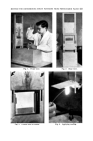
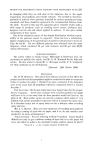
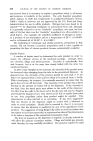
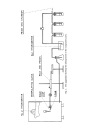
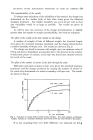
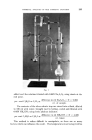
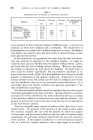
264 JOURNAL OF THE SOCIETY OF COSMETIC CHEMISTS Morgan •7 postulates the following equation as a summation of the reactions occurring in this process, where ethylene oxide is concerned: R.O-CH•.CH•.OH + (3 + x)HI = RI + x CH•.CH• I + (1 -- x) CH•:CH• + I• + 2H•O The ratio of ethyl iodide to ethylene varies with a number of reaction conditions---hence the need to determine both. A simple silver nitrate trap serves to absorb all the alkyl iodide, but in order to absorb all the ethylene a special absorber, consisting of a long tube containing a glass spiral to increase the time of contact between the gas and the absorbing solution, is necessary. A third trap containing potassium iodide solution is necessary to collect any bromine swept out by the gas stream. Carbon dioxide is generally used as carrier, but nitrogen works equally well. Figure I shows a slightly modified version of Morgan's apparatus. Trap E contains 10 ml 10 per cent potassium iodide solution, the spiral absorption tube D contains 15 ml of bromine solution (1 ml bromine, 300 ml glacial acetic acid and 5 g dry potassium bromide) and trap C contains 10 ml alcoholic silver nitrate solution (15 g silver nitrate are dissolved in 50 ml water and added to 400 ml absolute alcohol. Several drops of nitric acid are then added and the solution is standardized against 0.05N potassium or ammonium thiocyanate using Volhards method). Trap B contains a sus- pension of red phosphorus in water or, if sulphur is present, in 5 per cent cadmium sulphate. A weighed sample of the ethylene oxide derivative (0.05-0.12 g) is placed in flask A and 10 ml of constant boiling hydriodic acid (S.G. 1.70), freshly distilled over red phosphorus is added. The flask is connected to the apparatus and a slow stream of carbon dioxide is passed while the flask is gradually brought to a temperature of 140ø-145 ø C by means of an oil or glycerin bath. The flask is kept at this temperature for a minimum of one hour. Five minutes before the end of the heating, the silver nitrate trap is heated to 500-60 ø C, by means of a hot water bath, to drive out any dissolved ethylene. Tubes D & C are then disconnected in that order, the carbon dioxide is disconnected and the heat removed from flask A. The tube D is then connected by its lower adaptor to a 500 ml flask, containing 10 ml 10 per cent potassium iodide, and 150 ml water. The potassium iodide tube E is removed and the contents of the side arm rinsed into it. The bromine solution is run into the titration flask through the stop-cock and the tube rinsed out with water. The contents of the tube E are washed into the titration flask, which is then stoppered and allowed to stand 5 minutes. 5 ml of 10 per cent sulphuric acid are

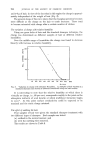
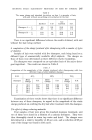
CHEMICAL ANALYSIS IN THE COSMETIC INDUSTRY 265 Fig. 1 added and the solution titrated with 0.05N Na2S203, using starch at the end point. difference in ml Na2S•O3 X N X 2.203 per cent C•H40 as C•H• • wt. of sample. The contents of the silver nitrate trap are rinsed into a flask, diluted to 150 ml with water, brought iust to boiling, cooled and titrated with 0.05N NH•CNS, using ferric alum as indicator. difference in ml NH4CNS X N X 4-405 per cent C•H•O as C2H•I ---- wt. taken This method is rather difficult to manipulate, as there are so many factors which can influence the result. The temperature must be kept within
Purchased for the exclusive use of nofirst nolast (unknown)
From: SCC Media Library & Resource Center (library.scconline.org)