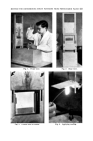
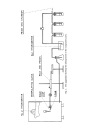
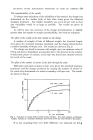
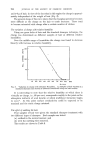
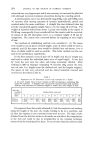
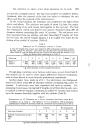
224 JOURNAL OF THE SOCIETY OF COSMETIC CHEMISTS as it is burning, with the tip of the flame an inch or two below the plate (Fig. 4). If the plate is to be printed after exposure to the spray, it is necessary to have an even coating in order to obtain a uniform field on the print. This may be obtained by moving the flame round the plate fairly near to its edges, until about half of the ribbon is consumed and then with zig-zag movements along the plate. The coated plate should be handled with care as the magnesium oxide layer is very soft and easily damaged. Care should also be taken to see that no droplets are inadvertently allowed to fall on the plate, as these will leave holes which will invalidate the spray pattern. (b) Exposure of the Plate The dispenser under test is placed on the box at the required distance from the plate holder and the height of the shutter (in the cocked position) adjusted so that the spray centres around the aiming mark. The plate holder is positioned so that the centre o[ the plate lies behind the aiming mark when it is inserted. The aperture required in the shutter must be determined by trial and error for most sprays it has been found that about 1"-2" is sufficient. When the plate is in position, the valve is actuated and the shutter released. The plate should then bear the imprint of the spray pattern (Fig. 5). If the holes in the coating are large, they may be viewed against a dark ground, where they stand out against the white of the magnesium oxide. If they are small, they are more easily seen against a light, where they stand out as bright spots against the opaque coating. (c) Printing If a permanent record of the spray pattern is required, the plate may either be printed directly on to photographic paper as a contact print, with the magnesium oxide layer against the paper or prints may be taken through an enlarger. The method of printing is the same as for normal photography, except that it may be necessary to wash off magnesium oxide which adheres to the photographic paper. With careful handling, it is possible to obtain two or more prints from the same plate without seriously interfering with the pattern of holes. APPLICATION The apparatus is dependent for its operation on the impaction of droplets at a relatively short distance from the dispenser and thus there are two main possible sources of error in its use. Firsfly, there is a risk of the loss of the smaller droplets by their being carried round the plate in the stream of vapourized propellant, and secondly, the size of the droplets may

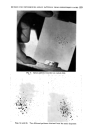
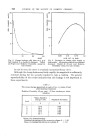
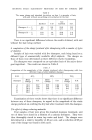
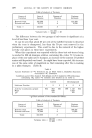
METHOD FOR DETERMINING SPRAY PATTERNS FROM PRESSURIZED PACKS 225 be changing while they are still close to the dispenser, due to the rapid evaporation of propellants and volatile solvents. The method is, therefore, primarily of interest where products intended for surface spraying are being examined, and these should be sprayed at the recommended distance from the plate. If used in this way the apparatus gives valuable results with a wide range of products, such as crawling insect sprays, perfumes, hair lacquers, sun tan oils and others applied to surfaces. It also gives useful comparisons of finer sprays. Due to the statistical nature of the droplet distribution absolute repeat ability of the patterns cannot be expected. None the less a satisfactory degree of duplication of the general type of pattern is obtained as is shown in Figs. 6a and 6b. The two different patterns were obtained from the same dispenser, which contained 20 per cent kerosene and 80 per cent 50/50 Arcton 6/9 mixture. ACKNOWLEDaEMENTS The author wishes to thank Cooper, McDougall & Robertson Ltd., for permission to publish this article, and Mr. R. M. Mumford for his help and advice. He also wishes to thank Mr. G. McGregor and Mr. P. E. Longhurst for their assistance in its development. [Received: l•tth October 1958• DISCUSSION DR. H. W. HIBBOTT: How much does distance and size of slot affect the pattern and the fact that propellant might be carried to the plate or evaporate before it reaches the plate ? Would it be more conclusive if the dispenser were so far away that all propellant will have evaporated before it reaches the plate ? THE LECTURER: We do not really know how long it takes for the propel- lant to evaporate. In the case of sprays with very fine particles one might well have to be so far away that the finer particles would not land on the plate at all. Most surface sprays are used in a manner which makes it very unlikely that all the propellant evaporates before it reaches the spray area. It is therefore better not to spray from too far a distance when recording spray patterns. MR. A. G. MCGEE: Have you any experience of recording spray patterns by using a coating of dyed talc on paper, and if so, do you consider your method to be more advantageous ? T•i• LECTURER: You are referring to Root's* method. I have found it difficult not only to get a uniform coating of dyed talc on to the paper but have also failed to achieve the standard of spray pattern shown by Root.* *Root, M. J. J. Soc. Cosmetic Chemists, 7 (1956) 153.
Purchased for the exclusive use of nofirst nolast (unknown)
From: SCC Media Library & Resource Center (library.scconline.org)