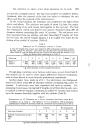
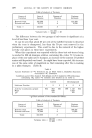
246 JOURNAL OF THE SOCIETY OF COSMETIC CHEMISTS As is well known, ethylene oxide condensates were found to inhibit the production of static electricity only so long as substantial amounts were left on the hair. Unlike the cationic detergents, they were not able to resist the effect of thorough rinsing. CONCLUSION It is beyond the scope of the present paper to theorize on the precise origin of the static electricity produced on hair after combing. The paper is merely presented to demonstrate the scope of a new method for making a rapid comparison between the effect of different treatments of the hair. ACKNOWLEDGEMENTS The authors' thanks are especially due to Dr. R. H. Marriott for his con- tinued interest, help and advice in this work. We should also like to thank the Directors of County Laboratories, Ltd., for giving their permission to publish this paper. [Received: 1st December 1958j REFERENCES • Mills, C. M., Ester, V. C., and Henkin, H. J. Soc. Cosmetic Chemists, ? (1956), 466. 2 Hersh, S. P., and Montgomery, D.J. Textile Research f., 25 (1955), 279. a Wool Industry Research Association Bull. 13 (1951), 279. 4 McLean, H.T. Proc. Am. Assoc. Textile Chemists Colorists (1955), 485. * Hayek, M., and Chromey, F. C. Am. Dyestuff Reptr., 40 (1951), 164. 6 Speakman, J. B. J. Textile Inst., 27 (1936), T185. THE HOSPITAL BEAUTY SCHEME ELEANOR MACDONALD* A lecture delivered before the Society on oe3rd January 1959. The establishment of Beauty Rooms in hospitals, for the treatment of the mentally and physically sick, is described together with the difficulties which faced, and faces, the pioneers. Case histories are quoted to illustrate the success of the scheme. IN MY view, to-day cosmetics have a very special part to play in the lives of women everywhere. To-night's talk is about Beauty work in hospitals, but this only acquires its full meaning when it is remembered that cosmetics not only represent something very important to women, something gay and stimulating, but cosmetics are also tremendously important psycho- logically. I have always felt that it is not iust the precise monetary value * J. & E. Atkinson, Ltd., London, W. 1.

THE HOSPITAL BEAUTY SCHEME 247 of a cream or a lipstick which makes it desirable, it is the hidden signific- ance which it has for a woman which is really the important factor. That significance is not just a frivolous thing, it is something which has very far- reaching results. If people are going to have a little bit of their individuality annihilated by lack of sympathy then it presents a very difficult position. Indeed, it is that attitude which makes a tremendous number of women withdraw, get very little out of life and really suppress a part of their whole personality, 'often with long-term disastrous results. Unless they are extremely well balanced, mature people, they can think that this kind of happening proves them to be inadequate, different, unattractive, which lowers their morale, making them nervous and uncertain, or alternately, difficult or withdrawn. In point of fact, such feelings react just as badly on men's characters as on women's. One has only to think back historically to such people as Richard III with his hunchback, or Wilhelm I and his withered hand. These people, it is recognized to-day, would have been very different if they had not had some kind of physical defect to contend with. In another field, more recently, it has been shown that many of the youths who are admitted to Borstal institutions are people who suffer from some physical defect, either a hare lip, a limp, or a disfiguring scar. This has meant that they have always felt different, awkward and unwanted, and they say to themselves: "All right, if I am different, I will prove I am different." As a result their conduct becomes immensely anti-social and they grow either aggressive or resentful and so find their way to such places as Borstal, with a record of crime. The modern psychiatric approach to this is to do something positive about the defect. Quite often the defects can be removed either by surgery or some special kind of treatment, and the mere fact that outside people make an effort to help leads to a more responsive attitude. Statistics show that a much smaller proportion of boys are re-admitted to Borstal than previ- ously with this kind of defect, if they are treated. I think that 33 per cent of the youngsters with these difficulties who have been treated do not come back again, which is a very significant trend. It seems that defects on the nose have a very much more marked and disastrous effect on person- ality than any other type, and when these deformities are corrected only one in eight of the boys is re-admitted. Against this forward thinking and creative approach, reports of two deplorable cases of suicide have appeared in the newspapers just recently. One was a 15 year old schoolboy who gassed himself because he was terribly depressed with his pimply face, and following about five weeks after that, there was a girl who did likewise. They were both suffering from the very usual type of acne condition with which we are all familiar. You might say that these two youngsters were unbalanced anyway, but the Coroner clearly
Purchased for the exclusive use of nofirst nolast (unknown)
From: SCC Media Library & Resource Center (library.scconline.org)