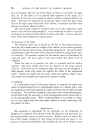
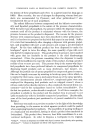
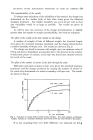
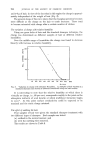
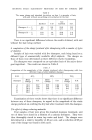
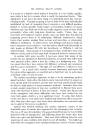
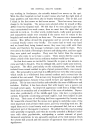
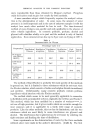
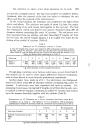
THE SORPTION OF AMINO ACIDS FROM SHAMPOOS ON TO HAIR 275 not provide a suitable control. The hair tress would be too small for further treatment, after the removal of the first two inches to eliminate the end effects and then the removal of the control pieces. In the second method, the technique was modified in the light of the above end effects. The sub-tress was made of about 2 g hair, the major tress consisting of six such tresses tied together at the root end. The hair was shampooed, rinsed and dried in the manner described using 200 ml shampoo solution containing 32½ curies •4C tyrosine. The sub-tresses were then separated from one another, and after discarding 2" lengths cut from the free ends, the next 6" lengths (approx. 1 g in weight) were taken for the elution of the sorbed •4C tyrosine (Table 8). Table 2 8ORPTION OF 14C TYROSINE WITHIN A TRESS A 12 g 12" length tress of hair was washed in 200 ml shampoo solution contain- ing 32/• curies •4C tyrosine. The tress was divided into six sub-tresses of 2 g after which 2" was cut from the tip end of each sub-tress and the next 6" (1 g) taken for elution and counting as in Table 1. Sub-tress 1 2 3 4 5 6 Mean -- Tress 3 1,080 986 1,388 1,311 1,170 1,137 1,170 149 Tress 4 940 891 1,046 988 1,287 926 1,013 145 * •- Best estimate of the standard deviation. Though large variations occur between sub-tresses, as seen from Table oe, this method can be used to show major differences between treatments, such as those known to occur from the preliminary experiments. Another major tress, made up of 6 X 2 g sub-tresses, was shampooed, rinsed and dried, using 200 ml shampoo solution containing 32/z curies tyrosine. 3 sub-tresses were then separated and used as controls. The remaining 3 sub-tresses, having had 2" lengths cut off from the tip ends, were re-washed in 100 ml shampoo containing no added x*C tyrosine and worked up in the manner described, together with the controls (Table 3). Table $ DESORPTION OF 14C TYROSINE BY A PLAIN SHAMPOO SOLUTION FROM HAIR Conditions as in Table 2. Sub-tresses 4 to 6 re-washed in 100 ml shampoo containing no added x4C tyrosine, then cut, extracted and counted as in Table 2. Control Re-shampooed Sub-tress Number 1 2 3 4 5 6 Activity (counts/min./g hair) 768 749 781 487 555 403 Mean 766 482 r•-* 14 68 * •- Best estimate of the standard deviation.

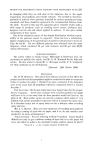
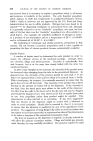
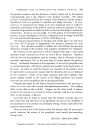
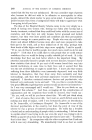
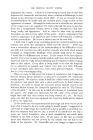
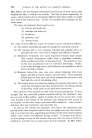
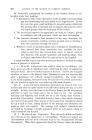
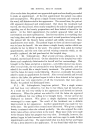
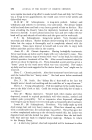
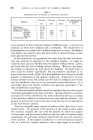
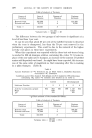
276 JOURNAL OF THE SOCIETY OF COSMETIC CHEMISTS Table of Analysis of Variance Source of Sum of Degrees of Variance Variation Squares Freedom Estimate Between tress 121,268 1 121,268 Between sub-tress 12,113 4 3,028 Total :-- 133,381 5 Variance ratio -- 121,268 _ 40 3,028 The difference between the two groups of sub-tresses is significant at a level of less than 1 per cent. It can be seen that about 37 per cent of the labelled tyrosine is desorbed when the tress is shampooed, less than the 70 per cent removed in the preliminary experiments. This could be due to the removal of the higher activity end pieces in these later experiments. When this experiment was repeated with the three test sub-tresses being re-washed in 100 ml shampoo solution containing 16• curies •C tyrosine in place of the non-radio-active shampoo, an increase in the amount of labelled amino acid deposited was found. As might have been expected, this increase was of the same order of magnitude as that remaining after the re-washing in a plain shampoo. (Table •l). Table 4 ADDED 8ORPTION OF •4C TYROSINE ON TO HAIR FROM A SHAMPOO SOLUTION CONTAINING 14C TYROSINE Conditions as in Tables 2 and 3. Sub-tresses 4 to 6 re-washed in 100 ml shampoo containing 16/• curies •4C tyrosine and treated as in Table 3. Control Re-shampooed Sub-tress Number 1 2 3 4 5 6 Activity (counts/min./g hair) 652 803 581 976 1,145 955 Mean 679 1,025 •-* 113 105 * c• Best estimate of the standard deviation. Table of Analysis of Variance Source of Sum of Degrees of Variance Variation Squares Freedom Estimate Between tress 180,267 1 180,267 Between sub-tress 47,409 4 11,852 Total: 227,676 5 Variance ratio -- 180,267 _ 15.2 11,852
Purchased for the exclusive use of nofirst nolast (unknown)
From: SCC Media Library & Resource Center (library.scconline.org)