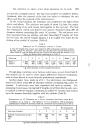
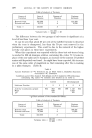
226 JOURNAL OF THE SOCIETY OF COSMETIC CHEMISTS I consider Root's method to be neither as reproducible nor his patterns as permanent as the results obtained by my method. MR. W. SCaON: Does the size of the hole in the magnesium oxide film vary with the speed of the particles ? THE LECTURER: I really do not know. It depends on droplet size and thickness of coating. If the thickness of the coating is greater than the droplet diameter one will get a hole somewhat larger than the droplet. If it is not, then I believe the droplet is likely to spread on impact and give a hole considerably larger in diameter. MR. A. FOSTER: There appears to be a considerable range in droplet size. Can the largest of these be taken as representation of single particles, or might they be due to coalescence ? TH• L•CTURF•R: If the hole is circular, it is almost certainly due to a single droplet. If it is of a different shape then it may be due to more than one droplet. The correct result can be achieved by interpreting the plate carefully, and the ability to do so grows with practice. DR. W. MITCHELL: As the particles of magnesium oxide are very fine and therefore presumably very reactive, is there a possibility that certain products might react with the magnesium oxide and that the holes produced are then larger than they should be ? Ta• L•CTURER: I have never found this to occur with cosmetic and insecticidal sprays. It may, however, occur with other products. COMPRESSED GASES AS PROPELLANTS FOR COSMETIC PRODUCTS A. HERZKA, B.Sc., A.R.I.C.* A paper delivered before the Society at the Symposium on Pressurized Packs on 14th October 1958. The dffierence between liquefied and compressed gases are described. Reference is also made to the quality factors which are of importance when formulating with compressed gases. NEARLY TWELVE months have elapsed since the publication of a feasible way of dispensing viscous products in non-aerated form from pressurized packsL It must not be assumed, however, that the idea of utilizing nitrogen and other compressed gases as propellants is a new one. Root• has ably reviewed * Research Department, The Metal Box Co. Ltd., Alperton, Middx.

COMPRESSED GASES AS PROPELLANTS FOR COSMETIC PRODUCTS 227 the history of these propellants and refers to a patent issued as long ago as 18628. More recently, the use of nitrogen for dispensing viscous food pro- ducts was recommended by Pyenson• and other publications •,',7 also foreshadowed the use of such propellants. The salient difference between compressed and the hitherto convention- ally used liquefied propellants is the nature of the pressure characteristics. With the latter type of propellant, the pressure within the dispenser remains constant until all the product is exhausted whereas with the former, the pressure decreases as the product is dispensed. The reasons for the pressure decrease with compressed gases have been described in other publications 8 9 and it is therefore not proposed to deal with this aspect in any detail. Suffice it to state that immediately after charging a dispenser with gaseous propel- lant, said propellant will exert a unit pressure and occupy a pre-determined ullage*. By the time sufficient product has been dispensed to make the headspace* equal to twice the ullage, the same quantity of gas will exert only half of its original pressure. This gradual drop in pressure, more marked with gases that are insoluble in the product is the chief disadvantage encountered. Often, the pressure remaining when the dispenser is nearly empty will be insufficient to expel the whole of the product, leaving a product residue of ten or more per cent. This pressure drop is the reason why lique- fied propellants have been preferred hitherto to compressed propellants for dispensing liquid products such as room deodorants, hair lacquer, etc. Although the particle size of sprays propelled by compressed gases is coarser, this can be largely overcome by resorting to break-up spray valves which, as is implied by their name, cause a mechanical break-up of the spray particles. Until the announcement already referred to •, compressed gases wer e only employed for dispensing food products such as whipped cream •ø, where a nitrous oxide/carbon dioxide mixture is often employed, flavoured drink con- centrates • and for fire extinguishers based on carbon tetrachloride •. For the last two products, carbon dioxide is employed. In all these examples, the propellant is soluble in the product and the gradual drop in pressure is not quite so marked as with the insoluble compressed propellants. (Incidentally, none of the food products just mentioned is at present marketed in Great Britain.) Reference was made on a previous occasion •8, in the light of the knowledge then prevailing, to the manner in which aqueous products could be packed when employing liquefied propellants. The possibility of packing toothpaste as a foam pack was mentioned, having in mind a product then marketed in Switzerland. This product does, however, bear little resemblance to a con- ventional toothpaste. In order to dispense a toothpaste in its original, * Ullage •?: Volume in dispenser not filled with liquid content immediately after packing. Headspace •?: Volume in dispenser not filled with liquid content.
Purchased for the exclusive use of nofirst nolast (unknown)
From: SCC Media Library & Resource Center (library.scconline.org)