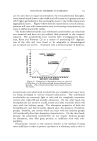
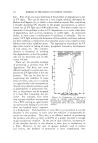
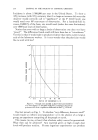
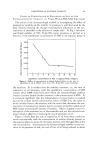
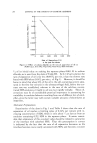
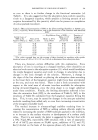
PARAMETERS OF EMULSION STABILITY 239 EFFECT OF CONCENTRATON OF EMULSIFIER OR SALT ON THE ULTKACENTKIFUGAL STABILITY OF NUjOL-WATER-SDS-NaC1 EMULSIONS The utility of the ultracentrifugal method in investigating the effect of preparative variables on the stability of emulsions is well illustrated by the data obtained showing the changes resulting from alterations in the con- centration of emulsifier or the addition of simple salts. In Fig. 1 the ultra- centrifugal stability of 50% Nujol-50% water emulsions is plotted as a function of the equilibrium concentration of SDS in the aqueous phase of 0.60 0.50 0.40 0.$0 -- 0.20 - O.lO -- o • 0 2 4 6 8 I0 12 14 16 18 Equilibrium Concentration of SDS in Aqueous Phase mmoles/I. Figure 1.--Effect of concentration of sodium dodecylsulfate on the rate of separation of oil at 39,460 r.p.m. from 50% NujoL50% water emulsions. the emulsion. It is evident that the stability increases, i.e., the rate of separation of oil decreases, until the equilibrium concentration of SDS reaches about 0.008 moles/liter, after which the ultracentrifugal stability remains constant despite further increases in the concentration of SDS. It is extremely significant that this independence of concentration is reached .just at the critical micelie concentration (cmc) of SDS (14), the value at which micelies form in the solution, with the result that thereafter the con- centration of monomer ion remains nearly constant, all further additions of SDS simply increasing the number of micelies. Hence it appears that it is adsorption of the monomer ion of the emulsifier and not the colloidal com- ponent which is effective in reducing the rate of separation of oil. Figure 2 shows that the rate of separation of oil from these emulsions varies exponentially with the concentration of sodium chloride present in the aqueous phase, as shown by the linear decrease with the logarithm of the salt concentration. Consequently the ultracentrifugal stability is very sen- sitive to the presence of salt, the rate of loss of oil being reduced to about

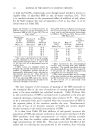
240 JOURNAL OF THE SOCIETY OF COSMETIC CHEMISTS 0.2 0.05 ø.ø2 F ø'ø• F 0.005[ 0.00 :' F o.ool I o O. lO 0.20 0.30 0.40 0.50 Rate of Separation of Oil in Per Cent Per Minute Figure 2.--Effect of sodium chloride on the rate of separation of oil at 39,460 r.p.m. from 50% NujoL50% water-0.2% SDS emulsions. "• of its initial value on making the aqueous phase 0.005 M in sodium chloride, as is seen from the data of Table III. In 0.1 M salt solution the rate of separation of oil is far less (0.095% per min.) than the slowest rate found with SDS alone (0.14% per min. cf. Fig. 1). However, it should be borne in mind that about 6% of the oil in the salt-containing system sepa- rated in the first few minutes in the ultracentrifugal field, before the con- stant rate was established, whereas in the case of the salt-free, concen- trated SDS emulsions virtually no oil was lost rapidly initially. These ob- servations may be of considerable practical importance in accounting for variability in emulsion behavior resulting from use of different lots of emul- sifier, since the latter may well contain variable amounts of electrolytes as impurities. Molecular Explanations Examination of the data in Fig. 1 and Table I shows that the rate of separation of oil reaches a limiting value of 0.14% per minute with in- creasing concentration of SDS, which is only about 1/3 as fast as from an emulsion containing 0.2% SDS in the aqueous phase. It seems reason- able that attainment of this constant value should be related to saturation of the interface with adsorbed SDS. That this presumption is correct is indicated by the fact that the rate of oil separation decreases as the interface becomes more nearly saturated with SDS, and becomes constant
Purchased for the exclusive use of nofirst nolast (unknown)
From: SCC Media Library & Resource Center (library.scconline.org)