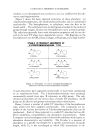
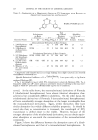
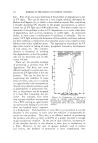
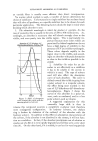
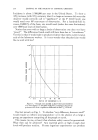
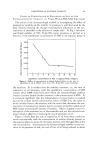
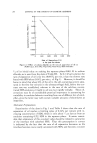
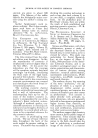
ULTRAVIOLET ABSORBERS AS STABILIZERS 221 can be seen that at equal concentrations the tetrasubstituted benzophe- nones absorb much closer to the visible and will screen out a greater amount of UV light, particularly in the wavelengths closer to the visible where much degradation occurs. Figure 4 shows how the transmission curve of a benzo- phenone will vary with concentration and, at increasing concentrations, the curve is shifted toward the visible. The hydroxybenzotriazoles and substituted acrylonitriles are relatively new materials and have not yet realized their potential in the cosmetic industry. The acrylonitriles have recently been investigated by Ross- man, Knox and Freeman (2) as a means of preventing UV degrada- tion of the skin and were found to be adaptable to dermatological use as topical sun screens. At present only a limited number of hydroxy- 80 7o &O $0 4-0 x 20 •0 PERCENT TRANSMISSION OF ABSORBERS // / ,, 2A:OIHYDIK)XY ./ ,/4,d• OIIdETHOXY WAVELENGTH MILLIMICRONS Figure &--Comparison of absorption curves, at a level of 0.025 g/liter, of a disubstituted and tetrasubstituted benzo- phenone. (The tetrasubstituted derivative absorbs closer to the visible). benzotriazoles and substituted acrylonitriles are available, but many more are being developed in various research laboratories. The substituted acrylonitriles are extremely light in color and are completely unreactive toward salts, high pH and metallic substances. On the other hand, the benzophenones are sensitive to pH, metals and other materials which will react with the hydroxy group. The absorption properties of both the benzophenones and benzotriazoles depend upon the presence of hydroxy groups therefore, any system which can react with the hydroxy groups will considerably alter their absorption characteristics. On the other hand, because the substituted acrylonitriles do not require hydroxy groups for absorption, they offer great promise as stabilizers with wide com- patibility. Of particular concern to the cosmetic chemist is the method of using these stabilizers in order to protect a product or a substrate, such as skin or

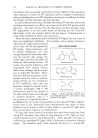
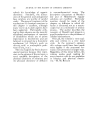
222 JOURNAL OF THE SOCIETY OF COSMETIC CHEMISTS hair. First of all, one must determine if the problem of degradation is due to UV light. This can be done by a very simple method, developed by Holmes and Signore (3), in which a clear cellulose acetate film, containing a broadly absorbing UV absorber in the proper concentration, is used to screen out all UV light up to 400 millimicrons. This filter enables one to determine if the problem is due to UV degradation or to some other form of degradation, such as heat, oxidation, or visible light. As mentioned earlier, in some cases a combination of stabilizers is desirable. For ex- ample, if UV light initiates the formation of free radicals, and these radicals are then oxidized, a combination of an absorber and an anti-oxidant is more efficient than either stabilizer alone. The degradation of products by UV light often results in fading of colors, precipitate formation, development of foul odors, etc. The cosmetic chemist is interested in avoiding this degradation, so that his product will not be destroyed and its effi- ciency will last. There are two possible methods of protecting a product from UV degradation. The first, and more efficient method, is to screen out com- pletely the UV light before it hits the product. This can be done by in- corporating the stabilizer in some form of screen, such as in a coating on a glass bottle or by incorporation directly into a plastic container, such as polyethylene or polystyrene bot- tles, or the product can be wrapped in a clear film containing the ab- sorber. For example, tests show that a proper stabilizer incorporated into a PVC coating on a glass bottle can prevent the fading of a red color after one hundred hours' exposure 10 o PERCENT TRANSHISSION o, VARIOUS CONCENTRATIONS o•, 2,4.-DIHYDI•OXY BENZOPHENONE ,. S MIL CELLULOSE ACETATE .o 75X Figure 4.--Comparison of absorption curves, at varying concentrations, of a disubstituted benzophenone. (Increasing concentration shifts the curve toward the visible.) in a Fadeometer. Unfortunately, it very often is not practical to use the absorber in this manner in most cases the stabilizer is incorporated di- rectly into the product. This, also, is an efficient method of protecting the product, and often as little as 0.05,07o of a proper absorber is enough to give satisfactory stability. In the case of clear solutions, incorporation of the absorber directly in the solution is often just as satisfactory as a filter. However, in the case of opaque products suctx as creams and lotions, the problem of protection is more complicated here
Purchased for the exclusive use of nofirst nolast (unknown)
From: SCC Media Library & Resource Center (library.scconline.org)