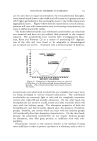
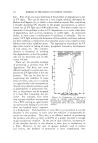
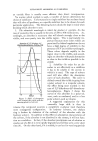
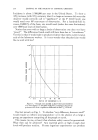
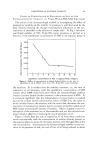
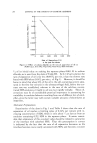
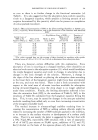
PARAMETERS OF EMULSION STABILITY 243 the electrical work required to bring additional negatively charged dodecyl- sulfate ions into the negatively charged interface. In addition, the presence of sodium chloride results in closer association of the sodium ions with the dodecylsulfate groups in the interface, thus reducing the effective negative charge and permitting closer packing of the SDS residues in the film. That molecular packing does not by itself constitute a complete ex- planation of the observations is shown by the fact that the actual number of SDS molecules per cm. 2 of interface is not very different in emulsions containing 0.2% SDS, 0.1 M NaC1 and those with 0.45% SDS, zero NaC1, the areas per molecule being respectively 57.4 fk 2 (Table III) and 58.9 • (Table II). Nevertheless, the salt-containing system separates oil only about 2/3 as rapidly as the salt-free system, the two rates being respectively 0.095% per minute (Table III) and 0.16% per minute (Tables I and II). It would not be expected that this concentration of salt would have this large an effect on the rate of drainage of water from between the flocculated oil drops. Hence, it is tempting to assume that its chief effect is to in- crease the cohesivehess of the adsorbed stabilizing film by reducing the repulsion between the chains by shielding the charges on the dodecyl- sulfate groups. Consequently, the protective film surrounding the oil drops may not break as easily on contact, thus increasing the time required for coalescence to occur. SUMMARY Different usages of the term "stability," the means of measuring each, and the factors influencing each process leading to instability, are first discussed. In the case of the ultracentrifuge the quantity determined is the rate at which free oil is separated from an emulsion layer in which the drops are so deformed and so closely packed that very little water remains between them. Although not necessarily having a direct correlation with shelf life, such results are very useful in attempting to determine the nature of the rate-determining step in the coalescence process. In conjunction with determination of interfacial adsorption, they are of particular value in quantitative evaluation of the effect of surfactant concentration, addition of salts, etc., on the rate of separation of oil. Thus it was shown that the ultracentrifugal stability increases with in- creasing concentration of sodium dodecylsulfate in the aqueous phase until the critical micelle concentration is reached, after which it becomes constant, independent of emulsifier concentration. Addition of sodium chloride was found to increase greatly the ultracentrifugal stability of the emulsions studied, the effect varying as the logarithm of the concentration of added salt. This result was shown to be related to an increase in the

244 JOURNAL OF THE SOCIETY OF COSMETIC CHEMISTS adsorption of sodium dodecylsulfate in the presence of salt and a change in the characteristics of the adsorbed film. (Received January 7, 1963) REFERENCES (1) R. C. Merrill, Ind. Eng. Chem., Atrial. Ed., 15, 743 (1943). (2) E. R. Garrett, y. Pharm. Sci., 51, 35 (1962). (3) A.J. Hayter, y. Soc. Cosmetic Chemists, 13, 152 (1962). (4) S.J. Rehfeld, •. Phys. Chem., 66, 1966 (1962). (5) R. D. Vold and R. C. Groot, Ibid., 66, 1969 (1962). (6) H. Koelmans and J. Th. G. Overbeek, Discussions Faraday Soc., 18, 52 (1954). (7) E.L. Mackor and J. H. van 4er Waals, •. ColloidSci., 7, $35 (1952). (8) M.J. Void, Ibid., 16, 1 (1961). (9) G. D. M. MacKay and S. G. Mason, Ibid., 16, 632 (1961). (10) R. S. Allan and S. G. Mason, Ibid., 17, 383 (1962). (11) K. J. Mysels, K. Shinoda, and S. Frankel, Soap Films, Pergamon Press, London, 1959. (12) J. Th. G. Overbeek, •. Phys. Chem., 64, 1178 (1960). (13) H.H.G. Jellinek, •. Soc. Chem. Ind., 69, 225 (1950). (14) J. N. Phillips and K. J. Mysels, y. Phys. Chem., 59, 325 (1955). (1 $) J. T. Davies and E. K. Rideal, Interfacial Phenomena, Academic Press, London, 1961. (16) M. B. Epst½inetaL, •. Phys. Chem.,58, 860 (1954).
Purchased for the exclusive use of nofirst nolast (unknown)
From: SCC Media Library & Resource Center (library.scconline.org)