264 JOURNAL OF THE SOCIETY OF COSMETIC CHEMISTS ozonolysis. The issue remained undecided for a number of years, leading finally to the belief that rhodinal and citronellal as well as their correspond- ing alcohols and derivatives consisted of inseparable mixtures of the two structural forms (8). Recently (9) the citronellol-rhodinol controversy was definitely settled when it was demonstrated that both citronellol and rhodinol were capable of individual and separate existence. The syntheses of pure rhodinal and its derivatives were achieved, and no spontaneous equilibration between the rhodinyl and the citronellyl forms was ever noticed. Both rhodinal and citronellal were reduced by the Wolff-Kishner method to 2,6-dimethyl-l-octene and 2,6-dimethyl-2-octene, respectively. The ozonolysis of the olefin from rhodinal afforded 6-methyl-2-octanone and that from citronellal, 4-methyl-hexanol. The ozonolysis of rhodinol yielded 6-methyl-8-hydroxy-2-octanone whereas ozonolysis of citronellol resulted in a complex mixture of cyclic derivatives of 4-methyl-6-hydroxy- hexanal (9). Oilactive tests confirmed the more fragrant and subtle rosy character of the rhodinyl in comparison with the citronellyl series. Rhodi- nol and its esters as well as rhodinal in particular blend exceedingly well with rose and mugnet compositions. It is worthwhile mentioning in this connection that the first gas-liquid chromatographic studies with the rhodinyl and citroneilyl series met with one of the few instances of failures. Indeed, the two isomeric species always appeared in the chromatograms as single unresolved peaks. Only the discovery of the unusual stability of rhodinal toward mild acids (9), as compared to the easy cyclization of citronellal into isopulegols under the same conditions, made it possible to devise an adequate chromatographic analysis of a mixture of both aldehydes. Mixtures of citronellal, rhodinal and isopulegols were analyzed by gas- liquid chromatography using alternatively a neutral and an acidic column. Rhodinal was resolved as a distinct peak over an acidic Celatom FM73 column (9), from the common peaks of isopulegols which included the citrondial. In a neutral Chromosorb W column, on the other hand, both rhodinal and citronellal showed up as a single unresolved peak distinct from those of the isopulegols. The amount of citronellal was easily deduced by difference. Today the use of capillary chromatographic columns, coupled with the recently available ion detectors, has increased the sensitivity of the chromatographs resulting in a better separation of the citronellyl and rhodinyl species. The commercial availability of a pure grade of (citronellal-free) rhodinal is based on its resistance to acid cyclization and its separation from iso- pulegols through boration. The chemical solution of the citronellol- rhodinol problem has not as yet affected the custom, prevalent in the trade, of using the term, "rhodinol," to describe a grade of/evo-citronellol ob-

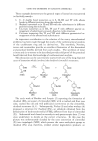
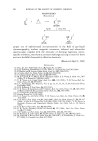
ODOR AND ISOMERISM IN OLFACTIVE CHEMICALS 265 tained from geranium oil as distinct from a grade of citronellol isolated from citronella oil. It is quite possible, in view of the recent work on the com- position of geranium oil, by Naves and his co-workers (10), that some minor constituents of the geranium oil including rosenoxide present in rhodinol of the trade contribute markedly to its superior fragrance and greater olfactive value when compared with the common grade of citronellol from citronella oil. In the field of the methylionones and irones an increasing demand for the supply of pure isomers has been evident for some time also certain pre- ferred mixtures of isomers of the methylionones are highly prized by perfumers for their fine odors. The right combination of isomers is ap- parently at the base of the secret of their commercial success. Here, Methyl-Ionones (XV) Isomethyl-Ionones (XIV) H H a-Irone (cis) (XVI) Iso-a-Irone (trans) (XVII) isomerism includes double bond isomerism (group 1), skeletal isomerism (group 2) and spatial cis-trans conformations (group 3). The practical value of isomethylionones has been emphasized in a recent patent by Beets and V. Essen (11) on the ways of preparation of the more fragrant a-isomethylionone (XIV), which possesses a finer violet note than methylionones (XV). Specific conditions for the reaction of citral with 2- butanone are reported which are said to favor the aldol condensation with the methylene group of the 2-butanone. In addition to the orignal work of Haarman and Reimer (12) on the preparation of the methylionones, extensive studies have been carried out by Naves, Kitchens (13) and others regarding the effect of various cyclizing agents on ionones and their derivatives. Of particular interest is the desirable effect of boron trifiuoride on the cyclization of trans-pseudoirones reported by Naves (14) to yield mainly a-irone (XVI). Under the same conditions, both 85% phosphoric acid and 62% sulfuric acid yield iso-a- irone (XVII) as the major constituent. Besides their skeleto-isomeric differences with the methylionones, steric differences exist between the a- and iso-a-irones in the cis-trans spatial arrangements of the ring substit- uents in the 2 and 6 positions (15). As reported by Naves (16), the olfac- tive value of the a-irone, which recalls iris odor, supersedes by far that of
Purchased for the exclusive use of nofirst nolast (unknown)
From: SCC Media Library & Resource Center (library.scconline.org)