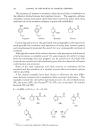
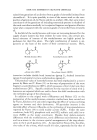
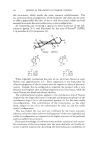
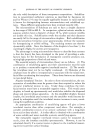
266 JOURNAL OF THE SOCIETY OF COSMETIC CHEMISTS the iso-a-irone, which recalls the more common methylionones. The cis- and trans-(neo)-arrangements of the butenone side chain do not seem to affect appreciably the odor of the a-and iso-a-irones, which are both assumed to acquire the most stable trans- or neo-configuration. An interesting case involving a spatial cis-trans isomerism of the sub- stituents (group 3) is well illustrated by the case of Nerone © (XVII), 1 - (p-menthen-6-yl)-l-propanone (2). H f XH(a) (a) Netone (XVIII) cis trans •r• = --133 ø st) = d- 44 ø no = 1.4711 no = 1.4736 d4 = 0.9087 d4 = 0.9110 When originally synthesized the ratio of cis- and trans-Nerone at equi- librium was approximately 2:1. Upon separation, it was found that the olfactive properties of the cis-isomer were far superior to those of the trans- isomer. Indeed, the cis-configuration imparted the product with a very pleasant and fragrant odor recalling bergamott and citrus leaves, while the trans-Nerone was bland and almost odorless. The conformational analysis applied to the cyclohexane ring of Nerone requires the two large substituents (isopropyl and propanone groups) of the cyclohexene ring to lie in the equatorial position (e) for the more stable cis-configuration. The conformation of the trans-isomer, on the other hand, assigns to one of its two substituents an axial (a) and less stable spatial configuration. This was indeed the case and was confirmed by the lower constants (density, refractive index and lower boiling point) of the more expanded and stable cis-configuration as compared to the higher constants of the puckered and less stable trans-structure. From past knowledge of conformational analysis a practical and success- ful conversion of the trans-isomer into the more desirable and stable cis- isomer could be expected by disturbing the thermodynamic equilibrium of

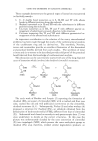
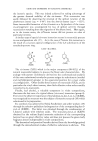
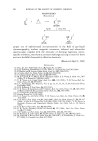
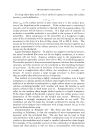
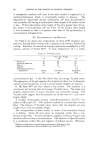
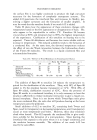
ODOR AND ISOMERISM IN OLFACTIVE CHEMICALS 267 the isomeric species. This was indeed achieved by taking advantage of the greater thermal stability of the cis-isomer. This conversion was easily followed by observing the reversal of the optical rotation of the dextro-trans isomer (aD = +44 ø) into the levo-cis-isomer (aD = --133ø). Some irreversible formation of the fi-isomer as a by-product of the trans- cis-arrangement was accompanied by loss of optical activity through racemization resulting from the migration of the alkene bond. Here again, as in the ionone series, the •-Nerone isomer did not possess an odor of particular interest. A similar type of spatial cis-trans isomerism occurs in rosenoxide present in rose and geranium oils (17). As in the case of Nerone this isomerism is the result of a cis-trans spatial configuration of the 2,4 substituents of the tetrahydropyrane ring. LEAF ALCOHOL "C5 cm trans (XXI) (xix) (xx) The cis-isomer (XIX) which is the major component (80-85%) of the natural rosenoxide happens to possess the finest odor characteristics. By analogy with parent cyclohexane derivatives the conformational analysis of this meta substituted tetrahydro pyrane assigns its substituents (methyl and methylpropenyl groups) to the equatorial position for a most stable cis-configuration. Other double-bond isomers of rosenoxide (XXI), and in particular the vinyl ether isomers, show little olfactive value unless readily converted to cis-rosenoxide. Finally, leaf alcohol, a valuable component in violet compositions, illustrates the last case of a typical alkene (cis-trans) isomerism (group 4). Ever since the olfactive importance of leaf alcohol, cis-hex-3-en-l-ol (XXII), was recognized its structure was the subject of intensive research (18) which culminated in its preparation. Its synthesis was achieved by Stohl, Sondheimer and other workers (19) through the selective palladium hydrogenation of the corresponding hex-3-. yn-l-ol (XXIII). The latter was obtained through the condensation of 1-butyne sodium with ethylene oxide. The trans-hex-3-en-l-ol (XXI¾) obtained by the sodium/liquid ammonia reduction of the corresponding hexynol has no great olfactive value and does not possess the green leafy fragrance almost indispensable in violet compositions. The theoretical and practical benefits derived from the knowledge gained through the stereochemical studies of olfactive substances is obvious. The
Purchased for the exclusive use of nofirst nolast (unknown)
From: SCC Media Library & Resource Center (library.scconline.org)