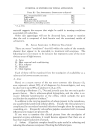
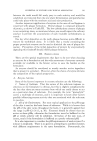
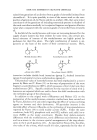
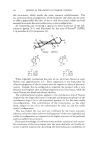
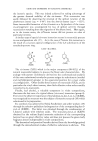
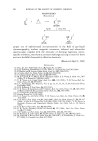
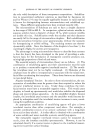
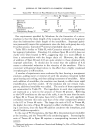
268 JOURNAL OF THE SOCIETY OF COSMETIC CHEMISTS O I 4- /\ Na ROSENOXIDES Hex-3-en-l-ol , [l• c)H (xxttt) H•/Pd [ Naliq. NH• cis trans (XXII) (XXIV) proper use of sophisticated instrumentation in the field of gasAiquid chromatography, nuclear magnetic resonance, infrared and ultraviolet spectroscopy, coupled with the necessity of devising ingeneous stereo- specific syntheses, constitute a constant challenge exciting to meet for those active in the field of research in o]factive chemicals. (Received April 5, 1963) REFEKENCES (1) Proc. Sci. Sect. Toilet Goods Atssoc., 36, Suppl. No. 37 (1962). (2) E.H. Eschinasi, GivaudanJan, p. 3 (Oct. 1959) U.S. Patent No. 3,007,961 (1961). (3) P. Barbier and R. Loquin, Cornpt. Rend. Atcad. Sci., 157, 1114 (1913). (4) A. Verley, Bull. Soc. CAirn. France (4),45, 845, 854 (1928). (5) V. Grignard andJ. Doeuvre, Ibid. (4) 45, 809 (1929). (6) M. F. Carroll, R. G. Mason, H. W. Thompson and R. C. S. Wood, y. Chern. Soc., 3457 (1950) U.S. Patent No. 2,902,495 (1959). (7) Y. R. Naves et al., Cornpt. Rend. Atcad. Sci., 200, 1112 (1935) Y. R. Naves, Bull. Soc. Chirn. France (5), 18, 505 (1951). (8) J. L. Simmonsen, The Terpenes, Vol. I, pp. 35, 37, 73, 74, 75, 80, University Press, Cambridge (1947). (9) E.H. Eschinasi, 5 t. Org. Chem., 26, 3072 (1961). (10) Y. R. Naves, D. Lamparsky and P. Ochsner, Bull. Soc. Chim. Prance (5), 28, 645 (1961) A. Melera and Y. R. Naves, Cornpt. Rend. ztcad. Sci,, 252, 1937 (1961). (11) U.S. Patent No. 2,957,027 (1960). (12) German Patent No. 75,120 (1893). (13) U.S. Patent No. 2,517,576 (1950) Y. R. Naves et al., Bull. Soc. Chim. France (5), 20, 873 (1953). (14) Y. R. Naves, Heir Chirn. ztcta, $1, 1103 (1948) Bull. Soc. Chirn. France (5), 21,321,667 (1954) cf. also U.S. Patent Nos. 2,517,800 (1950), 2,517,576 (1950) Y. R. Naves in Molecular Structure and Organoleptic •uality Symp., Soc. Chern. Ind., p. 38, Geneva (1957). (15) Y.R. Naves, Heir. Chim. Atcta, 32, 969 (1949). (16) Y. R. Naves, Perfumery Essent. Oil Record, 40, 197 (1949) Bull. Soc. Chim. France (5), 25, 377 (1958). (17) C.F. Seidel et al., Helv. Chim. Atcta, 42, 1830 (1959) Ibid., 44, 598 (1961). (18) H. Walbaum, 5 t. prakt. Chem., 96, I I, 245 (1917) S. Takei et al., Ber., 68, 953 (1935). (19) M. Stohl and A. Rouve, Helv. Chim. •icta, 21, 1542 (1937) F. Sondheirner, 5 t Chern. Soc., 877 (1950) L. Crombieetal.,Ibid., 873 (1950).

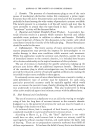
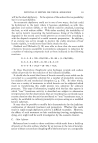
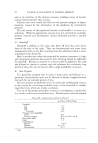
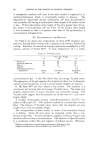
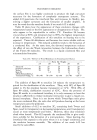
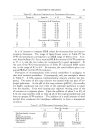
CHEMICAL STRUCTURE AND ANTIMICROBIAL ACTIVITY OF BIS-PHENOLS. III. BROAD SPECTRUM EVALUATION OF HEXACHLOROPHENE AND ITS ISOMERS BY WILLIAM S. GUMP, Pu.D., and Gsov,•s R. WALTER, P•.D.* Symmetrical methylenebis-(trichlorophenol) isomers being either 2,2'-, 3,3'- or 4,4'- with regard to the methylene bridge were investigated for their antimicrobial activity against a broad spectrum of bacteria, molds and yeasts. There are 10 possible isomers, including hexachlorophene two of them• 2,2'-methylenebis(3,5,6-trichloro- phenol) and 4,4'-methylenebis(3,5,6-trlchlorophenol), whose preparation would have been very difficult, had been omitted from the study. Maximum activity against bacteria was shown by the 2,2'-methylenebis-phenols 2,2'-methylenebis(3,4,5- u ichlorophenol) was found to be generally more potent than hexachlorophene and the other 2,2'-isomer. Great variations between the 3,3'-isomers were noted the 4,4'-isomer was definitely the least active of the compounds tested. Against the dermatophytes, the activity of the isomers was found to be of the same magnitude. None of the bis-phenols was active against C. albicans or P. ova/e at a concentration of 100 •g./ml. A previous investigation pertained to the bacteriostatic and fungi- static properties of a number of bis-phenols and a discussion of the relation- ship between chemical structure and antimicrobial activity (1). This work was then extended to an evaluation of the bactericidal properties of a se- lected group of the same bis-phenols in the presence of a synthetic anionic surfactant (2). Initially, 65 compounds were investigated for activity against three micro6rganisms. It would seem to be of interest, from the viewpoint of structural specificity and biological activity, to evaluate the closely related methyleneNs (trichlorophenol) isomers against a broader spectrum. •I'here are ten possible symmetrical configurations of the methylenebis- (trichlorophenols) being either 2,2'-, 3,3'- or 4,4'- with regard to the methylene linkage. Two isomers, 2,2'-methylenebis(3,$,6-trichlorophenol) and 4,4'-methylenebis(3,$,6-trichlorophenol), have been omitted because of the complicated preparation of the starting material, 2,3,5-trichloro- phenol (3, 5). Furthermore, condensation of 2,3,5-trichlorophenol with * Sindar Corporation, Delawanna, N.J. 269
Purchased for the exclusive use of nofirst nolast (unknown)
From: SCC Media Library & Resource Center (library.scconline.org)