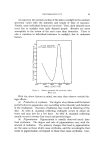
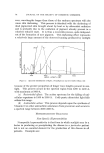
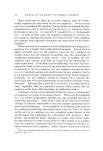
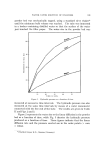
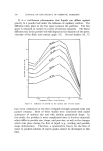
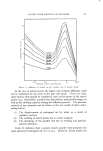
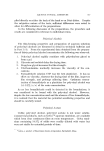
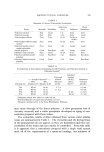
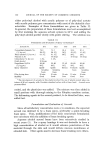
WATER VAPOR SORPTION OF STARCHES 109 powder bed was mechanically tapped, using a standard sieve shaker* until the minimum bulk volume was reached. The tube was immersed in a beaker containing distilled water so that the surface of the water just touched the filter paper. The water rise in the powder bed was • 60 // ' /- i i i i 15 30 45 60 75 TIME IN MIN. Figure 3. Hydraulic pressure as a function of time measured at successive time intervals. The hydraulic pressure was also measured at the same time intervals by means of a water manometer connected with the free end of the tube. The results are given in Table II and Figs. 2 and 3. Figure 2 represents the water rise or the linear diffusion in the powder bed as a function of time, while Fig. 3 denotes the hydraulic pressure produced as a function of time. These figures indicate that the linear diffusion rate and the pressure exerted are in the order potato corn wheat. * Friedrich Greyer K.G., Ilmenau (Germany).

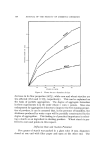
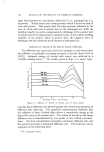
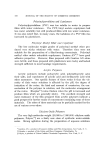
110 JOURNAL OF THE SOCIETY OF COSMETIC CHEMISTS It is a well-known phenomenon that liquids can diffuse against gravity in a powder bed under the influence of capillary suction. The diffusion takes place in the free space between the particles. The free space is assumed to consist of a series of tortuous channels. The linear diffusion rate in the powder bed will depend on the diameter of the pores, viscosity of the fluid, and contact angle (15). Several studies (16, 17) Figure 4. 0.01 0.1 1 10 100% AER. OSIL CONC. (LOG SCALE). Influence of Aerosil on the suction rate of corn starch have been conducted on the flow of liquids through granular beds and packed columns. Most of these studies were concerned with model substances of uniform size and with definite geometrical shape. In this study, the problem is more complicated since it involves materials which differ in particle size, shape, and pore size, as well as the changes which take place during the flow of liquid (e.g., swelling and possible shape deformation). Therefore, a quantitative theory for the flow of water in packed columns of starch grains cannot be developed at this time.
Purchased for the exclusive use of nofirst nolast (unknown)
From: SCC Media Library & Resource Center (library.scconline.org)