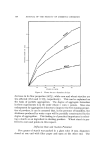
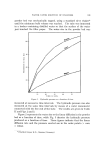
WATER VAPOR SORPTION OF STARCHES 113 The addition of small amounts of Aerosil produces rearrangement and new orientation of the starch grains. The very fine Aerosil particles separate the starch grains from one another, and this results in relatively wide voids. Since the size of the voids is partially responsible for the suction potential, the smaller the void the higher the suction potential. Therefore, the suction will be suppressed, and the first critical concen- tration will correspond to the amount of Aerosil producing the smallest suction potential for the packed column. The addition of more Aerosil starts to fill the voids between the particles in the powder bed. The effective pore size gradually di- minishes, favoring an increase in suction potential. The maximum rate of linear flow is obtained at the second critical concentration where the minimum pore size is reached. Further addition of Aerosil above the second critical value produces an expansion in the powder bed. The system is then assumed to consist of a matrix of Aerosil in which the starch grains are dispersed. The effective pore size increases greatly with the expansion in the powder bed. Thus suction potential and rate of linear diffusion will be seriously affected. On the basis of these basic experiments it is possible to modify the water permeability and capillary suction in a powder bed by appropriate addition of Aerosil. This finding is of practical importance in tablet disintegration since the suction potential and rate of permeability, coupled with the swelling capacity, are the main factors responsible for the disintegration time. The proper choice of a starch with suitable swelling capacity and the correct content of Aerosil in tablet formula- tions might explain the short disintegration time obtained with such tablets. REFERENCES (1) Neumann, B. S., Flow ]•roperties of Disperse Systems, Ed. Herroans, J. J., North-Holland Publishing Co., Amsterdam (1953). (2) Gregg, S. J., and Behrens, A. J., J. Appl. Chem. (London), 1, 139 (1951). (3) Whistler, R. L., Methods in Carbohydrate Chemistry, Vol. III, Academic Press, Inc,, London, 1963, p. 120. (4) Craik, D. J., and Miller, B. F., J. Pharm. ]•harmacol., 10, 136 (1958). (5) Millet, J., and Parisot, J., ]•roc. U. N. Intern. Conf. ]•eaceful Uses At. Energy, 2nd. Geneva, after CM. 56, 68596 (1962). (6) Ulmann, M., Ern•hrungs-forschung, 1, 96 (1956). (7) Dumon,,•kii, A. V., and Nekrgach, E. F., after C.A. 56, 9636 (1962). (8) Czetsch Lindenwald, H. V., E1-Khawas, F., and Tawashi, R., J. Soc. Cosmetic Chemists, 16, 251 (1965). (9) Tawashi, R., Pharm. Ind., 25, 655 (1963).

114 JOURNAL OF THE SOCIETY OF COSMETIC CHEMISTS (lO) (11) (12) (13) (14) (15) (16) (17) Train, D. J., Y. Pharm. Pharmacol., 10, 127T (1958). Grosby, E. J., Am. Perfurner, 75 (Sept.), 43 (1960). Tawashi, R., Pharm. Ind., 25, 64 (1963). Tawashi, R., Diss., Basel, 1960. Gregg, S. J., The Surface Chemistry of Solids, 2nd Ed., Chapman and Hall Ltd., London, 1961. Coulson, J. M., and Richardson, J. F., Chemical Engineering, Vol. II, Pergamon Press, London, 1962, p. 854. Roemer, G., Dranoif, J. S., and Smith, J. M., Ind. Eng. Chem., Fundamentals, 1, 284 (1962). Krasuk, J. H., and Smith, J. M., Ibid., 4, 102 (1965).
Purchased for the exclusive use of nofirst nolast (unknown)
From: SCC Media Library & Resource Center (library.scconline.org)