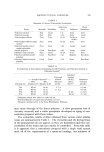
GUINEA PIG ASSAY OF PHOTOSENSITIZING POTENTIAL 127 0 = no erythema 2 = red erythema 1 = pink erythema 3 = erythema and trauma No erythema is evident in the first stage except for strong photosensi- tizers when erythema may appear after the third application. 2nd Stage After a rest period of 7-10 days, during which time the treated skin is restored to normal appearance, one or two challenge applications of 0.05 mi. of a 0.1% solution of the test agent in olive oil is applied. Ultraviolet irradiation is administered for 15 minutes, and on the fol- lowing day skin readings are taken. A relatively strong photosensitizer will give readings of 2 and 3. If the erythema is marginal, it is desirable to repeat the challenge with the test agent in the vehicle for which it is intended, such as soap. $rd Stage (Optional) Guinea pigs photosensitized to a test agent are shaven in the flank areas and treated with 0.1-0.2% of the test agent in an 8% soap solution once daily for a total of three applications. The solutions are applied by means of gauze patches (6 ply) kept in contact with the skin for 1 hour. The guinea pigs are immobilized on a board by means of tape. Ultraviolet irradiation for 15 minutes follows each application. Skin readings are taken 24 hours after each treatment. Erythema develop- ment indicates photosensitization. A control soap solution without the test agent is applied on the opposite flank. When slight erythema de- velops on the control side, the test side must show a more intense erythema to establish photosensitization. RESULTS Photosensitization data are given in Table I in a typical experiment in which the photosensitizing action of TCSA is compared with that shown by several other halogenated salicylanilides. Of particular in- terest is the negative response obtained for 3,4',5-tribromosalicylanilide (TBS).* This agent has been widely used in soaps and detergents for more than eight years. The chlorinated salicylanilides cause more photo- sensitizing reaction than the brominated analogs. In a study of the cross photosensitizing potential of germicides, TCSA-photosensitized guinea pigs, after a suitable period to allow the * Tcmi•sept II, manufactured b 7 Fine Or•ganics! Lodi• N, J,

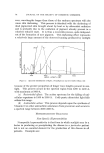
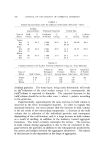
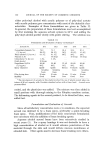
128 JOURNAL OF THE SOCIETY OF COSMETIC CHEMISTS skin to return to normal appearance, were shaven again in the neck region and treated with 0.05 ml. of 0.1% test agent in olive oil, followed by u.v.-irradiation, as described previously. The next day, skin readings were taken. Cross photosensitization data are given in Table II for TABLE I Relative Photosensitizing Effects of TCSA and Other Halogenated Salicylanides (Guinea Pig Skin Readings) • Substituents on Salicylanilide Ring 2% in Absolute Alcohol, 0.2% in 0.5% in 8% Soap 1st Stage Olive Oil Solution Re-challenge (days) Challenge (days) 1 2 3 4 5 1 2 1 2 3 3,3'4',5-Tetrachloro 0 0 0 2 2 2 3 1 2 2-3 3 ',4•,5-Trichloro 0 0 0 1 1 2 2 1 2 2-3 3',4'-Diehloro-5-bromo 0 0 0 0 sl. 1 1 0-sl. sl. 1 3,5-Dibromo-3',4'-diehlor 0 0 0 0 sl. 0 0 0-sl. 1 1-2 3,4',5-Tribromo-3 '-methyl 0 0 0 0 0 0 sl. 0-sl. sl.-1 1-2 3,4',5-Tribromo 0 0 0 0 0 0 sl. 0 0 0 Skin readings: 0 = no erythema, sl. = patchy pink, 1 = pink erythema, 2 = red ery- thema, and 3 = erythema and trauma. TABLE II Sensitizing and Photosensitizing Potential of Topical Germicides Skin Response Photosensitizing Potential Sensitizing Potential Guinea Pigs with Guinea Pigs (Landsteiner- No History of Photosensitized Jacobs Test) Photosensitization to TCSA ',4',5-Tetraehlorosalieylanilide (TCSA) Negative Strong positive ... 8,4',5-Tribromosalicylanilide (TBS) Negative Negative Negative Bithionol Negative Positive Positive Trichlorocarbanilide (TCC) Negative Negative Negative Hexachlorophene (G-11) Negative Negative* Weak positive * Erythema develops in both stages, indicating phototoxic effect, not photosensitization. hexachlorophene, bithionol, TCC, and TBS. Also presented in the way of comparison are data on sensitization potential (Landsteiner-Jacobs procedure) and photosensitization. It can be observed that bithionol and, to a lesser degree, hexachlorophene showed some cross photosensi- tizing action when studied on TCSA-sensitized guinea pigs. TBS and TCC were without effect in this cross photosensitization study.
Purchased for the exclusive use of nofirst nolast (unknown)
From: SCC Media Library & Resource Center (library.scconline.org)