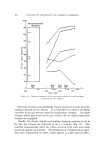
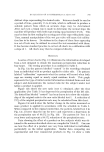
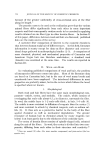
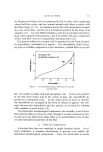
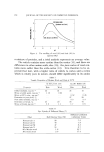
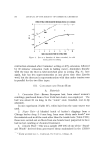
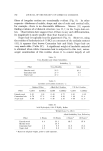
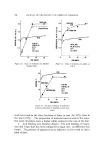
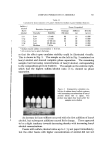
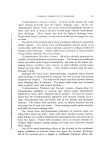
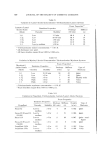
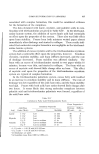
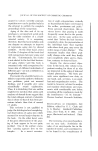
774 JOURNAL OF THE SOCIETY OF COSMETIC CHEMISTS broadly that hair is somewhat stiffer, stronger, and more extensible than wool, both in air and wet. Typical data are given in Table I. The lower elastic modulus of wool indicated by such extensometric data is due partly to the perturbing effect of fiber crimp a greater rate of stress relaxation, made possible by the lower degree of crosslinking, may also play a part. The dynamic moduli of hair and Lincoln wool, as determined by sonic measurement, are closely similar (26). Another mechanical parameter exhibiting a difference between wool and hair is the post-yield turnover point. When wool fibers are ex- tended in water at different temperatures, the location of this point on the strain axis (Fig. 3) is constant up to a characteristic temperature and then shifts to higher strains this effect has been ascribed to a second- order transition in the keratin (27). As shown in Table I, the extension at which the post-yield slope begins is similar for wool and hair at room temperature. However, the transition temperature is 72 øC for B. A. fleece wool (1), 70øC for Merino wool, and 85øC for hair examined under the same conditions (28). It appears that a higher temperature Table III Fiber Mechanical Properties in pH 9.2 Buffer--Effect of Acid (34) Fiber Human Hair 64's Wool Acid- Acid- Property Intact Treated* Intact Treated* Stress at 20% extension, mg cm -2 0.49 0.23 0.44 Stress at break, mg cm-2 1.28 0.46 1.18 Energy to break, gem -2 X 10⁻⁴t 30 11 30 Extension to break, % 58 51 51 0.13 0.19 4 30 * 0.04 N H2SO4, 16 hours at the boil. I Per unit volume. Table IV Acid Hydrolysis: 0.5 g Fiber in 25 ml Solution, 105øC, 18 Hours Residue Weight, % Fiber 6 N HC1 6 N H2SO• Lincoln wool 0.06 0.06 Caucasian hair Brown 2.5 2.2 White 1.0 0.7 Negro hair 2.7 2.3

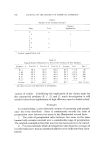
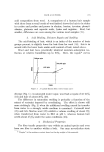
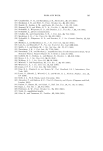
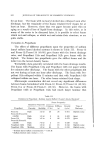
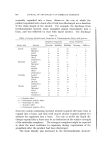
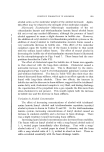
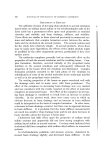
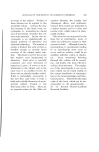
HAIR AND WOOL 775 is required in hair before disulfide-sulfhydryI interchange reaches sufficient proportions to have a significant effect on the mobility of the protein chains. 5. Diffusion of Reagents Human hair fibers have a larger diameter than most wools con- sequently, the penetration of a reagent to the core of the fiber would take longer even if its diffusion through the keratin substance were the same. In fact, for most large molecules, such as dyes, the diffusion is slower in hair. Data derived from measurement of uptake of a_n add dyestuff at 60 øC by several fibers are shown in Table II (7). The half-dyeing time, which is affected by both the fiber diameter and the diffusion coefficient, is 25 times longer for hair than for wool. Table V Axnino Acid Contents (Micromoles/g} Type of Side Chain and Amino Acid Lincoln Wool Caucasian Hair Negro Hair .4 liphatic 2830 2350 2470 Glycine 590 589 541 Alaninc 601 471 ,509 Valine 570 538 568 Leucine 740 554 670 Isoleucine 883 250 277 Aliphatic Hydroxyl 1020 I520 1290 Serine 541 870 672 Threonine 483 653 615 A romatic 540 260 380 Tyrosine 266 I32 202 Phenylalanine 273 130 179 .4 cidic 1400 1330 1350 Aspartic Acid 575 455 436 Glutamic Acid 828 871 915 Basic 1040 790 $00 Lysine 310 213 231 Arginine 662 512 482 Histidinc 71 63 84 ,¾ulf ur Containing 750 I440 J 384t Half-Cystine 745 1380 1370 Cysteic Acid 6 55 10 Methionine 0 0 0 Heterocyclic Proline 490 672 662 A mmonia .l 030 780 985
Purchased for the exclusive use of nofirst nolast (unknown)
From: SCC Media Library & Resource Center (library.scconline.org)