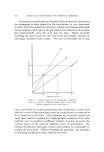
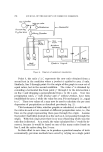
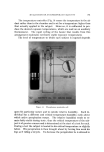
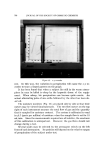
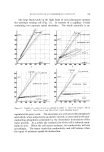
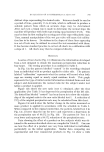
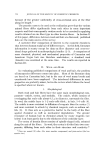
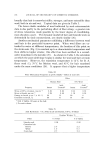
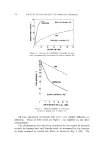
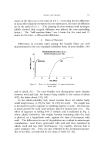
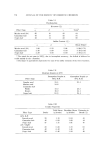
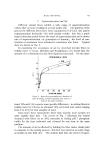
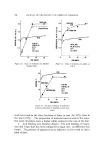
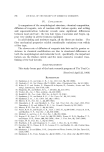
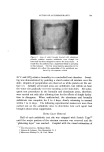
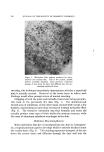
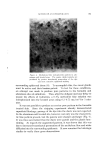
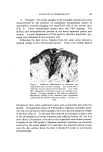
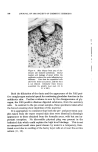
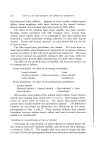
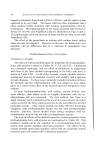
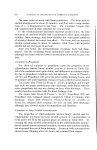
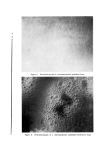
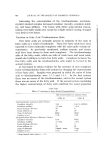
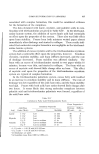
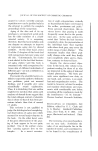
776 JOURNAL OF THE SOCIETY OF COSMETIC CHEMISTS 4• i i i i • LINCOLN WOOL Menkart and Speakman, 1947 • 30 • • HAIR • 10 • O.IM Hg[OAc]•in O.IN HOAC, 22•C • I I I 0 20 40 60 80 100 120 TREATMEHT TIME, HOURS lOO 2o HAIR MERINO•••, Dusenbury and Menkart, 1955 4 • 12 1• 2'0 24 TIME IN BOLLING O-04N H2 SOd, HOURS Figure ,5. Alkali insolubility as a function of time in boiling 0.04 W H•$O4 (10) All four specimens of human hair have very similar diffusion co- efficients. Those of both wools are higher: one slightly so, the other substantially. The phenomenon has also been examined for the action of mercuric acetate on human hair and Lincoln wool, as measured by the increase in work required to stretch the fibers as shown in Fig. 4 (29). The

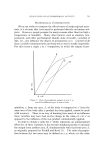
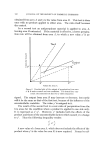
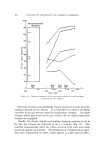
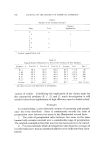
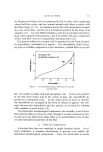
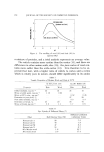
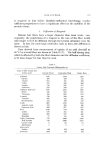
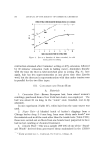
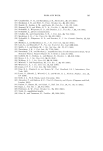
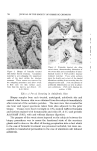
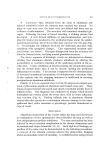
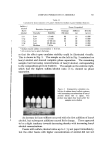
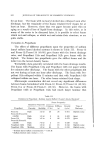
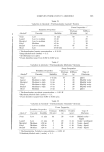
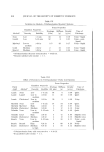
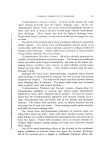
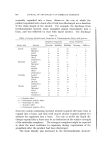
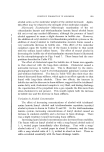
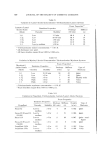
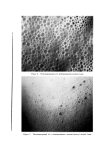
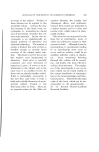
HAIR AND WOOL 777 slopes of the lines are in the ratio of 3.9:1 correcting for the difference in mean fiber diameter between the two substances, the rates of diffusion are in the ratio of 2.2:1. (The staining of cross-sections with hydrogen sulfide showed that reagent diffusion was indeed the rate-controlling factor.) The "half-reaction times" are 5 hours for the wool and 75 hours for the hair--a fifteen-fold difference. 6. Rates of Reaction Differences in reaction rates among the keratin fibers are well demonstrated in the two standard solubility tests, in urea-bisulfite (30) • 20 gig lad ,-- 10 F4gure 6. SUPERCONTRACTION FORCE IN 9M LiCI AT 97øC [Rebenfeld, Weigmann, Dansizer, 1963] RINO WOOL / HAIR / / / / / / 10 20 30 40 50 TIME. MINUTES Rate of development of supercontraction stress (24) and in alkali (31). The urea-bisulfite test distinguishes quite sharply between wool and hair, the former being soluble to the extent of about 50%, the latter about 15% (32). In the alkali-solubility test, intact keratin fibers all exhibit fairly small weight losses (4-6r•o for hair, 10-12% for wool). The weight loss is increased by prior exposure to oxidizing agents or acids this increase is much greater for wool (and mohair) than for human hair (10). The effect of exposure to boiling 0.04 N sulfuric acid is indicated in Fig. 5, where alkali insolubility (the weight fraction remaining after the test) is plotted, on a logarithmic scale, against the time of treatment with acid. The differences in ease of degradation are evident in microscopic examination: wool fibers, pretreated with acid and then examined in alkali, swell and lose their birefringence very rapidly, whereas hair is quite resistant (13). They are also reflected in the mechanical proper- ties of the fiber, as indicated by the data of Table III (33).
Purchased for the exclusive use of nofirst nolast (unknown)
From: SCC Media Library & Resource Center (library.scconline.org)