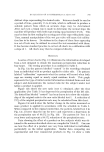
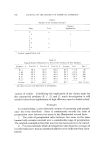
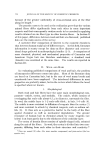
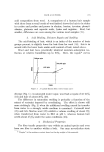
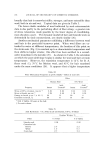
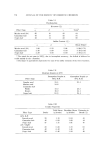
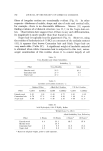
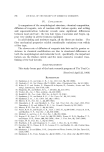
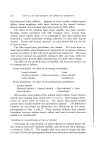
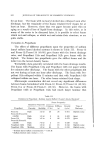
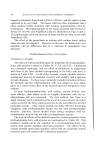
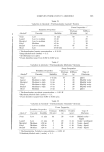
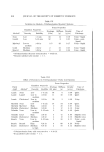
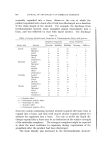
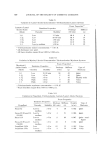
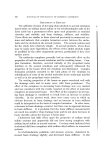
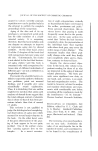
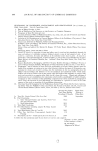
778 JOURNAL OF THE SOCIETY OF COSMETIC CHEMISTS Table Fractionation Keratose (%) Fiber Type a • T Total* Merino wool (34) 56 10 25 91 Caucasian hair 43 15 33 91 Negro hair 43 14 33 90 Sulfur Content (%) a • -/ Whole Fiber Merino wool (34) 1.88 2.13 5.84 3.38 (2.72) Caucasian hair 2.56 3.69 6.04 5.45 (3.65) Negro hair 2.38 4.00 6.60 5.40 (3.77) * The totals do not sum to 100%, due to incomplete recovery the deficit is believed to reside mainly in the -/-fraction. } The figure in parentheses represents the sum of the sulfur contents of the three fractions. Table VII Moisture Regain at 22øC Desorption Regain at Absorption Regain at Fiber Type 65% R.H. 87% R.H. Lincoln wool 15.4 23.4 Merino wool 14.8 . . . Caucasian hair White 15.2 23.3 Brown 16.2 24.1 Negro hair 16.0 24.4 Table VIII Tensile Properties Yield Stress Breaking Stress Extension to Fiber Type Denier (g/denier) (g/denier) Break (%) 65% R.H. Lincoln wool 20 1.10 Caucasian hair 46 0.93 Negro hair 37 1.11 pH 7 Buffer Lincoln wool 20 0.35 Caucasian hair 42 0.42 Negro hair 38 0.46 2.04 1.68 1 81 1.70 1.41 1.24 43 44 4O 65 47 48

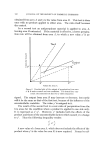
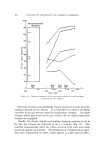
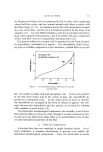
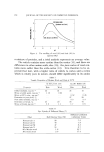
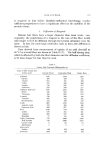
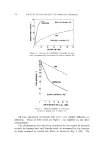
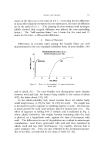
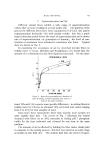
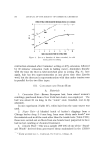
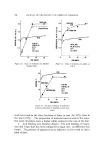
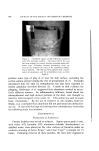
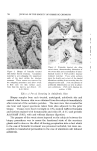
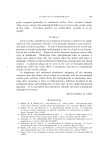
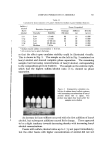
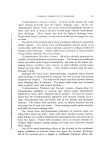
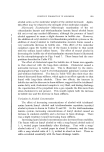
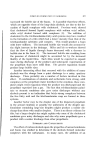
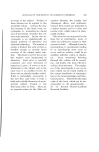
HAIR AND WOOL 779 7. Supercontraction and Set Different animal fibers exhibit a wide range of supercontraction values after an hour's boiling in several media (35). The kinetics of the process for different fibers have been examined in 9 M LiC1 (24) and in cuprammonium hydroxide (36) with similar results: hair has a much longer initiation period before the onset of supercontraction and a slower rate of supercontraction (or generation of tension) the level of con- traction or maximum force attained is sometimes also lower. Typical data are shown in Fig. 6. In examining the acceptance of set by stretched keratin fibers in boiling water or borax, Mitchell and Feughelman (37) found that the amount of set diminished as the fiber diameter increased. On the other SETTING IN BOLLING pH 7 BGFFER I • WOOL / • 0 / L•" , , , , , -10 -20 I II•k/* I I i 0 60 120 180 240 300 380 SETTING TIME, MINUTES Figure 7. Rate o[ set generation as a [unction o[ time of setting, at 40% extension (one hour's re- lease in the same medium) hand, Whewell (38) reports some specific differences: in setting fibers in boiling water for 2 hours, he obtained 12•o set in hair and values ranging from 6 to 21• for four samples of wool. Data from these laboratories show that Lincoln wool accepts set more rapidly than hair. The curves of Fig. 7 illustrate the results obtained with fibers set at AO• extension in boiling pH 7 phosphate buffer for the time indicated and released for one hour in the same medium. The amount of set is affected by holding the fiber under strain prior to exposure to the setting process this fact was noted at an early stage of studies in this field (27). The authors find that the extent of super-
Purchased for the exclusive use of nofirst nolast (unknown)
From: SCC Media Library & Resource Center (library.scconline.org)