8O2 JOURNAL OF THE SOCIETY OF COSMETIC CHEMISTS the two compounds and the association between the hydrophobic por- tions of the molecules which resulted from the Van der Waal's forces of attraction. The strength of the complexes was found to be dependent upon the stereochemical configurations of the two interacting molecules (2). Sodium cetyl sulfate and cholesterol, cetyl alcohol, or elaidyl alcohol formed strong complexes. However, sodium cetyl sulfate and oleyl alcohol formed weak complexes because the cis-configuration of oleyl alcohol prevented a close association between the two molecules. The effects of the complexes at oil/water interfaces in emulsion sys- tems were found by Schulman and Cockbain (3) to be similar to those observed previously at air/water interfaces. Sodium cetyl sulfate alone or with oleyl alcohol gave poor emulsions of mineral oil in water, while combinations of sodium cetyl sulfate with cetyl alcohol or cholesterol gave good emulsions. Studies of molecular complexes have also been carried out in con- nection with an investigation of the drainage rates of liquids through foams and the drainage properties of films from aqueous solutions. Miles et al. (4, 5) observed that the drainage rates of liquids through sodium lauryl sulfate foams were markedly decreased by the presence of lauryl alcohol. It was also noted that aqueous solutions containing combinations of sodium alkyl sulfates and cetyl alcohol gave slow drain- ing films, while those with sodium alkyl sulfates alone or with oleyl alcohol gave fast draining films. The slow draining property of the foams and films was attributed to a high surface viscosity which resulted from complex formation between the alkyl sulfates and alcohols. When the temperature of the slow draining films was increased, the film ultimately became fast draining at a specific temperature, called the film drainage transition temperature. The transition from slow to fast draining of the foams and films oc- curred at a temperature at which the molecules in the complex had sufficient thermal energy to overcome the bonding energies (6). Similar experiments were carried out on nonionic ethoxylated lauryl alcohols with lauryl or cetyl alcohol by Beeher and Del Vecchio (7). These com- binations also were found to give slow draining fihns. The compositions of a number of molecular complexes have been determined. Epstein et rd. (8) reported crystalline intermolecular products in which the sodium alkyl-sulfates and long-chain alcohols were combined in a tool ratio of 2:1. Kung and Goddard (9, 10) have also investigated the composition of complexes. Lithium, potassium, am- monium, and magnesium lauryl sulfates formed complexes in which the

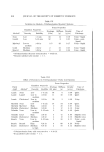
COMPLEX FORMATION IN AEROSOLS 803 sulfate/alcohol ratio was 1:1, while calcium and tetramethyl ammonium salts did not form complexes. Complexes between stearie acid and sodium stearate with mol ratios of acid to salt of 1:1, 3:2, and 2:1, respectively, were reported by Ryer (11), while other acid/soap com- plexes with ratios of 1:2 were found by John and MeBain (12). The investigation of molecular complexes in aerosol emulsions and foams appeared to be a promising field of study from both a fundamental and practical aspect. Aerosol systems offered a unique opportunity to study complex formation in both an emulsion system and a foam derived from the same emulsion system. Aerosol emulsions consist of disper- sions of liquefied propellants in an aqueous phase. When these products are discharged, the liquefied propellants vaporize and produce a foam. From a practical point of view, the use of emulsion systems for formu- lating aerosol products is now well established, and the number of aerosol products formulated as emulsion systems is increasing each year. Aero- sol foams are particularly useful for cosmetic and pharmaceutical appli- cations. These applications vary widely, and so do the properties desired for the aerosol products. Some basic information on aerosol emulsions and foams is already available (13-22), but the present knowledge is relatively small compared to what remains to be learned about these systems. If molecular complexes formed in aerosol emul- sions and foams, this could provide an additional method for varying the properties of the systems. This in turn could lead to new and more effective applications for aerosol products. }•XPERIMENTAL Complex formation was judged by the effect of the alcohols on the properties of the aerosol emulsions and foams. determined were as follows: 1. Emulsion viscosity ,5. 2. Emulsion stability 6. 3. Foam stiffness 7. 4. Foam drainage The properties that were Foam stability Foam density Type of discharge All of the properties, except foam stability, are summarized in tables. As a result of the difficulty of attempting to assign a numerical value to foam stability, the foam stability properties of the systems are discussed in the body of the report and are not present in the tables. The reasons for selecting the preceding properties and the methods used to determine them were as follows:
Purchased for the exclusive use of nofirst nolast (unknown)
From: SCC Media Library & Resource Center (library.scconline.org)