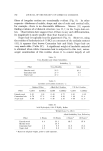
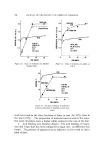
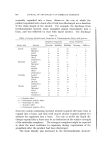
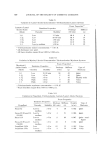
826 JOURNAL OF THE SOCIETY OF COSMETIC CHEMISTS DISCUSSION OF RESULTS The addition of many of the long-chain alcohols to aerosol emulsions based either on sodium lauryl sulfate or the triethanolamine salts of the fatty acids has a pronounced effect upon such properties as emulsion viscosity and stability and foam drainage, stiffness, and stability. These effects are similar to those observed previously in nonaerosol sys- tems and indicate that complex formation occurs between the surfac- rants and the alcohols in the aerosol systems. The aerosol systems used for the study were relatively simple. In aerosol products, where there may be many more ingredients, the effects of the added alcohols might be modified by the other components present, particularly if they were surface active. The molecular complexes generally had an observable effect on the properties of both the aerosol emulsions and the resulting foams. Com- plex formation, therefore, occurred initially at the propellant/water interface in the aerosol emulsions and subsequently influenced the properties of the foams when the emulsion was discharged. Complex formation probably occurred in the bulk phase of the emulsion by solubilization of some of the alcohol molecules in the surfactant micelles as well as at the propellant/water interface. The wetting properties of the foams on paper correlated well with the drainage rates and, in many cases, with foam persistence. The effect of the complexes in decreasing foam drainage was very marked and was consistent with the results reported on the effect of molecular complexes in nonaerosol foams. The effect of the complexes in decreas- ing foam drainage is considered to result from an increase in surface viscosity. In the present work, there were many cases in which an obvious decrease in foam drainage and an increase in foam stiffness could be interpreted on the basis of complex formation. In other cases, a decrease in foam drainage occurred, but there was no apparent increase in foam stiffness. It is probable that the foam stiffness measurements are much less sensitive than drainage tests and do not show increases in foam viscosity unless the increase is fairly large. Cholesterol had little effect upon the properties of sodium lauryl sulfate systems and apparently did not form strong complexes with sodium lauryl sulfate in aerosol systems. Previous work indicated that cholesterol did form complexes with sodium alkyl sulfates in nonaerosol systems. In triethanolamine palmitate and stearate systems, cholesterol in- creased foam drainage slightly and decreased foam stiffness. It also

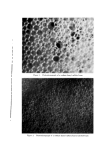
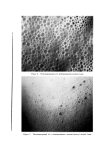
COMPLEX FORMATION IN AEROSOLS 827 increased the bubble size of the foams. It is possible that these effects, which are opposite those of the long-chain alcohols, are due to the for- mation of liquid complexes with cholesterol. Previous work showed that cholesterol formed liquid complexes with sodium cetyl sulfate, while cetyl alcohol formed solid complexes (3). The addition of cholesterol to the triethanolamine-fatty acid systems may have resulted in the formation of a film which had a lower viscosity than that of the triethanolamine salt-fatty acid complex. This would produce a foam with lower stiffness. The increased bubble size would also account for the slight increase in the drainage. Miles and his co-workers showed that the flow of liquids through foams decreased with a decrease in bubble size in the foam (4). The increased bubble size resulting from the presence of cholesterol might be accounted for by the increased fluidity of the liquid films. Such films would be expected to expand more during discharge of the product and subsequent vaporization of the propellant than more solid films. The greater expansion should produce large bubble sizes. Another interesting effect that occurred with the addition of many alcohols was the change from a quiet discharge to a noisy, spurtcry discharge. There probably are a number of factors involved in this effect. If combinations of alcohols and surfactants form strong, solid complexes at the propellant/water interface in the emulsion, these com- plexes might resist expansion when the product was discharged and the propellant vaporized into a gas. The fact that triethanolamine palmi- rate or stearate emulsions also gave noisy discharges without any alcohols present is an indication that fairly strong complexes between the free fatty acid and the triethanolamine soap are formed in these systems. Another factor may be the droplet size of the dispersed propellant in the aerosol emulsion or possibly the uniformity of the droplet size. Emulsions containing large-size droplets might produce a noisier dis- charge than those with smaller droplets. There is no direct evidence for this, but a larger droplet size might explain why some of the cholesterol emulsions gave noisy discharges and also why some propellants gave a product with a noisier discharge than other propellants. SUMMARY AND CONCLUSIONS The effect of various alcohols upon the properties of aerosol emulsions and foams was studied to determine if the alcohols formed molecular complexes with the surfactants. In many cases, the addition of an
Purchased for the exclusive use of nofirst nolast (unknown)
From: SCC Media Library & Resource Center (library.scconline.org)