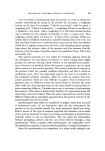
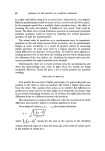
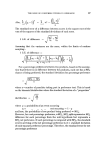
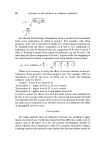
48 JOURNAL OF THE SOCIETY OF COSMETIC CHEMISTS •f5o% x 50% =2X n 100 In.a Round Robin design, information about a product can be obtained from every comparison in which it appears. For example, with three products, A, B, and C, the relative rating of C, when compared with B, can be obtained from the direct comparison of B and C, but additional in- formation can also be obtained from the comparison of B with A and of C with A. Working in terms of the ratios of preference, e.g. for B over C, the ratio from the direct comparison of B and C is given twice the weighting of the ratios from the indirect comparisons and the geometric mean is taken. e.g. best estimate of C - -- X • X • X •- 3 Where it is necessary to study the effect of several variables on the per- formances of one product a factorial design is best. For example, with two ingredients A and B, the levels of which can be varied, the following products could be tested. Control - A and B at a fixed level Test product 1 - higher level of A, B as in control Test product 2 - higher level of B, A as in control Test product 13 - higher level of A and higher level of B In order to assess the effects of A all four results can be used, similarly for B, (for A, the average of the scores for the control and test product 2 would be compared with the average of the scores for test products 2 and 13). Also, the data can be examined to see whether the level of A influences the effect of changing B and vice versa. CONCLUSIONS If t tables indicate that the difference between two products is signi- ficant at a level of say 1 in 20, this means that this difference could occur by chance once in 20 times. It is for the product development chemist to decide whether this is important to him. For a product intended to replace a leading brand on the market he may decide that the test product should be

THE ROLE OF CONSUMER STUDIES IN RESEARCH 49 superior to the standard product at a higher level of significance than this. For a preliminary examination of products a lower level of significance of difference might still be valuable. A great deal remains to be done in validating test methods for consumer studies. Since many panelists try to be helpful and state a preference even when they have none, some way of finding out how many "guessers" there are would be useful. One way of doing this is to repeat the test on the same panel. Different codes would be needed and care should be taken to see that these do not affect the test. Although, in a large panel the guessers should be equally divided in fayour of the two products, it is not known how large the panel must be for this to happen. Also, if there are a large number of guessers who should really be in the no preference/no difference category this can change the picture of the results. A large "no preference" with only a small percentage of the panel really having a preference, (significantly split in favour of one product) leads to different conclusions from a small "no preference" with the majority of the panel really having a preference (significantly split in fayour of one product). Since products are developed with a view to selling them to consumers, it is important to obtain consumers' views at a fairly early stage. Providing the limitations of these tests are kept in mind and reasonably simple objectives are aimed at, consumer studies are very valuable tools in guiding research. (Received: 22nd September 1966). REFERENCES (1) Horton, D. L. and Mecherikoff, M. J. Appl. Psychol. 44 259. (1960). (9.) Appel, V. and Hernandez, R. J. J..4ppl. Psychol. 40 263 (1969.). (3) Payne, S. L. The art of asking questions (1951) (Princetown University Press). Introduction by the lecturer Product tests for performance, involving consumers, are similar in some respects to product tests for safety, involving animals. In the latter the type of animals are specified, a comparison with a control product or interpretation in the light of previous experience is involved, and separate tests are mounted to examine for primary irritation, sensitisation, toxicity etc. Consumer studies to guide research should be specified in similarly precise terms. At the beginning of development, when ingredients are being screened, as objective an assessment as possible is required. This may involve the use of instrumental measurements or an expert panel of trained observers. Once prototype products have been developed, both objective and subjective assessments are useful, but great care is necessary in dealing with the words used because product properties are not the same thing as product attributes. The "final" (research) product that emerges can be
Purchased for the exclusive use of nofirst nolast (unknown)
From: SCC Media Library & Resource Center (library.scconline.org)