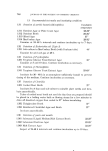
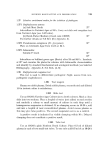
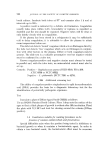
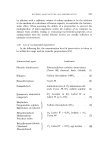
Appendix B This Appendix describes microbiological test procedures for use in product development and quality control, as well as giving detailed recommendations on preservatives. In order to produce a reasonably concise set of recommendations, it has been assumed that readers will have at least an elementary knowledge of microbiological laboratory technique. Whilst a fully-trained microbiologist should be thoroughly familiar with most of the contents of this and the following Appendices and may prefer various alternative procedures to those recommended here, the text has been prepared with a particular view to aiding the less experienced reader who is advised to follow the suggested techniques as closely as possible. 1. MICROBIOLOGICAL TEST PROCEDURES The information given below includes a selection of test media and conditions of incubation recommended for the isolation of microbial con- taminants commonly found in cosmetic products and raw materials or which would represent a serious hazard if they were present. The list of test media is not exhaustive nor is it suggested that the entire range of media needs to be used routinely. Inoculation of samples on or in the media designated as 1.311, 1.312, 1.314, 1.361 and 1.363 together with gram staining and study of the morphology of micro-organisms found, will provide basic information on the extent and type of microbial contamination affecting the preparation. References dealing with methods of identification are given in Appendix E. Samples showing growth in nutrient broth or by an agar streak method should be re-examined quantitatively. According to the present recommendations, bacterial counts are performed in duplicate in Oxoid Plate Count Agar. Cultures are incubated at 28-32 ø and 37 o and colonies counted after 48 h incubation. Mould counts are performed in malt extract agar or Sabouraud Dextrose Agar and incubated for five to seven days at 22-25 ø . Plates should be examined daily. New products, both at the formulation stage and with respect to the first large-scale batches, should be re-checked for micro-organisms after one month's storage at local ambient temperature. 1.1 Qualitative examination Methods of isolation and enumeration of micro-organisms usually require some form of special treatment of the samples to release into a fluid 743

744 JOURNAL OF THE SOCIETY OF COSMETIC CHEMISTS diluent or medium those organisms which may be embedded or trapped within the bulk of the material. Standardization of the preliminary pro- cedure is important. Excessive speed of the cutting blades of a blender or unduly prolonged use of a mixer may cause injury to the microbial cells either mechanically or by heat generated. Care must be taken to minimize risk from aerosols created by a mechanical blender when pathogens are present or suspected. 1.11 Preparation of sample for testing Mix the sample and transfer approximately 1 g or 1 ml to 9 ml of sterile Nutrient Broth to give an approximately 10% solution or suspension. Other dilutions may be prepared as necessary. The transfer and dilution technique must be carried out in such a manner as to avoid the introduction of extraneous contaminants. If the sample is not miscible with water, it should be dispersed with the aid of an emulsifying agent. Lubrol W, Tween 80 and Triton X100 are useful for this purpose. The following method may be adopted: Prepare a supply of Universal bottles containing 4 ml aliquots of 4% Lubrol W. Sterilize by autoclaving. Add approximately 1 g or 1 ml of the test sample to 4 ml of 4% Lubrol W. Place in a 44 o water bath for 10 min with intermittent shaking. At the end of the time add 5 ml of Nutrient Broth, previously warmed to 44 o, to make a final volume of 10 ml. 1.12 Inoculum Select a suitable range of agar and broth media and with a sterile Pasteur pipette inoculate each plate with 2 to 3 drops of suspension spread with a sterile wire loop and add 0.5 to 1 ml of suspension to each bottle of liquid medium. Additionally, streak out on Nutrient Agar or other suitable medium a loopful of the undiluted product (or heavy suspension). Streak-plate cultures of the preparation in its original form should be made routinely, since spoilage organisms tend to become dependent on the product for their nutritional requirements and may fail to grow or show only sparse growth when first isolated from this environment. When spoilage organisms fail to grow satisfactorily on standard culture media, it may be advantageous to employ diluted, e.g. half-strength, media this provides conditions more suitable for organisms adapted to an environ- ment of poor nutritive status. On incubation, blood agar is lysed by prolonged contact with Lubrol W broth. If contamination with haemolytic
Purchased for the exclusive use of nofirst nolast (unknown)
From: SCC Media Library & Resource Center (library.scconline.org)