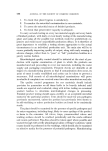
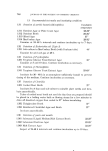
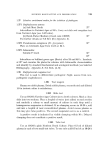
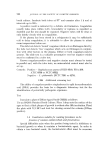
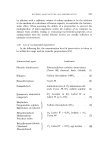
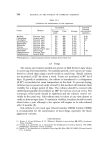
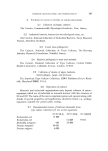
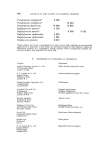
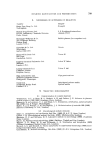
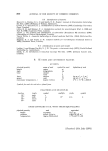
Appendix E 1. STOCK CULTURES OF SPOILAGE MICRO-ORGANISMS Several references are made in this monograph to the use of spoilage micro-organisms in testing preservative systems. For this purpose, it is helpful to maintain cultures of various species and strains, isolated at various times, but some care is necessary to obtain consistent results in preservative studies. Requirements of different laboratories vary as regards the size and type of collection. This may often be limited to a few essential strains, for which full records are kept. Test strains may be isolated from contaminated materials and either freeze-dried or maintained on agar. Freeze-dried cultures may also be purchased from various National Collections (see Appendix E.2.). 1.1 Freeze-dried cultures Freeze-dried (lyophylized) cultures remain true to type and are pre- ferred to stock cultures maintained continuously on growth media, since freeze-dried cultures are less liable to undergo changes in preservative resistance and other characteristics. For the preparation of freeze-dried cultures, appropriate publications should be consulted {1). Slope cultures for current use are prepared from freeze-dried cultures and stored at 5-10ø the sub-culture should be checked for purity and used preferably within a month. After making four serial sub-cultures a new freeze-dried tube should be opened and the old culture discarded. 1.2 Other stock cultures When freeze-drying is not carried out, cultures may be maintained on a suitable nutrient agar medium by sub-culturing at appropriate intervals. The cultures should be stored in tightly-capped bottles in the dark at 5-10 ø. Cultures maintained continuously on agar should be specially checked for purity and to see that the required degree of preservation resistance is being maintained. To guard against accidental contamination or the de- velopment of an atypical strain, a duplicate set of master cultures should always be kept. Suitable culture media and suggestions for minimal frequency of sub- culture needed to ensure survival of the organisms are listed in Table •.2.•. ½). 795

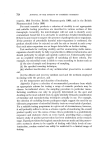
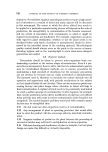
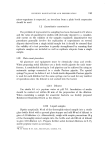
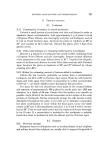
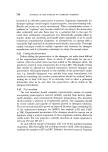
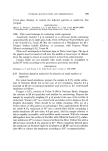
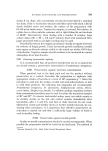
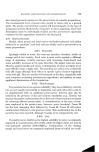
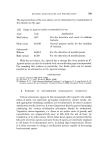
796 JOURNAL OF THE SOCIETY OF COSMETIC CHEMISTS Table 1.2.1. Conditions for maintenance of test organisms Genus Bacillus Clostridium Citrobacter Enterobacter Escherichia Klebsiella Proteus Pseudomonas Salmonella Staphylococcus Streptococcus Medium Nutrient Agar Cooked meat* Nutrient Agar Nutrient Agar Nutrient Agar Nutrient Agar Nutrient Agar Peptone Water Agar Dorset egg* Nutrient Agar Cooked Meat Incubation Temper- Time ature 30 ø 48h 37 ø 48h 37 ø 18h 37 ø 18h 37 ø 18h 37 ø 18h 37 ø 18h 30 ø 18h 37 ø 18h 37 ø 18h 37 ø 18h Storage 5-10 ø 5-10 ø 5-10 ø 5-10 ø 5-10 ø 5-10 ø 5-10 ø 5-10 ø 5-10 ø 5-10 ø 5-10 ø Interval between sub-cultures (months) 6-12 6-12 3-6 6 6 3 3 3 6-12 3 3 *Obtainable as a ready prepared culture medium from Oxoid Ltd. 1.3 Fungi The yeasts and common moulds are grown on Malt Extract Agar slopes in screw-cap Universal bottles. To maintain growth, a few spores are trans- ferred to a fresh slope using a sterile needle or small loop. Mould cultures are incubated at 22 ø for about a week. Yeasts are incubated at 30 ø for 3 days. If growth is satisfactory, the culture is transferred to a refrigerator (5-10 ø ) or incubated at room temperature in the dark. To prevent drying, cultures may be preserved under oil and by this method will maintain their viability for a longer period of time. The cultures should be covered with sterile liquid paraffin oil (sterilized at 160 ø for 1-2 h in a hot-air oven). The screwcaps of the bottle should be tightened and the cultures stored ver- tically in the usual way. Sub-cultures may be taken at any time almost as easily as from an agar slope. To maintain viability, transfers should be made about twice a year although a few species will require to be sub-cultured after 3 months (3). Sub-culture to corn meal agar (Oxoid Granules CM103, Tablets CM104) is recommended for the maintenance of most fungi, especially the black pigmented varieties. REFERENCES (1) Norris, J. R. and Ribbons, D. •r. (Editors). Methods in microbiology $A (1970) (Academic Press, London). (2) Cowan, S. T. and Steel, I(. J. Manual for the identification of medical bacteria 176 (1966) (Cambridge University Press, London). (3) Smith, G. An introduction to industrial mycology 5th Edn. 300-313 (1960) (Edward Arnold l,td., London).
Purchased for the exclusive use of nofirst nolast (unknown)
From: SCC Media Library & Resource Center (library.scconline.org)