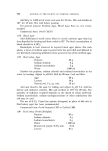
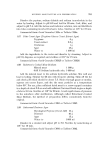
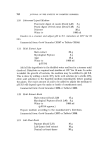
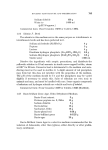
HYGIENIC MANUFACTURE AND PRESERVATION 761 if the first sample fails to satisfy the test. Take two separate 1 ml aliquots from the pack to be examined and dilute each aseptically with 9 ml Nutrient Broth in a 30 ml (1 oz) Macartney bottle. Incubate at 30 ø for at least 24 h. When taking aliquots from a bottle pack, invert the bottle several times and transfer the sample aseptically, flaming the mouth of the bottle each time it is opened the transference should actually be carried out in close proximity to the burner. To take an aliquot from a sachet, snip the corner using a pair of scissors, flamed by dipping in alcohol and burning away the excess cutting should be carried out while the scissors are still hot. Transfer aseptically as in the case of bottle packs. If growth in the broth culture is difficult to detect owing to turbidity of the product, sub-culture a loopful onto Nutrient Agar, or use method $.$5. 3.2612 If the 24 h reading is negative (no visible turbidity), the batch may be passed provisionally. Tests should be continued, however, for at least a further 48 h for information. If the reading is positive (any degree of turbidity indicating bacterial growth), the tests should be repeated on the duplicate sample and on further aliquots taken from the same sample which will have stood at room temperature for 24 h. After 24 h incubation, negative cultures may be taken to show that contamination has died out and the batch would then be accepted as satisfactory. Material failing to pass the test under these conditions should be discarded, except that there would be no objection to repeated sampling after several days' storage to ascertain whether the contamination has eventually died out. 3.262 Membrane filtration methods for shampoo testing Tests for coliforms, total counts, and sterility may be carried out by means of membrane filter techniques. Ability to filter the product (usually employing a membrane having a pore size of 0.45 gm) is only restricted by the amount of gross suspended matter present. The membrane filter tech- nique offers certain advantages over the conventional methods of testing: Larger volumes of fluid may be sampled than are conveniently handled with conventional plating techniques. Small numbers of organisms can be detected, which might be missed with conventional counting methods. Counts can be carried out in a shorter time. To eliminate the effect of preservative or antimicrobial, the membrane can be washed free from inhibitory substance. In principle, procedures similar to those used in water bacteriology may

7{32 JOURNAL OF THE SOCIETY OF COSMETIC CHEMISTS be adopted for shampoo testing. The membrane filter should not, however, be used for testing shampoos containing preservatives which are not com- pletely soluble in water. For the recovery of Pseudomonads and similar micro-organisms a membrane with a pore size of 0.22 lim is recommended. A wide range of membrane filtration systems, including disposable filter units, is now available commercially. For further technical information concerning membrane filter apparatus, filtration and dilution of sample, recovery media and incubation of membranes, the following technical references should be consulted: GENERAL REFERENCES Microbiological Analysis of Toiletties and Cosmetic Products. Application Report AR-16. (Millipore U.K. Ltd., Heron House, Wembley, Middlesex). Membrane filtration with 'Oxoid' membrane filters and membrane media. Temporary leaflet (July 1967) (Oxoid Ltd., London). Burman, N. P. et al. "Membrane Filtration Techniques" in Shapton, D. A. and Gould, G. W. Isolation methods for microbiologists, Technical Series 3. {Academic Press, London). Collins, C. H. Microbiological Methods gnd Edn. 150-152 and 313-314 (Butterworths, London). Mulvany, J. G. Membrane filter techniques in microbiology, in Norris, J. R. and Ribbons, D. W. Methods in microbiology 1 (1969) (Academic Press, London). 3.3 Creams and lotions 3.31 Assessment of preservative capacity When practical, test in the final pack and use the product without preservative as a control. Samples should be inoculated in triplicate with spoilage organisms (bacteria, moulds, yeasts and fungi). Incubate one set of samples at 22 ø , one set at 32 ø and another set at 35-37 ø . When testing for bactericidal action, steps should be taken to neutralise any residual preservative (see Section 1.4, p. 750). 3.32 Inoculation with bacteria This is carded out by stirring about 0.25 ml of a bacterial suspension into each 25 g sample of the product, using a sterile spatula. The inoculum should be suitably diluted with Peptone Water Diluent to give a final con- centration of about 106 organisms g-1 of product. The test inocula should include micro-organisms recently isolated from spoilt preparations. Addi- tionally, the following strains obtainable from Type Culture Collections are recommended as test organisms: Staphylococcus aureus, Streptococcus faecalis, Pseudomonas aeruginosa, Pseudomonas fluorescens, Escherichia coli, Klebsiella spp. and Proteus spp. Immediately after inoculating the samples and thereafter at regular intervals, estimate the number of viable organisms by plating out in Plate Count Agar. (See methods $.35 and $.$6). A drastically reduced count or the
Purchased for the exclusive use of nofirst nolast (unknown)
From: SCC Media Library & Resource Center (library.scconline.org)