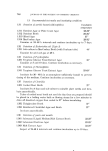
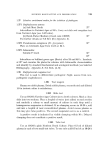
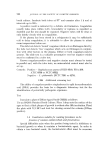
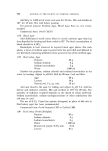
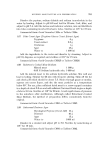
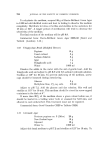
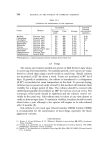
HYGIENIC MANUFACTURE AND PRESERVATION 747 1.218 Counting of colonies Colonies should normally be counted within 4 h of the end of the incuba- tion period, or the plates may be stored overnight at a temperature not exceeding 4 ø . Use an illuminated, preferably electronic, colony counter. Alternatively, a lens of a magnification not exceeding 2•- diameters, and a tally counter may be used to facilitate counting. Count all visible colonies on the plate including pin-point colonies beneath the surface. Where spreading organisms occur, count each "spreader" as one colony. Whenever possible, include only plates in which the dilutions have given colony counts between 30 and 300 for recording the results. To calculate the colony count per ml, multiply the number of colonies by the reciprocal of the dilution and determine the arithmetic mean for the replicates. Express results as colony count ml-1. If "spreaders" cover more than half the area, discard the plate concerned. The result will be of doubtful validity if one quarter or more of the plate is covered by a spreading organism. In such cases an approximate estimate of the count may sometimes be obtained by examin- ing a plate from another dilution. Multiplication of many organisms may be inhibited by high osmolarity or the presence of a preservative. Un- dissolved particles can complicate bacterial counts and must not be confused with colonies. It is sometimes more convenient to carry out a surface inoculation count (Method &SIS, p. 768). REFERENCE Postgate, J. R. Viable counts and viability, in Norris, J. R. and Ribbons, D. •V. g/[ethods in microbiology 1 (1969) (Academic Press, London). 1.219 Optimal temperatures There is a wide divergency in the optimal temperatures for the propaga- tion of various micro-organisms. Bacteria have been divided into three classes - psychrophiles, mesophiles and thermophiles - accordin k to their optimum temperature-requirements for growth. Psychrophilic bacteria may show activity at 7 ø or below with optimal growth at 10 ø to 20 ø. They do not reproduce at 40 ø. Mesophiles grow optimally at 37 ø to 40 ø. Growth does not occur at 55 ø or at 20 ø. The optimal temperature for growth of thermo- philes is 55 ø, but they may also grow at temperatures as high as 89 ø. They do not multiply at 40 ø . There is considerable overlapping in the divisions since some bacteria grow well over a wide range of temperatures whereas the optimal growth of others is restricted to a very narrow temperature range. It is advisable to incubate within the range of 22 to 32 ø as well as at 37 ø, for the isolation of spoilage organisms in cosmetics.

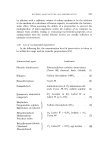
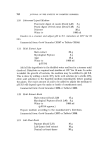
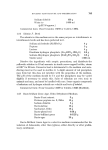
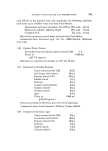
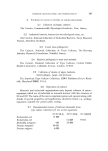
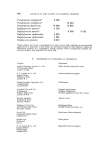
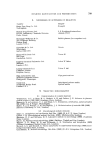
748 JOURNAL OF THE SOCIETY OF COSMETIC CHEMISTS 1.31 1.311 Nutrient Agar or Plate Count Agar 1.312 Nutrient Broth 1.313 Blood Agar 1.314 MacConkey Agar 1.3 Recommended test media and incubating conditions Detection of aerobic bacteria (Mesophiles) Incubation temperature 28-32 ø 28-32 ø 37 ø 28-32 o Examine at 24-48 h intervals and continue incubation up to 7 days. 1.32 Detection of Escherichia coli (Type 1) 1.321 Sub-culture in MacConkey Broth (with Durham tube) 44 ø Examine for acid and gas at 48 h. 1.33 Detection of Psychrophiles 1.331 Tryptone Glucose Yeast Extract Agar 10 ø Examine at 5 and 10 days. Continue incubation as necessary. 1.34 Detection of Thermophiles 1.341 Tryptone Glucose Yeast Extract Agar 55-63 ø Incubate for 36 - 48 h in an atmosphere sufficiently humid to prevent drying of the medium. Continue incubation as necessary. 1.35 Detection of Clostridia 1.351 Cooked Meat Broth 37 ø Incubate 3 to 4 days and sub-culture to suitable plate media and incu- bate anaerobically. Tubes of cooked meat broth not used the day they are prepared should be placed in a boiling water bath or flowing steam for a few minutes to drive off dissolved oxygen then cooled to 37 ø before inoculating. 1.352 Thioglycolate Broth 37 ø 1.353 Reinforced Clostridial Agar and Broth 37 ø Incubate anaerobically. 1.36 Detection of yeasts and moulds 1.361 Sabouraud Liquid Medium/Malt Extract Broth 22-25 ø 1.362 Sabouraud Dextrose Agar 22-25 ø 1.363 Malt Extract Agar 22-25 ø Inspect at 24-48 h intervals and continue incubation up to 10 days.
Purchased for the exclusive use of nofirst nolast (unknown)
From: SCC Media Library & Resource Center (library.scconline.org)