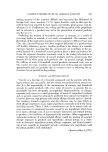
240 JOURNAL OF THE SOCIETY OF COSMETIC CHEMISTS The relationship between the mechanical properties of stratum corneum and its moisture content has been studied by several techniques (4-6). Much of this work has been conducted on stratum corneum obtained from guinea pig foot pads or human callus. It was pointed out by Kligman that the stratum corneum of guinea pigs allows water to pass three times as fast as human abdominal stratum corneum (7). He also states that "the specialization of the horny layer of the palms and soles is so unique as to require separate status." These tissues contain lower quantities of the water-soluble substances present in abdominal skin and are more permeable to water data from callus will not "accurately apply to the membranous horny layer." A considerable lzody of work on the mechanical properties of human skin in vivo is not perti- nent because it deals primarily with the mechanical properties of the dermis which presumably is not touched by normal cosmetic treatments. Water vapor transmission experiments in vivo are made difficult by sweating unless this is repressed by vasoconstricting drugs. As a result, well-controlled experi- mentation in vivo is very difficult. Substrate variability and the noted complications of in vivo studies make it attractive to study mechanical and water-holding properties of human stratum comeum in vitro. This study has been designed to study and to compare tech- niques suitable for measuring the interaction of stratum corneum with water. Part II of this work deals with the effect of a variety of typical cosmetic in- gredients in order to establish a rationale for their use in skin treatment prep- arations. THEORETICAL TREATMENTS AND EXPERIMENTAL PROCEDURES Mechanical Properties Elastic Modulus When a viscoelastic strip of material of length 1 and cross sectional area A is subjected to a normal tensile force ()t), the stress (or) is -•, and the strain (e) is the fractional increase in length, A1/h Below the yield point, Young's modulus of elasticity (E) is the ratio of or/e, i.e., the slope of the load-elonga- tion curve. Since A of the stratum corneum is not constant and is very diffi- cuIt to measure at all points, it was decided to use the parameter AxE (eq 1) and assume that strips taken from the same specimen of stratum corneum have approximately the same cross-sectional area. It was, therefore, necessary to determine AxE of an untreated control for each specimen of stratum cor- neum in order to compare the effect of a given treatment. A x E --fl A1 (1}

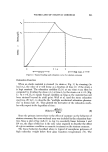
WATER LOSS OF STRATUM CORNEUM 241 o o 0 t*O t : Strain • • Time {sec.) Figure 1. Typical loading and relaxation curve for stratum corneum Relaxation Function When an elastic material is strained (to strain E, Fig. 1) by stressing (to lead o-0), the value of •r will decay as a function of time (t) if the strain E is kept constant. The relaxation modulus Er(t) at any time t can then be computed by dividing the stress (•r•) at time t• by the strain g at t = 0 (Fig. 1). At t = 0, E•(t) equals Young's modulus as long as the material has not been strained beyond its yield point. Wall et al. used the stress relaxation spectrum, H(lnr), to describe the "multiple mechanical relaxation phenom- ena" in human hair (8). They plotted the derivative of the relaxation modu- lus with respect to the logarithm of time: H(lnr) d(E•(t) ) -- d lnr (2) Since the primary interest here is the effect of moisture on the behavior of stratum corneum, the cross-sectional area was included in the relaxation func- tion. Since a plot of log AxE•(t) rs. log t is essentially linear between 1 and 10 4 sec, the slope of this line is the only value required to describe the effect of a given moisture condition or cosmetic treatment on the stratum corneum. The linear behavior described above is typical of amorphous polymers of high molecular weight below their glass transition temperatures (9). The
Purchased for the exclusive use of nofirst nolast (unknown)
From: SCC Media Library & Resource Center (library.scconline.org)