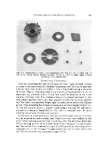
WATER LOSS OF STRATUM CORNEUM 243 Figure 2. Construction of water vapor transmission cell. Top row, left to right: body of cell, lower silicone gasket, stratum corneum. Bottom row, left to right: upper silicone gasket, top plate, closure nuts) Water Vapor Transmission Cells for measuring the rate of diffusion of water vapor through stratum corneum were constructed of cylindrical aluminum stock (3.7 cm in diameter x 2.2 cm high) into which was drilled a 1.5-cm deep hole having a diameter of 1.3 cm (Fig. 2). This depression has a capacity of approximately 2 ml. An aluminum top provided with a 1.3-cm hole could be attached to the lower chamber with four bolts. The stratum corneum was placed between two sili- cone rubber gaskets which were then placed between the chamber and the top. The bolts were attached "finger tight" in order not to deform the silicone gasket. After mounting the stratum corneum on a cell containing 0.3 ml of wa- ter, the cell was placed into a chamber containing a constant RH solution or exposed to a stream of humidified air. The cell was weighed every 24 hours until the rate of water loss became constant. Initial rates of transep'idermal water loss are fairly high, and up to 4 days may be required to reach a steady rate. Only those rates were utilized in this study which remained constant for 2 to 3 days after the initial equilibration. Whenever long periods of time were required for testing at several humidi- ties, the sample was examined for signs of mold growth or stretching of the epidermis due to the "vacuum" formed inside the cell as water leaves the cell. The loss of water was computed as mg/cm2/hr.

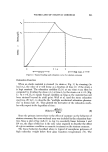
244 JOURNAL OF THE SOCIETY OF COSMETIC CHEMISTS Humidity Control In order to obtain dry air (0% RH), the air was first passed through re- agent grade sulfuric acid and then magnesium perchlorate* since it has been reported that calcium chloride will permit passage of up to 160 ppm of water in a gas stream (10). In experiments in which constant humidity solutions were used, the saturated solutions of several salts were employed ( 11 ). When an air stream of constant humidity was required for several days, the use of saturated salt solutions is inconvenient due to blockage of the gas dispersion tube by crystallization. Therefore, the apparatus described by Smith (12) was used. This apparatus consists of a proportioning valve and saturators to mix controlled quantities of wet and dry air to obtain a given humidity. The equipment is capable of accurately supplying air at any RH between 0 and 100% in 5% RH steps over a wide range of temperatures. Materials Unless otherwise indicated, C.P. reagents were employed throughout. Post- mortem abdominal skin was immediately frozen in dry ice. Within 72 hours, the samples were heated in a water bath to 52 ø ñ 2øC, and the stratum cor- neum was peeled from the dermis as described by Kligman and Christoph- ers (13). The separated stratum corneum was washed in several changes of distilled water and gently picked up on a piece of stainless steel wire mesh. The stratum corneum was air-dried, removed from the screen, and stored over magnesium perchlorate. When extracted stratum corneum was required, it was extracted according to the procedure of Blank (14), i.e., 24 hours in pyridine at room temperature followed by 1-hour extraction with water at room temperature. •{ESULTS AND DISCUSSION Mechanical Properties In order to avoid experimental artifacts and to conserve material it was de- cided to determine whether the stratum corneum is elastically isotropic or anisotropic like the dermis. The values of the quantity AxE for stratum cor- neum extended under water at room temperature were 1.79 - 0.12 x 10 4 dynes and 1.90 ñ 0.18 x 10⁴ dynes, respectively, for strips (8 in each direction) cut at right angles to each other. The results indicate that the stratum corneum may be considered isotropic. Adjacent strips of stratum corneum usually have AxE values within +- 5% but occasionally vary by as much as 30-40% As expected, the elastic modulus of human stratum corneum was found to be a function of the ambient RH. The results of Fig. 3 confirm those of many other investigators and show that stratum corneum becomes "softer" when *Anhydrone©, I. T. Baker Chemical Co., Philadelphia, N.J.
Purchased for the exclusive use of nofirst nolast (unknown)
From: SCC Media Library & Resource Center (library.scconline.org)