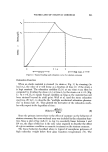
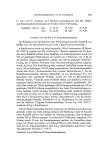
WATER LOSS OF STRATUM CORNEUM 241 o o 0 t*O t : Strain • • Time {sec.) Figure 1. Typical loading and relaxation curve for stratum corneum Relaxation Function When an elastic material is strained (to strain E, Fig. 1) by stressing (to lead o-0), the value of •r will decay as a function of time (t) if the strain E is kept constant. The relaxation modulus Er(t) at any time t can then be computed by dividing the stress (•r•) at time t• by the strain g at t = 0 (Fig. 1). At t = 0, E•(t) equals Young's modulus as long as the material has not been strained beyond its yield point. Wall et al. used the stress relaxation spectrum, H(lnr), to describe the "multiple mechanical relaxation phenom- ena" in human hair (8). They plotted the derivative of the relaxation modu- lus with respect to the logarithm of time: H(lnr) d(E•(t) ) -- d lnr (2) Since the primary interest here is the effect of moisture on the behavior of stratum corneum, the cross-sectional area was included in the relaxation func- tion. Since a plot of log AxE•(t) rs. log t is essentially linear between 1 and 10 4 sec, the slope of this line is the only value required to describe the effect of a given moisture condition or cosmetic treatment on the stratum corneum. The linear behavior described above is typical of amorphous polymers of high molecular weight below their glass transition temperatures (9). The

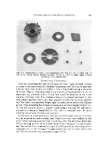
g49. JOURNAL OF THE SOCIETY OF COSMETIC CHEMISTS response to the external stress consists primarily of local adjustments since the chain backbone configuration is essentially immobilized. Technique A model TM Instron Tensile Tester©* was used for measuring both elastic toodull and relaxation spectra. The rate of travel of the cross head was 2.54 mm/min, which was equivalent to an extension of about 10-15%/min. (The sample length varied between 17 and 25 mm. ) Strips of stratum corneum, 0.5 cm wide by approximately 3.5 cm long, were attached to Bakelite©t tabs with a commercial epoxy cement or Duco©* cement. The length of each strip (between tabs) xvas measured to the nearest 0.01 mm with a cathetometer.õ The samples were stored at the desired rela- tive humidity (RH) for at least 24 hours and then suspended in a cvlinder (diameter, 7 cm length, 15 cm) mounted on the Instron. Air at the same RH was passed through the chamber for 20 rain at which time the samples were extended to a load of 4.0 g. Some obvious minor modifications of the above procedure were required for those stratum corneum strips which were extended under deionized water or test solutions. Water Absorption A Cahn RG Electrobalance©// was used to measure moisture absorption by stratum corneum or of cosmetic materials applied to samples of stratum corneum or to glass filter paper. The Electrobalance was fitted with an X-Y recordertl which has an input range of 0.1 mg/2.54 cm, while the graph can be read to 0.002 mg. Equilibrium weights can be estimated to 0.001 mg using a null system. The balance was also fitted with a cube-shaped plastic chamber (7.5 cm on each side) into which air of controlled humidity was blown at a rate of 1200 ml/min. The determination of equilibrium water content was made immediately after stopping the air flow so that air currents would not affect the reading. Equilibration occurs quite rapidly due to the moving air stream (absence of an unstirred layer and the small size of the sample). At- tainment of equilibrium •vas evidenced by constancy of •veight for 4 to 5 hours. *Instron Corp., Canton, Mass. pUnion Carbide Corp., New York, N.Y. E. I. du Pont de Nemours & Co., Wilmington, Del. õEa]ing Corp., Cambridge, Mass. //Cahn Instrument Co., Paramount, Calif. •TModel 7035 B xvith internal time base generator, Hexvlett-Packard Co., Palo Alto, Calif.
Purchased for the exclusive use of nofirst nolast (unknown)
From: SCC Media Library & Resource Center (library.scconline.org)