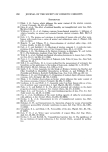
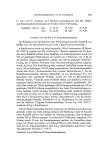
EFFECTS OF COSMETIC INGBEDIENTS 9.59 Table II Equilibrium Moisture Absorption Material Water Absorbed at 31% RH 52% RH 76% RH 90% RH Stratum corneton Glycerol Sodium lactate Sodium pyrrolidone carboxylate Mineral oil Safflower oil 7 9 11 26 19 40 17 45 0.2 0.4 0.2 0.5 13 22 67 240 104 ... 210 ... 0.9 ... 1.0 ... Table III Weight Gain (Water Content) of Stratum Corneum and Stratmn Corneum Plus Hnmeetant Sample Amount of Water (rag) after Equilibra•ion at Initial Weight a (mg) 35% RH 75% RH Stratum corneum Glycerol ø Stratum corneum q- glycerol Experimental Calculated Stratum corneum Sodium pyrrolidone carboxylate c Stratum corneum q- sodium pyrrolidone carboxylate Exp•Hmental Calculated 3.816 3.058 6.874 . . . 3.784 3.468 7.252 0.226 0.530 0.339 2.058 0.b'•72 2.575 0.15615 2.588 0.183 0.515 0.720 3.488 0.892 3.892 0.903 4,003 •At equilibrium with air at 0% RH. •U.S.P. CApp.•ied from a 50% solution. Water Vapor Transmission The loss of moisture from the skin to the atmosphere is a continuous pro- cess, and excessive loss at low humidity and low temperatures is generally associated with skin dryness and chapping. It seemed particularly important to determine how cosmetic ingredients applied to stratum corneum might al- ter this tissue's ability to "transpire" water to an essentially dry atmosphere. Some typical in vitro water vapor transmission rates through stratum corneum are summarized in Table IV. This table also includes some common cosmetic humectants, some occlusive lipid materials, and Lotion #78. This last prep- aration, which is Formula 78 described by Barnett (10), was employed here because it wa• also studied in vivo by Berube et al. (11).

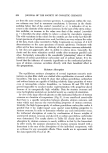
g60 JOURNAL OF THE SOCIETY OF COSMETIC CHEMISTS Material Table IV Vitro •Vater Vapor Transmission through Stratum Corneum Rate (mg cm -'• hr-•) Ratio Untreated Treated (Treated / Untreated) 25% glycerol 0.264 0.518 1.96 4% sodium lactate 0.294 0.372 1.27 4% sodium pyrrolidone carboxylate 0.142 0.227 1.60 4% propylene glycol 0.223 0.267 1.20 Light tech. mineral oil 0.274 0.205 0.75 Safflower oil 0.309 0.281 0.91 Lotion 78 a 0.335 0.1'81 0.54 "Formula 78 from Barnett (10). The results obtained here are only directional in view of several experimen- tal uncertainties: Experimentally, stratum corneum was first equilibrated in the diffusion cell against 0% humidity to yield an "untreated" rate. The mate- rial of interest was then applied to the exposed stratum corneum surface with the aid of a cotton swab. An effort was made to remove excess material while maintaining a continuous film, but there is no quantitation of the amount of substance actually remaining on the stratum corneum. The "treated" rate recorded in Table IV is the rate resulting after complete equilibration of the treated stratum corneum against the dry environment. As expected, lipid materials reduce water vapor transmission, whereas humectants cause a marked increase. The results with Lotion #78 confirm the in vivo data of Berube et al. who found that heavy application of this preparation was re- quired to produce the occlusive effect (11). It is particularly noted that the small amount of sodium pyrrolidone carboxylate remaining on the stratum corneum after applying a 4% aqueous solution still causes a very large in- crease in the rate of water vapor transmission. These results clearly confirm the earlier data presented by Powers and Fox (12) that humectants increase transepidermal moisture loss. Traditionally, humectants, such as glycerol, have been used for "improving dryness of skin and chapping." Published controlled clinical data attesting to the utility of humectants are missing, although the authors have access to a monadic clinical in-use study suggesting strongly that a preparation contain- ing a high concentration of glycerol without any occlusive properties allevi- ates the dryness/chapping syndrome (13). It is difficult to reconcile the evidently beneficial effects of glycerol with its ability to increase transepider- mal water loss. Only a very tentative hypothesis is offered here: Stratum cor- neum is commonly thought of as a homogeneous layer of cornified epithelial cells. The assumption is probably incorrect, since the outer portion of the stratum corneum may have suffered some damage due to wear and tear and the dissolution of lipid- and water-soluble constituents. As a result, the outer
Purchased for the exclusive use of nofirst nolast (unknown)
From: SCC Media Library & Resource Center (library.scconline.org)