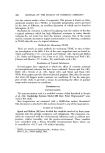
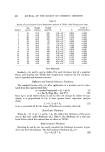
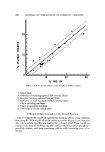
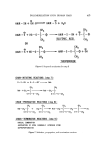
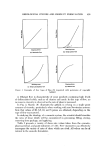
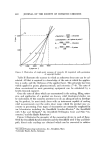
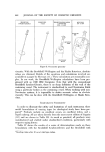
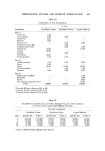
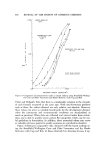
438 JOURNAL OF THE SOCIETY OF COSMETIC CHEMISTS Emulsions and suspensions are important classes of cosmetic formulations. However, little is known about the correlation between the rheology of a product system and its ultimate application or use in the cosmetic field. Great emphasis is still placed on arbitrary subiective evaluation, with little predic- tive knowledge of how the product system Will perform or be altered by pro- cessing and filling procedures. The cosmetic scientist is interested in the rheology of his product as it af- fects mixing, packaging, stability, dispensing, and ultimate use characteristics. In each of these instances, the sound application of rheological studies can avoid many pitfalls. The manner in which the consumer views product per- formance is nicely summarized by Marriott who wrote, "In use, cosmetic products are evaluated generally by touch. A touch of the finger tells of rigidity, thixotropy, viscosity, smoothness and texture in general. Coupled with the seeing eye, simply spreading the preparation on the skin can cause the brain to appreciate uniformity, coherence, absorption and many other features of the thin film-it may be shiny, be dull or matte, or have pearly lustre. Such procedures involve some motion or flow and fall within the ambit of theology" (4). This paper is sharply directed toward the practical use of rheology in the development of improved cosmetic products and is intended to give a con- c'se review of rheology and its application to cosmetic formulations. Genera] principles will be reviewed. The capabilities and limitations of four different viscometers will be presented by utilizing them in a rheological study of three model cosmetic formulas. The application of rheological principles to formulation and processing will be discussed. Case histories from experience will be presented to show how rheology is used to solve practical problems. Figure 1 briefly illustrates the four types of flow which are encountered, with definitions developed as a function of rate of shear (G) versus shearing stress (F). These are as follows: 1. Newtonian flow is an orderly flow pattern in which the rate of shear is directly proportional to shearing stress. Viscosity values are obtained by di- viding the rate of shear by the shearing stress, all expressed in appropriate units. 2. Plastic flow is characteristic of Bingham bodies. In this type of flow a certain Yield Value must be exceeded before flow starts. This type of flow will be discussed in more detail, particularly as it relates to formulation. 3. Pseudoplastic flow is characteristic of most natural and synthetic gums. In this type of flow the rate of shear is not directly proportional to the shear- ing stress. The curve passes through the origin, but is rarely linear. Recently, Yakatan and Araujo (5) proposed the use of an analog computer to simulate this type of flow. Mathematically, it is the most difficult form to handle.

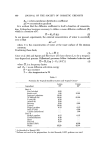
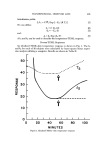
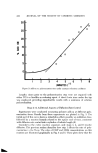
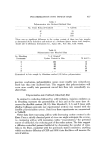
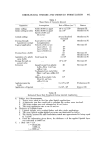
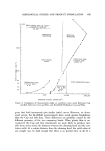
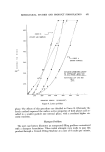
RHEOLOGICAL STUDIES AND PRODUCT FORMULATION 439 Shearing stress (a) Newtonian flow Shearing stress (b) Simple plastic flow Shearing stress (c) Simple pseudoplastic flow Shearing stress (d) Dilatant flow Figure 1. Examples of four types of flow (6) (reprinted with permission of copyright holder) 4. Dilatant flow is characteristic of some products containing high levels of defloccu]ated solids, such as oil slurries and muds. In this type of flow, an in?rease in viscosity is observed as the rate of shear is increased. In Fig. 2, Martin (6) illustrates the pitfalls in relying on a single point measure of viscosity, particularly when working with non-Newtonian systems. Note that values of 20, 8.5, 10, and 5 poises are obtained, depending on the type of flow encountered. In studying the rheology of a cosmetic system, the scientist should simulate the rates of shear which will be encountered in processing, filling, storing, removing from package, and applying. Table I presents a variety of shear rate values taken from the cosmetic, pharmaceutical, and paint industries (7-10). Few viscometers can effectively encompass the variety of rates of shear which are cited. All values can be of interest to the cosmetic formulator,
Purchased for the exclusive use of nofirst nolast (unknown)
From: SCC Media Library & Resource Center (library.scconline.org)