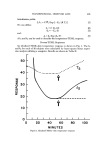
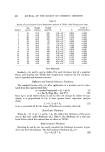
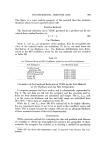
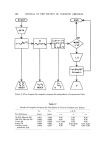
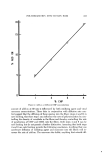
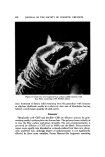
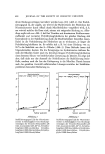
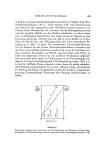
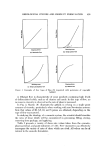
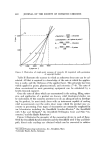
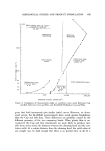
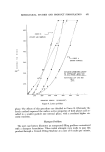
RHEOLOGICAL STUDIES AND PRODUCT FORMULATION 453 Once this approximation had been made, performance of the product when pumped at a low rate of shear of approximately 250 see -x was investigated, using the Rotoviseo. Figure 9 illustrates the remarkable differenee between the control and new product when evaluated at rates of shear not encountered with the usual Brookfield Synehro-Eleetrie test. Here we see that at 245 see 4 the newly developed product had a shearing stress of 2,830 dynes/em 2, while the control product gave a shearing stress value of 700 dynes/em 2. Closer in.speetion of the Cozzoli Filler revealed a shear pin whieh would and did fracture at this shear stress. Once the problem was dearly recognized, it was easily solved. Other production scale-up problems have been diseussed in an article by Fujiyama et al. (22). SUMMARY The basic principles of rheoIogy have been reviewed. Using three model formulations and four different viseometers, the utility and the shortcomings of the instruments have been demonstrated. The problems eneountered in the formulation and stability evaluation of eosmetie prodnets has been dis- cussed. By way of ease histories we have illustrated the value of proper rheologieal study. The viseometer is a valuable tool for the eosinerie seientist. It should be utilized to its fullest capability. (Received May 3, 1973) t•EFERENCES (1) Fischer, E. K., Note on the origin of the term "theology," J. Colloid Sci., 3, 73-4 (1948). (2) Scott Blair, G. W., Rheology and the pharmacist, Pharrn. J., 154, 3-4 (1945). (3) Reiner, M. W., and Scott Blair, G. W., Rheological Terminology, Academic Press, New York, N.Y., 1967 pp. 461-88. (4) Marriott, R. H., Rheological measurements in cosmetic industry, J. Soc. Cosmet. Chern., 12, 89-98 (1961). (5) Yakatan, G. J., and Araujo, O. E., Analog computer simulation of rheological sys- tems. I. Pseudoplastic flow, J. Pharm. Sci., 57, 155-8 (1968). (6) Martin, A. N., et al., Physical Pharmacy, Lea & Febiger, Philadelphia, Pa., 1970, pp. 498-514. (7) Sherman, P., Problems associated with the assessment of the consistency of cosmetic and toilet preparations, Soap, Per[urn. Cosmet., 45, 54-60 (1972). (8) Henderson, N. L., Meer, P.M., and Kostenbauder, H. B., Approximate rates of shear encountered in some pharmaceutical processes, J. Pharrn. Sci., 50, 788-91 (1961). (9) Fink-Jensen, P., Rheological properties of paint and two new instruments for measur- ing them, J. Oil Colour Chem. Ass., 49, 974-92 (1966). (10) Kinney, J. F., Personal communication, Estimated shear rate employed during lip- stick application, April, 1972. (11) Sherman, P., Techniques for assessing the rheological properties of toiletry and cos- metic products, J. Soc. Cosmet. Chern., 17• 439-65 (1966).

454 JOURNAL OF THE SOCIETY OF COSMETIC CHEMISTS (12) (13) (14) (15) (16) (17) (18) (19) (20) (21) (22) Balsam, M. S., and Sagarin, E., Cosmetics: Science and Technology, 2nd Ed., Vol. 1, Wiley Interscience, New York, 1972. Meyer, R. J., and Cohen, L., The theology of natural and synthetic hydrophilic polymer solutions as related to suspending ability, Ibid., 10, 143-54 (1959). Martin, A. N., et al., Physical Pharmacy, Lea and Febiger, Philadelphia, Pa., 1960, pp. 531-32, 620-2. Boylan, J. C., The application of rheology to parenteral suspensions and emulsions, Bull. Parenteral Drug Ass., 19, 98-109 (1965). Wood, J. H., and Catacalos, G., Prediction of the rheologic aging of cosmetic lo- tions I. Soc. Cosmet. Chem., 14, 147-57 (1963). Wood, J. H., Giles, W. H., and Catacalos, G., Problems in cosmetic rheology, Ibid., 15, 564-77 (1964). Sherman, P., A method for predicting rheological changes in emulsion products when aged, Ibid., 16, 591-606 (1965). Barry, B. W., and Warburton, B., Some rheological aspects of cosmetics, Ibid., 19, 725-44 (1968). Sherman, P., Changes in the theological properties of emulsions on aging and their dependence on the kinetics of globule coagulation, I. Phys. Chem., 67, 2531 (1963). Boylan, J. C., DeKay, H. G., and Banker, G. S., Temperature-induced rheological variability in an emulsion system, I. Pharm. Sci., 51, 742-8 (1962). Fujiyama, Y., Tahara, S., and Kumano, Y., Rheological properties of creams upon rroduction scale-up, I. Soc. Cosmet. Chem., 21, 625-37 (1970).
Purchased for the exclusive use of nofirst nolast (unknown)
From: SCC Media Library & Resource Center (library.scconline.org)