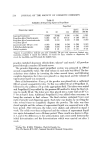
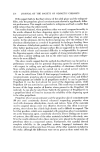
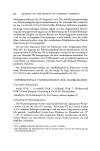
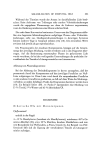
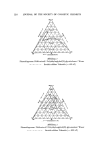
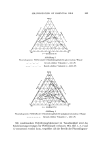
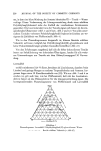
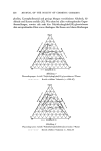
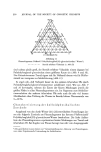
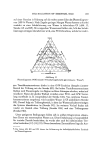
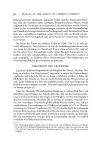
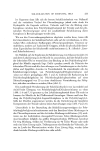
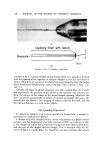
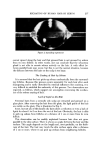
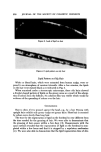
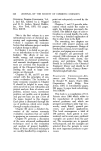
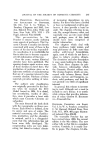
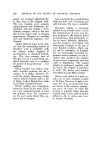
RECOATING OF HUMAN HAIR BY SEBUM 237 Figure 2. Spreading experiment cannot spread along the hair and that greased hair is not greased by sebum from its own follicle. In other words, one can conclude that the sebaceous gland is not able to secrete sebum actively on the hair. A wick effect be- tween parallel hairs may occur, but this is not the normal situation, because the distance between the hairs on the scalp is too large. The Coating of Hair by Sebum It is assumed that the hair picks up sebum mechanically from the surround- ing follicles. Because this process occurs separately for each hair after each shampooing and is easily disturbed by exten•al influences like combing, it is very difficult to establish the unformity of this process. Two observations are reported, as follows, which support our assumption concerning the mechan- ism of the sebum coating of hair. Lack of Lipid on the Hair Terminal hairs from a normally oily scalp are extracted and pressed on a glass plate. After removing the hair from the plate, the lipid prints of the hair are visible on the plate. This is illustrated in Fig. 3. Some, but not all, of this head's oily hairs show a reduction or even a lack of lipids for about 1 to 2 cm from the root of the hair. Obviously, the hair is able to pick up sebum from follicles at a distance of i cm or more from its own follicle. This observation can be readily explained because hair does not grow parallel to the skin surface. There is always an angle between the hair and the surface. This angle depends on the length and, most probably, on the thick- ness of the hair. The hair may touch the skin surface again after a distance of 1 cm or more, where it can pick up serburn from neighboring follicles.

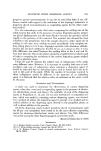
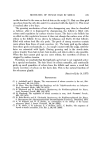
238 JOURNAL OF THE SOCIETY OF COSMETIC CHEMISTS Figure 3. Lack of lipid on hair Figure 4. Lipid pattern on oily hair Lipid Pattern on Oily Hair White or blond hairs, which were extracted from human scalps, were ex- posed to an atmosphere of osmium tetroxide. After a few minutes, the lipids on the hair were stained black as is indicated in Fig. 4. When examined under a stereoscopic microscope, these oily hairs showed a droplet-shaped pattern of lipids on the greasy areas as a result of the adsorp- tion of sebum from the follicles. No coherent film was visible which would be evidence of the spreading of sebum over the hair. CONCLUSIONS Hair is oilier, if it is pressed against the head, e.g., by a hat. Persons with upright hairs exhibit only greasy scalps not greasy hairs. Short hair is recoated by sebum more slowly than long hair. The time for the regeneration of lipid on the forehead is very different from the time needed for the greasing of hair. We were able to demonstrate that the greasing of hair occurs within a few days (3). Measurements with the same method revealed that the regeneration of lipid on the forehead is com- pleted within a few hours and that it is stopped by a regulatory mechanism (4). We were also able to demonstrate that the lipid regeneration time of skin
Purchased for the exclusive use of nofirst nolast (unknown)
From: SCC Media Library & Resource Center (library.scconline.org)