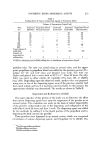
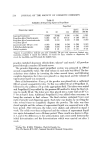
SYNTHETIC ESTER DISPERSING AGENTS 217 Table III Effect of Dispersing Agent/Propellant Mixture Upon the Redispersion of Solids • Dispersing Agent Aluminum Chlorhydrate Starch Talcum 24 hours 1week 24 hours 1week 24 hours 1week Isopropyl myristate 5 5 oe 2 5 5 Hexadecyl alcohol 4 4 2 2 6 6 Propylene glycol dipelargonate 3 3 2 2 3 3 2-ethy]hexy] pelargonate 2 2 2 3 5 6 Methyl myristate 5 5 2 3 5 5 Propylene glycol monoisostearate 12 30 2 2 4 4 Isopropyl isostearate 3 3 2 2 5 6 Propylene glycol monoisostearate (90 per cent) 14 30 2 2 4 4 •Resu]ts given as number of inversions required for complete redispersion of solid. Table IV Effect of Dispersing Agent/Solid Mixture Upon the Redispersion of Solids • Dispersing Agent Aluminum Chlorhydrate Starch Talcum 24 hours 1 week 24 hours 1 week 24 hours 1 week Isopropyl myristate 5 4 5 5 6 6 Hexadecyl alcohol 5 5 3 3 4 5 Propy]ene glycol dipelargonate 5 6 5 5 4 4 2-ethylhexyl pelargonate 2 2 6 6 7 8 Methyl myristate 2 3 12 15 4 4 Propylene glycol monoisostearate 18 30 15 15 4 5 Isopropyl isostearate 4 4 15 20 3 3 Propylene glycol monoisostearate (90 per cent) 20 30 15 20 7 7 _ 2Results given as number of inversions required for complete redispersion of solid. Discussion, o[ Results The nonpressurized method, which was used to evaluate several dispersing agents proved to be successful. While petroleum ether was used in this study, other nonpolar solvents such as carbon tetrachloride and methylene chloride could also have been used. The measurement of the settling rate by this meth- od showed four of the five materials to exhibit similar performances, with only the propylene glycol monoisostearate showing a significantly slower rate of settling. Isopropyl myristate showed a slightly faster rate of settling than the others.

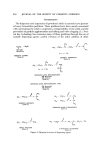
'218 JOUBNAL OF THE SOCIETY OF COSMETIC CHEMISTS With respect both to the final volume of the solid phase and the redispersi- bility, only the propylene glycol monoisostearate showed a significantly differ- ent performance. This sample was harder to redisperse and had a smaller final solids volume than the others tested. The results obtained, when petroleum ether was used, compare favorably to the results obtained for these dispersing agents in similar tests, but in an ac- tual pressurized aerosol system. The propylene glycol monoisostearate is the only agent studied with any functional group present other than an ester moiety. In this substance, the free hydroxyl group may slow the settling of the aluminum chlorhydrate as a result of its potential for hydrogen bonding. Once the aluminum chlorhydrate particles are coated, the hydrogen bonding may allow tighter packing and a stronger surface film as suggested by the observed smaller solids volume and increased difficulty in redispersibility. In general, the dispersing agents, which are more capable of strong intermolecular attrac- tions allow a slower settling rate, but on the other hand, may cause redisper- sion to be more difficult. The above results suggest that the method described here may be used as a preliminary screening test for potential dispersing agents for aerosol systems •xith respect to settling rate and redispersibility of aluminum chlorhydrate. More subtle evaluations must be carried out in an actual aerosol system in order to establish definitely the usefulness of the method. It can be noted from Table II that isopropyl isostearate, propylene glycoi monoisostearate, propylene glycol monoisostearate (90 per cent), and 2-ethyl- hexylpelargonate are soluble in all propellants studied. As can be predicted, Propellant 11 was the best solvent for most of the dispersing agents, while Propellant 114 was noted to be a poor solvent. This result was not unexpected because of the large number of fluorine atoms present in the Propellant 114 molecule. As can also be noted from Table II, the presence of Propellant 11 in a propellant blend will tend to increase the solubility of the dispersing agent in the other propellants. Propylene glycol monoisostearate and the propylene glycol monoisostearate (90 per cent) consistently showed enhanced suspending properties when used with aluminum chlorhydrate, starch, and talcum. None of the materials used to suspend talcum were very effective. However, this effect is not sur- prising, since talcum has a fairly high density and is difficult to suspend. The fact that powders, which were suspended with propylene glycol monoisostear- ate as the dispensing agent, consistently showed a slower settling rate in aero- sol systems, than did some of the other materials included in this study, con- firms the results obtained when these mixtures were placed in the presence of petroleum ether in a nonaerosol system. Furthermore, this material showed complete solubqity in the propellant systems. Isopropyl isostearate also showed a slower settling rate than d d some of the other materials included in this study, although the differences were not as great as those noted with the
Purchased for the exclusive use of nofirst nolast (unknown)
From: SCC Media Library & Resource Center (library.scconline.org)