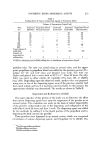
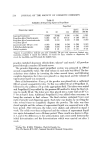
SYNTHETIC ESTER DISPERSING AGENTS 213 Table I Settling Rate of Various Dispersing Agents in Petroleum Ether Volume of Supernatant Liquid (ml) Time See Isopropyl Propylene Glycol Isostearyl Isopropyl Propylene Glycol Myristate Monoisostearate a Isostearate ' Isostearate Dipe]argonate 15 11 - -- 26 26 30 36 -- - 51 53 45 56 - -- 73 74 60 74 - - 75 76 75 76 - 77 76 -- 105 77 - -- 77 -- 180 78 -- 77 77 78 900 - 81 -- -- -- Final volume of solids (ml) 8 5 7 8.5 8.5 Number of inversions for redispersion i 2 i I I •Could not measure prior to final settling due to cloudiness of supernatant liquid. patibility tube. The tube was sealed using an aerosol valve, and the appro- priate propellant or propellant blend was added by the pressure process (Pro- pellant 11,* 127 and 114' alone and blended were used). The tube was shaken and placed into a water bath at 25øC -+ 1 ø. After 24 hours, the solu- bility was rated as either soluble (S), insoluble (IN), hazy (H), or slightly hazy (SH). Depending upon the observed result, another tube was prepared using more or less of the dispersing agent more if the previous quantity had been rated soluble and less if it had been rated insoluble. In this manner, the approximate solubility was determined. The results are showm in Table II. Suspension and Redispersion of Solids The •najor objective of this portion of the study was to determine the effect that various dispersing agents have upon the suspension of the powder in an aerosol system. The evaluation was made on the basis of initial dispersibility of the powder, sedimentation rate of the dispersion, and redispersion of the solid after it stood 24 hours and then 1 week. The dispersing agent was added by two methods: by adding it to the liquid portion of the propellant and by dispersing the fluid onto the dry powder. Three powders were dispersed in an aerosol system, which was comprised of mixtures of various dispersing agents, and Propellant 12/11 (50:50). The *Trichloromonofiuoromethane. tDichlorodifiuoromethane. Dichlorotetrafiuoroethane.

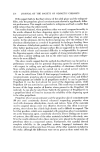
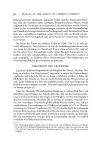
214 JOURNAL OF THE SOCIETY OF COSMETIC CHEMISTS Table II Solubility of Dispersing Agent in Propellants Dispersing Agent Propellant 11 12 114 12/11 12/114 (50:50) (60:40) Isopropyl isostearate S (30) • ,S (30) S (30) Propylene glycol dipelargonate S (30) SH (1) SH (1) Propylene glycol monoisostearate S (30) S (30) S (30) Propylene glycol monoisostearate (90 per cent) S (30) S (30) S (30) 2-Ethylhexylpelargonate S (30) S (30) S (30) Methyl myristate S (30) S (3) S (3) s (30) s (30) S (30) SH (1) S (30) S (30) s (30,) s (30) s (30) s (30) s (3) s (3) •Figures in parentheses indicate per cent solubility 30 per cent represents highest con- centration studied S stands for solnble H stands for hazy solution or dispersion IN stands for insoluble and SH stands for slightly hazy. powders included aluminum chlorhydrate, talcum* and starch.* All po vders passed through a number 325 mesh screen. The powder/dispersing agent/propellant system was prepared in 100-ml aerosol compatibility tubes. The total volume in each tube was 80 ml. The for- mulations were shaken by inverting the tubes several times, and following complete dispersion, the tubes were placed in a ring stand, and the volume of snpernatant liquid was measured. Rate o[ Sedimentation-Four g of the powder was placed into a calibrated 100-ml aerosol compatibility tube. To this was added 35 ml of Propellant 11, followed by the addition of 4 g of the appropriate fluid. The tubes were sealed and Propellant 12 was added by the pressure fill method to bring the final vol- ume to exactly 80 ml. The tubes were then placed into a water bath at 25 ø C-m-_ 1 ø for at least 1 hour. Additional Propellant 12 was added when necessary, to bring the contents to final volume. The final mixture contained 5 per cent each of powder and dispersing agent. Each tube was shaken by inverting the tube several times to completely disperse the powder. The tube was then stored upright and the volume of supernatant liquid was measured over a 24- hour period. After 24 hours, the tubes were shaken and allowed to stand 1 week. The solids were then redispersed and the volume of supernatant liquid was again determined over a 24-hour period. These results are shown in Figs. 2, 3, and 4. No differences in the sedimentation rates were noted between the initial determination and the determinations which were carried out after 1 *Italian Talc • 1602 Whittaker, Clark & Daniels, Inc. *Dry Flo Starch •p 78-1567 National Starch & Chemical Corporation.
Purchased for the exclusive use of nofirst nolast (unknown)
From: SCC Media Library & Resource Center (library.scconline.org)