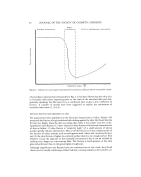
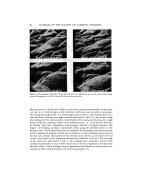
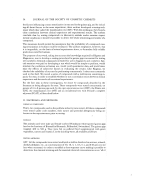
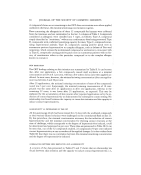
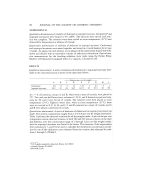
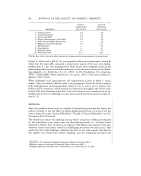
48 JOURNAL OF THE SOCIETY OF COSMETIC CHEbIISTS ./ Figure 6. Photographs coded 6917 B and 6918 B show two different sites on skin surface before probe contact. Photographs coded 69l 3 B and 6914 B show the after effect Measurements of the friction coefficient were then repeated immediately on the same test site. A 2-3 fold increase in the coefficient of friction was recorded on most pan- elists using the rough probe. It is interesting to note, however, that normal values of/c, obtained before rinsing, were again achieved after about 2 min. It is also worth noting that during the first measurement, immediately after rinsing and blotting, the rough probe exhibited a response similar to the polished probe, i.e., an increase of the force of friction with time. Subsequent measurements showed a normal. response. The degree of wrinkling increased substantially when using the polished probe on the hydrated skin. These observation'• can be explained by assuming a substantial decrease in the compression modulus of skin due to presence of water, leading to an increase in the size and, perhaps, the number of the junction zones (hence, an increase in the real contact area) which would ultimately increase the coefficient of friction. The decrease in the value of/c, after about 2 min, to the original value, indicates a return of the mechanical properties to the normal values due to the fast evaporation of water from the skin surface. These findings support Appeldoorn and Barnett's observations con- ' cerning the effect of skin hydradon on friction properties (11).

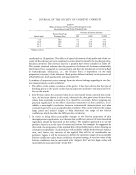
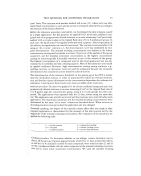
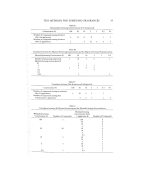
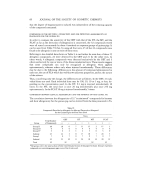
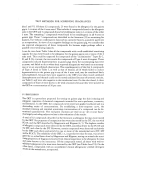
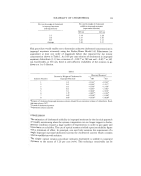
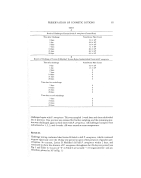
SKIN FRICTION MEASUREMENTS Table III Comparison of Friction Values on "Normal" and "Dry" Skin Load 98.9 g, Rotation Speed 2.03 cm/sec 49 Friction Force (g)a Friction Force (g)b Polished Probe Rough Probe Normal Skin 62.5 16.0 Dry Skin 37 11.6 aValues after 20 sec. bValues refer to kinetic friction force. EFFECT OF SKIN DRYNESS ON FRICTION PROPERTIES Because of the difficulty in inducing skin dryness under laboratory conditions, it was not possible to conduct an exhaustive study on the effect of dryness. We were able, however, to conduct some measurements on 1 panelist suffering from a severe case of skin dryness, which was obvious even to the untrained eye. The dry site was located on the dorsal forearm, and its extent was rather restricted. Friction measurements were made on a "normal" and the "dry" site using the polished and rough probes. The data are given in Table III. it can be seen that a substantially lower value of the force of fric- tion is found on the dry site with both probes. A much larger decrease is observed with the polished probe, however. EFFECT OF TALCUM POWDER Before-and-after friction measurements were conducted using talcum powder as a solid lubricant on 7 panelists. The polished and rough probes were used at a speed of 32.4 rpm and 98.9 g normal load. As expected, some wrinkling was observed on the untreated skin with the polished probe, and the force readings were arbi- trarily taken after 20 sec. A decrease averaging 50 per cent in the friction force was ob- served with the polished probe after application of talcum powder. No wrinkling of the skin or increase of the force with time was observed in the course of the measurement. Little or no decrease in the friction force was registered with the rough probe after ap- plication of talcum powder. The amount of talcum powder applied to the skin was enough to cover the surface with a thick film, such that direct contact between the probe and the skin substrate was not possible. The effect of talcum powder can be at- tributed to its low Sm value and adhesion to the stainless steel surface hence, a lower friction force would be expected. The fact that the same values for the friction force were obtained with the polished and rough probes after application of talcum powder, lends support to the notion that a film of talcum powder was transferred to the probe surface such that the measured values of the force reflect the property of the talcum/talcum system. EFFECT OF SILICONE OIL An investigation of the effect of silicone oil (polydimethyl siloxane) as a fluid lubricant, when applied as a thick film onto the skin surface, on the friction properties was
Purchased for the exclusive use of nofirst nolast (unknown)
From: SCC Media Library & Resource Center (library.scconline.org)