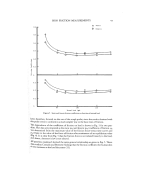
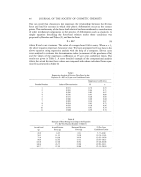
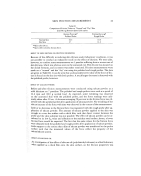
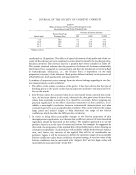
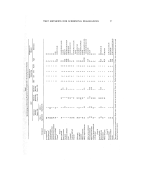
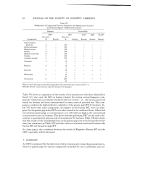
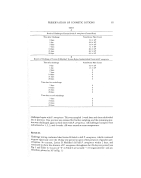
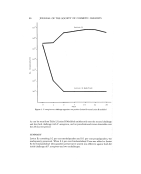
50 JOURNAL OF THE SOCIETY OF COSMETIC CHEMISTS Table IV Effect of Silicone Oil Viscosity and Probe Speed on the Friction Force. Load 98.9 g. Polished Probe Viscosity of Silicone Oil (cks) Friction Force a (g) Speed (rpm) Untreated Skin 100 1,000 10,000 3.6 30.6 6.5 7.5 8.5 10.8 30.8 7.5 11.9 15.0 32.4 30.7 9.4 15.0 28.8 67.2 30.8 11.9 19.6 37.5 aValues at 20 sec. conducted on 10 panelists. The effects of speed of rotation of the probe and of the vis- cosity of the silicone oil were examined in some detail to identify the mechanism of lu- brication involved. The relevant data for 1 panelist have been compiled in Table IV. The results obtained indicate that the presence of silicone oil decreases substantially the friction force compared to untreated skin and that the mechanism involved is fluid or hydrodynamic lubrication, i.e., the friction force is dependent on the bulk properties (viscosity) of the lubricant. Both probes behave similarly in the presence of a fluid lubricant, both qualitatively and quantitatively. A number of important points emerge from the above findings regarding in vivo fric- tion measurements on skin as follows: 1. The effect of the surface condition of the probe. It has been shown that the type of finishing given to the probe surface has an important qualitative and quantitative ef- fect on the results. 2. Low friction values for untreated skin do not necessarily mean a smooth skin condi- tion. As has been shown in this work, obviously dry skin gave lower friction force values than seemingly normal skin. It is, therefore, necessary, before assigning any practical significance to the effect of product treatments on skin condition, to es- tablish a meaningful correlation between instrumental measurements and what consumers perceive as an acceptable skin condition. This can be achieved by using a large panel and trained judges to help determine the range of the friction coefficients which describe the different skin conditions. 3. In order to bring about perceptible changes in the friction properties of skin through product application, it is obvious that a sufficient amount of some beneficial ingredient should be deposited on the surface. The simplest approach is to use the product directly as in the case of creams and lotions, for example. As suggested by this work, the properties of the residual film will probably have a direct bearing on consumer acceptability. Such products will probably exhibit hydrodynamic lubrica- tion, and, hence, the viscosity of the applied film will be of considerable im- portance. Again, it will be necessary to define the optimum ranges of an acceptable friction coefficient under these conditions via panel testing. A very low value of the friction coefficient may be associated with "slippery feel" and too high a value will most likely be associated with "sticky feel."

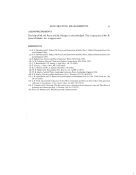
SKIN FRICTION MEASUREMENTS 51 ACKNOWLEDGMENTS The help of Mr. M. Pesce and Ms. Hodges is acknowledged. The cooperation of Mr. R. Jernal of Haake, Inc. is appreciated. REFERENCES (1) F. P. Bowden and D. Tabor, The Friction and Lubrication of Solids, Part 1, Oxford University Press, Ox- ford, England 1964. (2) F. P. Bowden and D. Tabor, The Friction and Lubrication of Solids, Part 2, Oxford University Press, Ox- .ford, England, 1964. (3) E. Rabinowicz, Friction and Wear of Materials, Wiley, New York, 1965. (4) A. W. Adamson, Physical Chemistry of Surfaces, Interscience, New York, 1967. (5) J. T. Burwell and C. D. Straug, J. Appl. Phys., 20, 79 (1949). (6) T. Fort, Jr., J. Phys. Chem., 66, 1136 (1962). (7) R. C. Bowers and W. A. Zisman, Mod. Plast., 41 (1963). (8) W. B. Hardy and I. Bircumshaw, Proc. Roy. Soc., Ser. A,180, 1 (1925). (9) W. B. Hardy, Collected Works, Cambridge University Press, Cambridge, England, 1936. (10) P. F. Naylor, The skin surface and friction, Brit. J. Dermatol, 67,239-48 (1955). (11) J. K. Appeldoorn and G. Barnett, Frictional aspects of emollience, Proc. Sci. Sect. Toilet Goods Ass., 40, 28-35 (1963). (12) J. K. Prall, Instrumental evaluation of the effects of cosmetic products on skin surfaces with particular reference to smoothness, J. Soc. Cosmet. Chem., 24, 693-707 (1973). (13) S. Comaish and E. Bottoms, The skin and friction--deviations from Amonton's law, and The effects of hydration and lubrication, Brit. J. Dermatol., 84, 34-73 (1971). (14) B. Joy, D. Machin andJ. McGaw, personal communications.
Purchased for the exclusive use of nofirst nolast (unknown)
From: SCC Media Library & Resource Center (library.scconline.org)