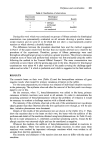
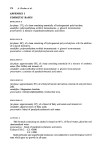
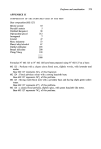
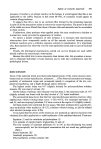
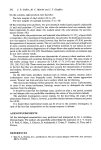
368 A. Rochas et al. PROCEDURE TEST SUBSTANCES Cosmetic bases The following bases were used: a water-based lotion three oil in water emulsions which differed in the proportion of the oil phase and in the type of fats used, and in the pro- portion of surfactant emulsifier two water in oil emulsions differing in the mixture of fats used, in the emulsifier used, and in the preservative. All the raw materials used and the finished products were submitted to physico- chemical analyses and bacteriological control. Perfumes (see Appendix) The following were incorporated at 1 •o into the cosmetic bases: a reference substance: benzylideacetone (3) an aromatic base perfume preparations containing 34•o, 54•o, 67•o or 74•o of the aromatic base mentioned above. METHOD Details of the methods used can be found in the first part of this paper (1). An outline of the principle of the method is as follows: Sensitisation in the guinea-pig is induced by intradermal injections of Freund's adjuvant and by topical applications of test substances under occlusive dressings. After a rest period of 12 days a single challenge application of the test substance, again under an occlusive dressing, provokes the appearance of a sensitisation reaction. Readings were conducted immediately after the removal of the patch in order to eliminate errors due to subsequent scratching, etc. and then, one hour, 24 h and 48 h after removal of the patch. The last reading at 48 h was accompanied if necessary by a skin biopsy for eventual histological examination. It is however, preferable to perform the biopsy 7 h after the removal of the patch, as explained in Part I. The erythema was scored from 0 to 4 and any other anomalies (papules, vesicles, exfoliations) or a reactivation of the induction site were noted. The number of animals showing an evident reaction (equal to or greater than 2) at any of the readings was calculated and the mean erythema value for the whole group was also determined. The aim of the histological examination was to determine the allergic character- istics of the reaction. In fact when the macroscopic examination was positive, a histo- logical examination was also conducted. When this examination was positive, sensitization was confirmed. If this examination was negative, for instance, if the reaction noted was of primary irritation, then the overall result was said to be negative. When the macro- scopic examination was negative, the histological examination was not conducted. The test was called 'doubtful' when the macroscopic examination was positive and the histological examination was unable to determine the type of reaction present. The interpretation of the results can therefore be summarized in Table I.

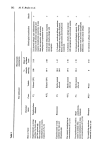
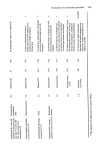
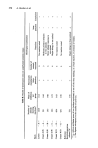
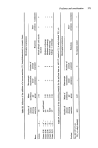
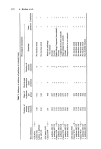
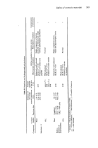
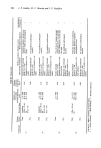
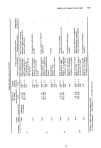
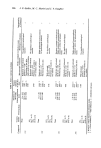
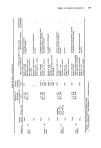
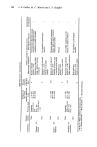
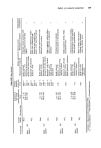
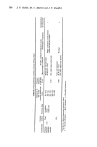
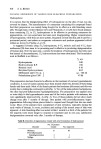
Perfumes and sensitisation 369 Table I. Classification of observations Macroscopic Histological examination examination Results + + (allergy) + + -- (orthoergy) -- + doubtful doubtful -- not conducted -- During this work which was conducted on groups of fifteen animals the histological examination was systematically conducted on all animals showing a positive macro- scopic reaction and on some (3 to 6) which did not show a macroscopically positive reaction or which showed a doubtful reaction. The differences between the procedure described here and the method suggested in Part I of the paper result from the fact that our studies allowed us to improve the procedure of the experiment. Therefore, groups of fifteen guinea-pigs were used throughout although larger groups would give a greater precision. The primary cutaneous irritation score of bases and perfume-base mixtures was first evaluated using the rabbit following the method in the 'Journal Officiel Francais'. The same concentration was confirmed as non-irritant with the guinea-pigs used in the tests. Biopsies for histological examinations were taken 48 h after removal of the patch covering the challenge appli- cation and not after 7 h which is preferable and which is suggested in the final method. RESULTS The cosmetic bases on their own (Table H) and the base-perfume mixtures all gave negative results when tested for primary cutaneous irritation in the rabbit. For the same preparations, no evidence was obained of individual irritation reactions in the guinea-pig. The erythema observed after the removal of the first patch was always equal to one or less. On the contrary, when 1 • benzylideneacetone was added to the bases, primary cutaneous irritation reactions were noted in all animals. In order to demonstrate the sensitising potential of benzylideneacetone without the problems of irritation it would be necessary to conduct a challenge reaction with a diluted solution. The intensity of the erythema observed at the end of the sensitisation test was always clearly greater than that observed after the first application even though, as will be seen later, irritation phenomena were dominant. Details of the results of the sensitisation test are shown in the Tables H to V. They show the reactions due to the bases on their own, the bases with the addition of the perfumes and details of the reactions obtained using benzylideneacetone. In Table H only the oil in water preparation, C, exhibited a potential sensitizing activity. Cream B, the allergic reaction was extremely slight and can be considered as negative. Whatever the medium, the addition of benzylideneacetone resulted in reactions in nearly all subjects. There were some cases of allergic reactions. In other cases these reactions were masked by important orthoergic reactions which were evident in all animals from the first application. The intensity and character of the reaction does not seem to differ with the type of emulsion.
Purchased for the exclusive use of nofirst nolast (unknown)
From: SCC Media Library & Resource Center (library.scconline.org)