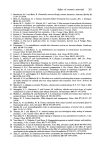
Safety of cosmetic materials 393 2 Bandmann, H. J. and Breit, R. Chemically induced allergic contact dermatitis. Intermist (Berlin) 15 (1) 47-51 (1974). 3 Breit, R., Bandmann, H. J. Contact dermatitis XXII. Dermatitis from Lanolin. Brit. J. Dermatol. 88 (4) 414-416 (1973). 4 Brulos, M. F., Gulllot, J.P., Martini, M. C. and Cotte, J. Mise au point d'une m•thode d'•valuation du pouvoir sensibilisant, par applications topiques, chez le cobaye. Comptes rendues des s•ances de la Soci•t6 de Biologic et de ses filiales. Communication prOsentre • la 1 le semaine internationale de Dermocosm•tologie (18 janvier 1977/t Lyon). A parattre dans J. Cosmet. Chem. 5 Cronin, E. Contact dermatitis from cosmetics. J. Soc. Cosmet. Chem. 18 681-691 (1967). 6 Epstein, E. The detection of lanolin allergy. Arch. Dermatol. 106 (5) 678-681 (1972). 7 Fallon, P. Dermatitis litigation. Proc. R. Soc. Med. 65 (12) 1071-1078 (1972). 8 Feuerman, E. Editorial: allergic skin reaction to lanolin. Harefuah, 86 (7) 380-381 (1974). 9 Fischer, A. The use of patch-test series. In: Contact Dermatitis, 2nd Ed. Lea & Febiger, Phila- delphia (1973). 10 Foussereau, J. La multiplication actuelle des substances nocives en dermato-allergie. Strasbourg Med. 15 704-715 (1964). 11 Foussereau, J. and Basset, A. La sensibilisation aux excipients et conservateurs de pommades. Coneours Med. 11 1063-1068 (1967). 12 Gaul, L. E. Dermatitis from stearyl and cetyl alcohols. Arch. Derre. 99 598 (1969). 13 Hardy, J. Allergy, hypersensitivity and cosmetics. J. Soc. Costa. Chem. 24 423-468 (1973). 14 Huriez, C., Martin, P. and Vanowerschelde, M. L'allergie au propyl•ne glycol. Bull. Soc. Franc. Derre. Syphl. 73 263-267 (1966). 15 Journal Officiel de la R•publique Fran•aise du 21/4/71, •dition Lois et D•crets, et du 5/6/73, ed. Documents administratifs--M6thodes officielles d'Analyse des cosm6tiques et produits de beautY. 16 Kinmont, P. D.C. Skin reactions to cosmetic preparations. J. Soc. Cosmet. Chem. 15 3-32 (1964). 17 Martini, M. C1. Les produits cosm•tiques. Toxicologie clinique et analytique L•gislation. III: les produits de beaut• et les parfums. Lyon-Pharmaceutique 25 (3) 279-303 (1974). 18 Marzulli, F. N. and Ruggles, D. I. Rabbit eye irritation rest: collaborative study. J. of the AOAC. 56 (4) 905-914 (1973). 19 Marzulli, F. N. and Maibach, H. A. The rabbit as a model for evaluating skin irritants: a comparison of results obtained on animals and man using repeated skin exposures. Food Costa. ToMcol. 13 553-540 (1975). 20 Masters, E. J. Allergies to cosmetic Products--Symposium cosmetic allergy, N.Y.N.Y. State J. Med. 1934-1940 (1960) 21 Meneghini, C. L., Rantuccio, F. and Lomuto, M. Additives, vehicles and active drugs of topical medicament as causes of delayed type allergic dermatitis. Dermatologica 143 137-147 (1971). 22 Phillips, L., Steinberg, M. and Maibach, H. I. A comparison of rabbit and human skin response to certain irritants. ToMcol. & Appl. Pharm. 21 369-382 (1972). 23 Schorr, W. F. Contact dermatitis. Office diagnosis and management. Minn. Med. 57 (10) 831-837 (1974). 24 Shore, R. N. and Shelley, W. B. Contact dermatitis from stearyl alcohol and propylene glycol in fluocinonide cream. Arch. Derrnatol. 109 (3) 397-399 (1974) 25 Suzuki, M. et al. Autoradiographic study on percutaneous absorption of several oils in cosmetic field. I.F.S.C.C. (1976). 26 Thomas, M. J. and Majors, P. A. Animal, human and microbiological safety testing of cosmetic products. J. Soc. Cosmet. Chem. 24 135-146 (1973). 27 Van Abbe, N.J. Eye irritation: studies relating to responses in man and laboratory animals. J. Soc. Cosmet. Chem. 24 685-692 (1973). 28 Van Abbe, N.J., Nicholas, P. and Boon, E. Exaggerated exposure in topical irritancy and sensitiza- tion testing, J'. Soc. Cosmet. Chem. 26 173-187 (1975). 29 Van Hecke, E. A case of dichromate dermatitis. Arch. Belg. Dermatol. Syoehi. 28 (4) 405-408 (1972). 30 Wollmann, C., Meyer, F. U. Schwerke, W. Animal experiments studies on the effect of various ointment bases on the epidermis. II: Studies on the effect of vaselinum flavum and various batches of cera liquida on the epidermis width and mitosis. Dtsch Gesundheitsw 27 (33) 1571-1575 (1972). 31 Zina, G. and Bonu, G. Importance des divers composants des excipients dans l'allergie de contact aux topiques utilis6s en m6decine. La Revue de la Mddecine 28 1639-1644 (1970).

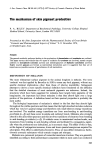
J. Soc. Cosmet. Chem. 28 395-401 (1977)¸ 1977 Society of Cosmetic Chemists of Great Britain The meohanism of skin pigment produotion P. A. RILEY Department of Biochemical Pathology, University College Hospital Medical School, University Street, London WC1 E6JJ Presented at the Joint Symposium with the Pharmaceutical Society of Great Britain "Cosmetic and Pharmacological Aspects of Colour" 9-ll November 1976, at Stratford upon Avon. Synopsis The general metabolic pathways leading to the production of pheomelanins and eumelanins are outlined. This paper surveys the evidence that two types of oxidation by tyrosinase are involved, namely oxygen addition to monophenols (cresolase activity) and dehydrogenation of diphenols (catecholase activity). Highly reactive quinones are formed as intermediate metabolites and it is suggested that they are of importance as possible sources of perturbation of cell metabolism. DEFINITION OF MELANIN The most widespread surface pigment in the animal kingdom is melanin. The term 'melanin' was first applied by Berzelius in 1830 to mean any dark pigment, without any specific chemical implications other than those of relative insolubility. Subsequent attempts to derive a more specific chemical definition have foundered on the difficulty that the detailed structures of most melanoid pigments are unknown. Indeed, the structures which have been suggested for melanins have largely been pigments of the imagination. An important fact about melanins is that they absorb light over a large portion of the spectrum. A definition based on their spectral properties is probably the most useful. The biological importance of melanins is related to the fact that they absorb light throughout the visible spectrum and that means that the light absorbed includes radiation which has very low quantal energy and therefore only small electron energy transitions are involved. The smallest energy transitions are from non-bonding to anti-bonding pi-orbitals (n•) and these occur in amide and carbonyl bonds. Melanins also strongly absorb in the ultraviolet spectrum and this involves transitions of electrons from bonding to anti-bonding pi-orbitals (=•*). Pi-orbitals occur in unsaturated carbon-bonds, and transitions from bonding to anti-bonding orbitals are facilitated by conjugation, especi- ally when the p/-electrons are delocalised, as in aromatic rings. The effect of this is that, as the degree of conjugation increases, lower and lower quantal energies are required for absorption. This effect is called bathochromicity. Thus, we may define melanins as batho- chromic aromatic substances which contain oxygen and nitrogen. Melanins are quinonoid polymers of somewhat uncertain structure. They are generally classified according to their predominant component which in most cases is an oxidation 395
Purchased for the exclusive use of nofirst nolast (unknown)
From: SCC Media Library & Resource Center (library.scconline.org)