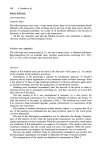
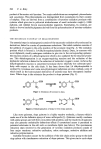
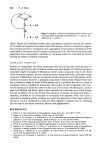
J. Soc. Cos•net. Chem. 28 403-406 (1977) ¸ 1977 Society of Cosmetic Chemists of Great Britain Enhancement of pigmentation: psoralens RODNEY P. R. DAWBER Consultant Dermatologist, Radcliffe Infirmary and Slade Hospital, Oxford Presented at the Joint Symposium with the Pharmaceutical Society of Great Britain "Cosmetic and Pharmacological Aspects of Colour" 9-11 November 1976, at Stratford upon Avon. Synopsis Biological extracts of various common plants have been used in depigmenting conditions for many centuries to enhance pigmentation. Specific photodynamic chemicals have been extracted from such sources--psoralens. Synthesis of these substances in 1947 led to detailed laboratory and clinical investi- gation of their mode of action and effectiveness in increasing normal pigmentation and repigmenting vitiliginous skin. The theoretical fear that long-term psoralen and ultraviolet radiation treatment might induce skin turnours has not so far been realised in practice. INTRODUCTION Psoralens belong to a group of heterocyclic compounds known as furocoumarins and are found in many edible plants, e.g. celery, caraway and figs. They have formed the basis of many herbal remedies used in recent centuries, mostly extracted from the two plant families Umbelliferae and rutaceae, though furocoumarins are somewhat ubiquitous throughout the plant kingdom. These substances appear to have a variety of physio- chemical properties which in general contribute towards the survival of the plant syn- thesising them. Specifically they inhibit the growth of certain potentially harmful parasitic plants, possess natural growth regulating properties, and some have important antifungal, antibacterial and antiviral actions. Figure 1. Psoralen. CHEMICAL STRUCTURE AND PHOTODYNAMIC ACTIVITY Furocoumarins are formed from coumarin which is produced by the fusion of a pyrone ring with a benzene nucleus. A furan ring may be condensed with a coumarin molecule in twelve different ways producing compounds which can each become the parent of a family of psoralen-like derivatives. However, only those with a linear tricyclic structure resembling psoralen (Fig. 1) have important photodynamic, photosensitising and pig- menting actions. 332'/4• i I '1' 0 '/ '0' ""' 0 403

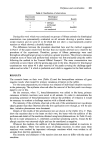
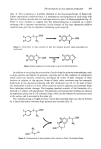
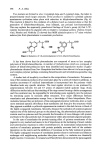
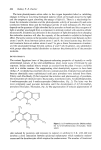
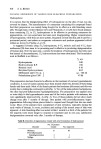
404 Rodney P. R. Dawber The term photodynamic action refers to the oxygen dependent lethal or inhibiting changes in living or non-living biological systems which are brought about by the light and the exogenous agent absorbing the energy of light (1). There is a relationship be- tween the molecular structure and the photodynamic activity of psoralens (2) and some correlation between these and the biological activity of such substances (3). The latter depends on the quantum of light absorbed by the psoralen molecule and the emergence of light at another wavelength from a component in intimate contact with sensitive cellular structures (4). Evidently any deviation in the character of light absorption from changing the molecular structure will alter the capacity of the molecule to exhibit its biological effect. The active centres in the psoralen molecule are: the valence bond between carbon atoms 3 and 4 those between carbon atoms 5 and 8 the intact lactone ring the furan and coumarin fusion at carbon atoms 6 and 7 to give a linear furocoumarin structure and the unsaturated linkage between carbons 4' and 5' (2). In general, any substitution with groups other than methyl diminishes or destroys the photoactivity of the psoralen molecule. DEVELOPMENT The ancient Egyptians knew of the pigment-enhancing properties of topically or orally administered extracts of the wild umbelliferous plant Ammi majux if followed by sun exposure. Indian medical history reveals an extract from the plant Psoraea coryli/blia used in a similar manner--for repigmenting what descriptively appears to have been vitiligo. P. cotTlifolia has since been shown to contain psoralen. Extracts froin such plants became chemically more sophisticated until pure psoralens were isolated from them. Fahmy and Abu-Shady (5) first reported the isolation and pharmacology of psoralens, the most potent of which proved to be psoralen, 4-methylpsoralen, 5,8-dimethylpsoralen, 5-methoxypsoralen and 8-methoxypsoralen (Methoxsalen P•g. 2). The latter was the most commonly used psoralen derivative until the development of 4,5',8-trimethyl- psoralen (Trisoralen Trioxsalen, Fig. 2). The augmentation of melanin pigmentation of O' 0 '• 0CH 3 CH 3 0 CH 3 CH• Figure 2. (a) 8-methoxypsoralen (Methoxsalen). (b) 4,5',8-trimethylpsoralen (Trisoralen Triox- salen). skin induced by psoralens and exposure to natural or artificial U.V.R. (320-400 nm) involves a close interaction between epidermal melanocytes which synthesise melano- somes and the keratinocytes which acquire the melanosomes. The number of functional
Purchased for the exclusive use of nofirst nolast (unknown)
From: SCC Media Library & Resource Center (library.scconline.org)