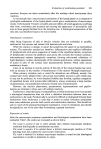
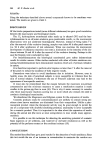
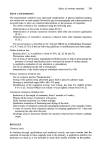
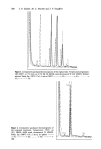
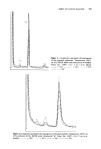
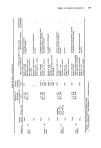
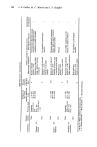
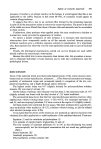
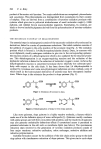
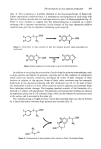
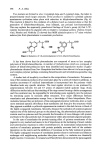
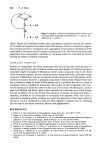
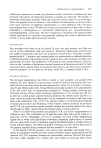
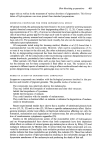
Safety of cosmetic materials 3 81 014 016 018 Figure 3. Comparative gas-liquid chromatograms of the isopropyl palmitates. Temperature: 180øC. on 10 •o DEGS, 60/80 mesh chromosorb W HMDS. Temp. Inj.: 320øC. Col.: 2 rn X ¬ in. (glass). --. =/11/ -/12/ ....... /13/ -- /14/. Figure 4. Comparative gas-liquid chromatograms of the oleyl alcohols. Temperature: 245øC. on 15•o carbowax 20 M, 80/100 mesh chromosorb W. Temp. Inj.: 320øC. Col.: 2 mX•r in. (metal). --/22/ ...... =/23/ --/24/ --/25/.

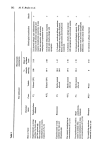
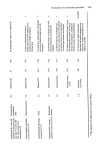
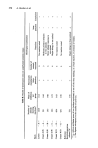
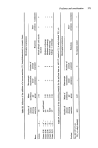
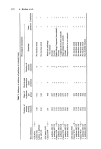
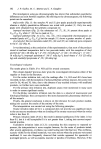
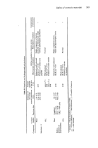
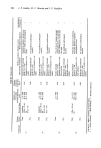
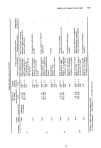
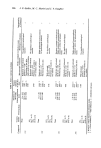
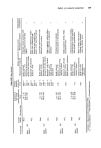
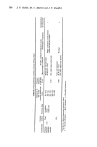
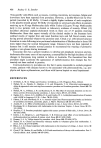
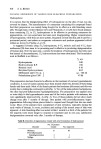
382 d. P. Guillot, M. C. Martini and J. Y. Giauffret The investigation using gas chromatography has shown that substantial quantitative differences can exist between suppliers. By referring to the chromatograms, the following points can be remarked: triglycerides (Fig. 1): the samples/4/ and/5/give peaks practically superimposable whereas a slightly quantitative difference was noted with product/3/. Only two early peaks were obtained from the synthetic compound/6/. isopropyl myristate (Fig. 2): the substances reft /7/, /8/, /9/present three peaks at Cx2, Cx4, Cx6 while n ø/10/has no peak at Cx2. isopropyl palm#ate (Fig. 3): (/11/, /12/, /13/, /14/) comparable chromatograms are revealed (peaks at Cx4, Cx6, Cxs) but the sample/11/shows a greater number of peaks. oleyl alcohol: the raw materials coded/23/,/24/and/25/are relatively pure compared to the n ø/22/(Fig. 4). It was determined, at the conclusion of the experimentation, that most of the products stored at ambient temperature had a low peroxide index, with the exception of oleyl alcohols (n ø/22/=20 mEq kg -•, n ø/23/=64 mEq kg -•, n ø/24/=41 mEq kg -•, n ø/25/= 56 mEq kg-•) isopropyl palmitate n ø/14/(7 mEq kg-•), decyl oleate n ø /15/(25 mEq/ kg) and arachidyl propionate n ø/21/(10 mEq kg). Toxicological evaluation The results given in Tables H to VIII call for several comments: The column headed 'previous data' gives the toxicological information either of the supplier or found in the literature. For the ocular irritation test, only the readings after 1 h, 24 h and 48 h have been recorded in fact, with the exception ofpolyoxyethylene sorbitan stearate, the scores were zero for 3d, 4d and 7d. Also, due to the absence of any marked irritancy with undiluted products, no further tests were conducted. For the primary skin irritation test, duplicate assays were monitored in many cases in order to ensure significant results. For the 60-day cumulative irritation test, the data is a r•sum• of macroscopic and histological findings: they correspond to the most characteristic phenomena observed on all the animals. Finally, the general conclusion is drawn on the tolerance for each product studied, taking into account the results of the entirety of the tests. The interpretation was carried out using the following principles: Ocular irritation index (0.I.I.): a compound does not provoke any significant injury to the eye mucous membrane when no clouding of the cornea occurs and when the ocular index is less than 10. Primary irritation index (P.LI.): the result is deemed satisfactory if the index is less than 0.5, but it is still acceptable if it is not greater than 1, taking into account experi- mental practice. Cumulative irritation index (C.I.I.): concerning the skin response to repeated ex- posures, the interpretation is more complex because, for the series of products tested, after several applications, erythema was noted lasting until the final test. This erythema, scarcely visible for the diluted materials, was more serious when the products were tested undiluted. It was also frequently observed that vesicles appeared for spasmodic or prolonged periods, as well as papules, maculae or patches of erythema. However, if the
Purchased for the exclusive use of nofirst nolast (unknown)
From: SCC Media Library & Resource Center (library.scconline.org)