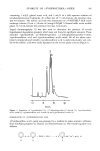
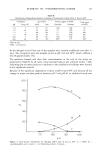
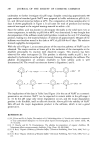
j. Soc. Cosmet. Chem., 33, 243-248 (August 1982) The stability of 2-pyridinethiol-l-oxide, sodium salt, as a function of pH ROBERTJ. FENN and DAVID A. CSEJKA, Olin Research Center, P.O. Box 30-275, New Haven, CT06511. Received December 9, 1981. Synopsis The hydrolysis of sodium-2-pyridinethiol-l-oxide has been studied in aqueous solutions buffered at pH 4.1, 7.1, and 10.0 at 5øC and 40øC. The sample concentration studied was approximately 100 ppm. Samples stored at 5øC showed very little loss of starting material over the 30 day duration of the study. Samples held at 40øC showed significant loss only at pH 10.0. The major product found at pH 4.1 and 7.1 was the disulfide oxidation product, while at pH 10.0 the major product was the sulfinate salt, formed by attack of hydroxide ion on the disulfide. Additional 30-day experiments run at pH 7, 8, 9, and 10 indicated a gradual shift of the product distribution from the disulfide to the sulfinate with increasing pH. The sulfinate salt was shown to be the end product of alkaline hydrolysis up to 30 days by its demonstrated stability at pH 10 and 40øC. An authentic sample of 2-pyridinesulfinic acid-l-oxide was prepared and characterized as an aid to product identification and quantitation. INTRODUCTION The sodium salt of 2-pyridinethiol-l-oxide (NaPT) is used as a preservative in some cosmetic formulations at typical use levels of 100 to 1000 ppm. Information was desired concerning the stability and possible degradation products of this compound in formulations at various pH values. Accordingly, studies were undertaken to monitor stability of aqueous buffer solutions of 100 and 500 ppm NaPT from pH 4 to 10 at 5 ø and 40øC. Degradation products were identified and quantitated during the course of the 30-day study. Based upon the results of the present study, recommendations can be made concerning the product pH range suitable for the applications of NaPT as a preservative. EXPERIMENTAL APPARATUS Polarograms were obtained using a Princeton Applied Research Model 174 Polaro- graphic Analyzer equipped with either a Model 172A Drop Timer or a Model 303 Static 243

244 JOURNAL OF THE SOCIETY OF COSMETIC CHEMISTS Mercury Drop Electrode. A three electrode system was employed, including a Pt counter electrode and saturated calomel or silver/silver chloride reference electrode. The chromatograph used was a Waters Associates ALC/GPC 244 Liquid Chromato- graph equipped with a Model U6K injector and Model 440 UV detector operated at 254 nm. A Waters Associates/a-Bondapak C•8 reverse phase column, 30 cm x 3.9 mm i.d., or a PARTISIL©SAX anion exchange column, 25 cm x 4.6 mm i.d., were used for all separations. REAGENTS The sodium salt of 2-pyridinethiol-l-oxide, 2-pyridinethiol, 2,2'-dithiobis-pyridine, 2-pyridinesulfonic acid, 2-pyridinesulfonic acid-l-oxide and 2,2'-dithiobis-pyridine- 1,1'-dioxide were prepared and purified by the Biocides Group, Chemicals Division, Olin Corporation. 2-Pyridinesulfinic acid 1-oxide, previously unreported, was synthe- sized specifically for this study and is described elsewhere in this paper. Acetonitrile (UV) was obtained from Burdick & Jackson Laboratories and the tetrabutylammonium hydroxide, 40% aqueous, from Aldrich Chemicals. The pH of the test solutions was maintained with 0.02M buffers prepared in distilled deionized water from potassium biphthalate and hydrochloric acid (pH 4.1) potassium dihydrogen phosphate and sodium hydroxide (pH 7.1) sodium tetraborate and sodium hydroxide (pH 10.0). A 0.2M phosphate buffer at pH 6.9 and 0.2M borate buffers at pH 8.1 and 9.1 were also used. All reagents were analytical reagent grade. PROCEDURES Solutions containing approximately 100 ppm and 500 ppm of NaPT were prepared by transferring appropriate aliquots of intermediate strength stock solutions into 500 ml volumetric flasks and raising to volume with buffer. After thorough mixing, these solutions were transferred to 16 oz. amber bottles. Solutions were stored in the dark at 5øC and at 40øC. The possibility of unwanted photolytic reactions was thus minimized. NaPT solutions were prepared either from a 40% aqueous production sample or from the analytical standard grade. Aliquots were taken for analysis at the time of preparation and at several intervals during the study. Duplicate analyses were performed at each sampling interval. The concentration of NaPT was determined by sampled d.c. polarography. A 10 ml aliquot of sample solution was transferred to the polarographic cell and deoxygenated for 5 minutes. The polarogram was then obtained from + 0.1V to -0.4V vs. a saturated calomel electrode (SCE). An anodic wave with E¾2 = --0.24V rs. SCE was observed. Aliquots of a standard solution were then added to the cell and corresponding polarograms recorded. Wave heights for all polarograms were measured using a previously recorded buffer blank polarogram as the point of origin. The sample concentration was determined from the resulting standard calibration plot. The two maj or reaction products, 2,2'-dithiobis-pyridine-l,l'-dioxide (disulfide), and 2-pyridine- sulfinic acid-l-oxide (sulfinic acid), were determined chromatographically. Injections of 10/zL were used and quantitation was accomplished by external standard calibration plots of peak heights rs. concentration. The disulfide was determined on a/z-Bondapak C•8 column, 30 cmx 3.9 mm i.d. The mobile phase was 15:85 acetonitrile/water,
Purchased for the exclusive use of nofirst nolast (unknown)
From: SCC Media Library & Resource Center (library.scconline.org)