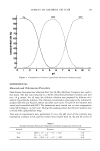
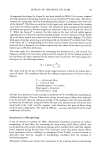
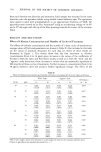
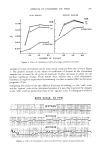
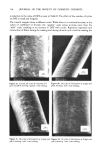
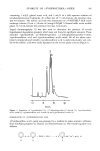
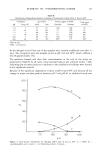
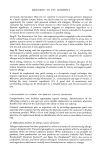
EFFECTS OF CHLORINE ON HAIR 231 IOO 9o 8o • 7o o 60 n,. 50 z "• 40 z o • 3o 2o IO Cl2 HOCJ OCl- i/ •'•' •'• ' • '"""*•' /•.,,•'"" • • • / \. / i x. / i / \\ /I \•\ I II ? \ / /' \ / .... ß /', , , •-..--"" ,/ , , ' ,%-...._ _ •, I 2 3 4 5 6 7 8 9 IO pH Figure 1. Composition of a sodium hypochlorite solution as a function of pH. EXPERIMENTAL Materials and Chlorination Procedure Dark brown Caucasian hair obtained from the De Meo Brothers Company was used in this study. The hair was extracted in a 50/50 chloroform/methanol mixture and tied into 2.0 g tresses. For all tests, the chlorine solution was prepared by dilution of a sodium hypochlorite solution. The chlorine concentration was analyzed by iodometric analysis with KI and Na2S20 3 before and after each cycle. The pH of the solution was varied and controlled with HC1. The treatments were carried out at room temperature using 500 ml liquor: 1 g hair ratio. During the soaking period, the chlorine solution was covered with a polyethylene wrap. Two sets of experiments were performed. In one, the pH level of the solution was maintained constant at 8.0, and the tresses were treated with 20, 40, and 60 cycles of Table I Standard Oxidation Potentials for Reactions of Chlorine Compounds with H20 [4] Solution Reaction E* (volts) Acid HOC1 + H + + 2e-• CI- + tt20 --1.49 Cl 2 q- 2e- --} 2Cl -1.36 Base Clo-- + H20 + 2e'- • C1 + 2OH -0.90

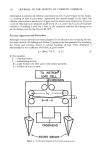
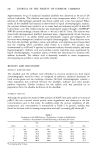
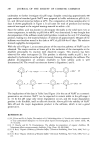
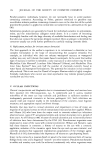
232 JOURNAL OF THE SOCIETY OF COSMETIC CHEMISTS chlorination in solutions of chlorine concentrations of 0, 10, and 50 ppm. In this, 0 ppm, i.e., soaking of tress in pure water, represented the control sample. In the other, the chlorine concentration was fixed at 50 ppm, and the tresses were subjected to 10 and 20 cycles of chlorination in solutions at pH levels of 2, 4, and 8. Each cycle of treatment consisted of soaking a tress for 1 hour in the treatment solution and drying in an air-circulating oven for one hour at 40-50øC. Friction Apparatus and Procedure Although several methods have been proposed in the literature for measuring friction, the twist method of Lindberg and Gralen (5) presents the best potential for simulating the forces and contacts found in normal handling of hair. They developed a relationship for the coefficient of friction,/a, given below. /• = (/37rn)-•(ln T2- In T•) (2) In this equation, T• = entering tension T 2 = withdrawing tension /3 = angle between the fiber axes in the twisted assembly n = number of turns to twist. TO INSTRON LOAD CELL ,ECIMEN L2 i CROSSHEAD KNOWN WEIGHT Figure 2. A schematic diagram of the friction testing device.
Purchased for the exclusive use of nofirst nolast (unknown)
From: SCC Media Library & Resource Center (library.scconline.org)