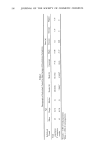
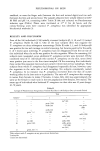
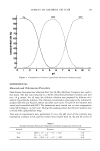
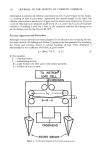
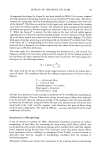
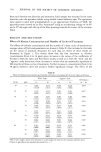
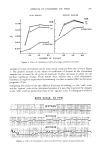
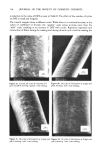
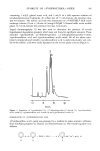
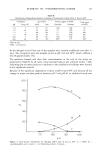
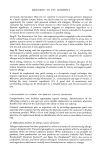
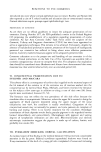
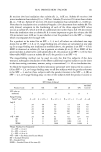
SUN PROTECTION FACTOR 261 //1 receives 25% less irradiation than subsite//2, i.e., 3.0X sec. Subsite//3 receives 25% more irradiation than subsite//2, i.e., 5.0X sec. Subsite//5 receives 25% more than subsite if4, i.e., 7.5X sec. Subsite//7 receives 25% more irradiation than subsite//6, i.e., 10.OX sec. Note that the irradiation time at subsite//4 equals a 25% decrement from subsite//6. The only (minor) exception to the bracketing of each of the three expected SPF values occurs at subsite//3, which is 0. SX sec additional time rather than a full 25% decrement from the irradiation time at subsite//4. It is more important to give the subject the full 25% increment over 4.0X sec to see whether or not the product is in the SPF = 4 range, which encompasses 4.0 through 5.99. For a product to be tested for an SPF = 2, 4, or 6, all values are calculated one step down for an SPF = 6, 8, or 15, range-finding test, all values are calculated at one step up. In a range-finding test irradiated as outlined above, the product is an SPF = 4 if no MED is observed at subsite//1, but is present at subsite//2 or//3. If no MED of the protected skin is observable until subsite//4 or//5, the product is an SPF = 6. If the first observable MED occurs at subsite//6 or//7, the product is an SPF = 8. The range-finding method can be used on only the first five subjects if the data warrants, subsequent irradiation of the fifteen additional required subjects can be done in the time-saving customary manner, using a conventional 5 x 10 cm irradiation site. To blind the experimentation further, laboratory personnel were instructed to conduct: (A) an SPF = 2, 4, or 6 range-finding assay on all five subjects with the products known to be SPF = 2, and on three subjects with the product known to be SPF = 4 (B) an SPF = 4, 6, or 8 range-finding assay on two of the subjects with the product known to Table I SPF Values Achieved 8% HMS Product Code EI OE EN LE ON Control SPF value as marketed 2 4 6 8 15 4 Range-Finding Test(s)* used A = all A = 3, B = 2 B = 4, C = 1 B = 2, C = 3 C = all A = all Subj # 1 2.0 4.0 6.0 7.5 15.0 4.0 2 2.0 4.0 7.5 7.5 15.0 4.0 3 2.0 4.0 6.0 8.0 10.0 4.0 4 2.0 4.0 5.0 10.0 15.0 4.0 5 2.0 4.0 6.0 8.0 18.7 4.0 __ •*X = SPF 2.0 4.0 6.1 8.2 14.7 4.0 SD 0 0 0.8 0.93 2.77 0 SE 0 0 0.357 0.414 1.24 0 SEM% 0 0 5.86% 5.06% 8.43% 0 *Range- Finding Test Designation A=SPF=2,4or6 B =SPF=4,6or8 C =SPF=6,8or15 -- **X = SPF = Sun Protection Factor (Mean) SD = Standard Deviation SE = Standard Error SEM% = Standard Error of the mean (%)

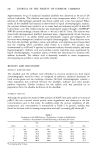
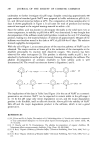
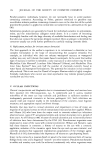
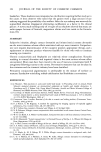
262 JOURNAL OF THE SOCIETY OF COSMETIC CHEMISTS be a 4, on four of the subjects with the product 6, and on two of the subjects with the product an 8, as well as on the 8% HMS control (SPF = 4) (C) an SPF -- 6, 8, or 15 range-finding assay on one subject with the SPF = 6 product, on three of the subjects with the product known to be an 8, and on all five subjects with the SPF = 15 product. The observer who read the irradiated sites had no knowledge of the labelled value of the products. RESULTS Table I presents the SPF values achieved, based on the division of the subjects' protected MED value by the unprotected MED value. All products, tested blind, achieved their proper SPF values with this range-finding technique, except for the SPF = 15 product which is, however, in its own proper category. As a footnote of interest, it should be noted that the marketed product with a value SPF = 15, which did not achieve its true SPF value with only five subjects, achieved an 8.43% Standard Error of the Mean %, well above the Monograph's (1) allowable _+ 5.0%. These data reinforce the fact that individual biological variation (both inter- and intra-subject) requires that the Sun Protection Factor assay be performed on twenty subjects [See Monograph (1)]. CONCLUSION With a change of template shape and selection of subjects with suitable back area, few but sufficient additional irradiated subsites can be added to the conventional 4, 5, or 6 test subsites to achieve an efficient range-finding technique. As few as five subjects may reveal the probable expected SPF, which can be then tested for in the conventional manner. REFERENCES (1) The Food and Drug Administration, Proposed monograph for otc sunscreen drug products, 43, 166, 37206-38629 (August 1978). (2) D. S. Berger, Specification and design of solar ultraviolet simu/ators, J. of Invest. Dermatolo., 192-199 (1%9).
Purchased for the exclusive use of nofirst nolast (unknown)
From: SCC Media Library & Resource Center (library.scconline.org)