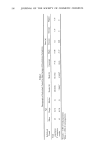
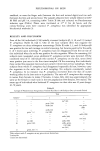
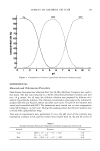
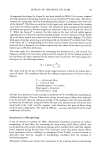
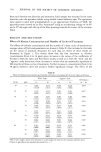
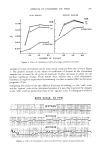
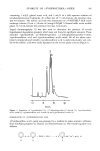
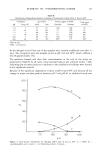
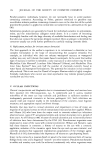
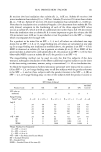
STABILITY OF 2-PYRIDINETHIOL-1-OXIDE 247 Table II Distribution of Degradation Products of Sodium 2-Pyridinethiol-l-Oxide After 31 Days at 40øC Conditions ppm NaPT Products (ppm as NaPT) Total (ppm) pH Temp (øC) Initial Final Disulfide Sulfinate as NaPT 4.1 5 117 115 0.08 ND 115 4.1 40 111 109 2.3 ND 111 7.1 5 105 105 3.7 ND 109 7.1 40 101 99 9.4 ND 108 10.0 5 105 105 ND ND 105 10.0 40 102 66* ND* 37* 103' *after 45 days (ND) = not detected. At the 100 ppm level all but one of the samples were virtually unaffected even after 31 days. The exceptions were the samples stored at pH 10.0 and 40øC, which suffered a loss of approximately 25%. The products formed and their final concentrations at the end of the study are presented in Table II. In all cases a final material balance was achieved within _+ 10%, indicating that no other products in addition to the disulfide and sulfinate were formed in any significant amount. Because of the significant degradation evident at pH 10 and 40øC and because of the change in major reaction product between pH 7 and pH 10, an additional study was qoo 80 60 40 B 20 ! 7, 0 8.0 g.O 10.0 pH Figure 2. Final product distribution for 500 ppm NaPT after 30 days at 40øC. A = NaPT, B = 2-pyridinesulfinic acid-l-oxide, C = 2,2'-dithiobis-pyridine-l,l'-dioxide.

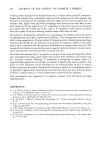
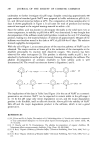
248 JOURNAL OF THE SOCIETY OF COSMETIC CHEMISTS undertaken to further investigate this pH range. Samples containing approximately 500 ppm analytical standard grade NaPT were prepared in buffer solutions at pH 6.9, $.1, 9.1, and 10.0 and stored as before at 40øC. The composition of these samples after 33 days is shown graphically in Figure 2. In all cases the total of products and starting material was equal to the original starting material to within _+ 5%. Since the sulfinic acid was known to decompose thermally in the solid state even at room temperature, its stability at pH 10.0 at 40øC was determined. It was thought that decomposition of the sulfinate would yield pyridine-l-oxide as the only UV absorbing product, leading to a low material balance. A solution of approximately 100 ppm of the sulfinate was therefore stored in the dark at 40øC a t pH 10.0 for 47 days. The solution showed negligible decomposition. With the aid of Figure 2, an accurate picture of the reaction pathway of NaPT can be obtained. The major reaction at lower pH is the oxidation of the mercaptide to the disulfide presumably by reaction with dissolved oxygen. This reaction has been observed for other mercaptans (3). This product is relatively stable at pH 7, but is attacked by hydroxide ion as the pH is increased, forming, ultimately, the sulfinate. The alkaline decomposition of aromatic disulfides to form sulfinic acids is well documented (4). The overall reactions are shown in Equations 2 and 3. 4 • S- + 02 + 2H20 I o I I + 4OH- (2) 0 0 0 0 The implications of the data in Table I and Figure 2 for the use of NaPT as a cosmetic preservative are obvious. NaPT can be expected to remain stable in the pH range 4 to -8. In this pH range only minor degradation occurs, and the major degradation product is the disulfide, itself an effective biocide. Above pH 8 the stability of NaPT •falls off and the major degradation product is the sulfinate, which is not a good preservative. REFERENCES (1) R..J. Fenn and D. A. Csejka, The analysis of 2,2'-dithiobispyridine-l,l'-dioxide and related compounds in clear antidandruff shampoos via reverse-phase liquid chromatography, J. Soc. Cosmet. Chem., 30, 73-79 (1979). (2) J.P. Danehy and K. N. Parameswaran, The alkaline decomposition of organic disulfides. III. Substituent effects among aromatic disulfides,J. Org. Chem., 33, 568 (1968). (3) E. E. Reid, "Organic Chemistry of Bivalent Sulfur," (Chemical Publishing, New York, 1958), Vol. 1, p 118. (4) E. E. Reid, "Organic Chemistry of Bivalent Sulfur," (Chemical Publishing, New York, 1960), Vol. 3, p 375.
Purchased for the exclusive use of nofirst nolast (unknown)
From: SCC Media Library & Resource Center (library.scconline.org)